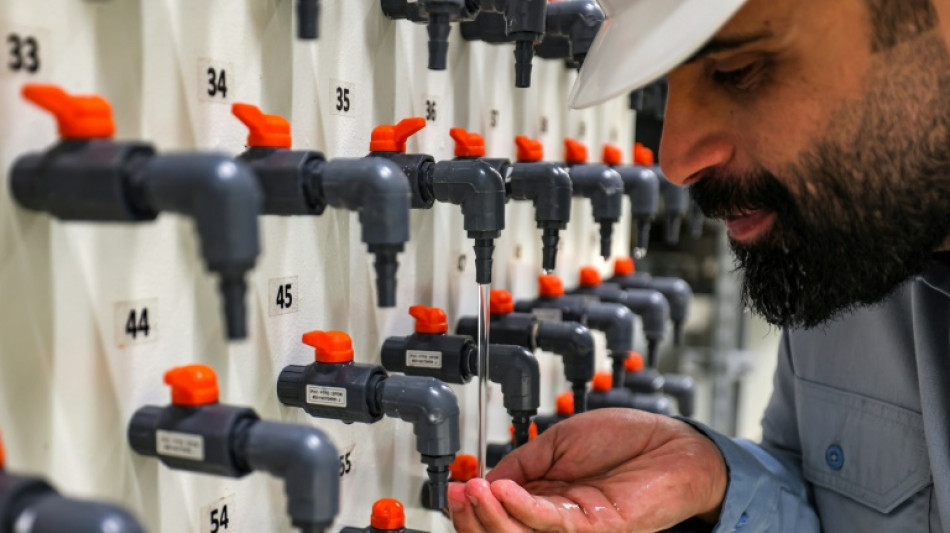
Water-starved Saudi confronts desalination's heavy toll / Photo: Fayez Nureldine - AFP

 LeBron, Sixers spoil Knicks party as NBA season tips off

 Man in court over alleged 'targeted' attack on Australian lawmaker

 Regulator has 'power' to force Man City sale

 Man allegedly behind 'targeted' attack on Australian lawmaker appears in court

 Musk backs SpaceX-Tesla merger as rocket firm turns profit

 Zelensky, US hail 'productive' talks to end Trump feud

 'Unbelievable' Foden back in the groove with treble in Man City rout

 Pistons rally to beat Celtics in NBA 2026-27 season opener
 PSG late show downs Barca in Champions League, Liverpool fight back

 Liverpool strike back to beat Villarreal in seven-goal thriller

 Dow boosted as markets rotate from tech shares

 Zelensky hails resumption of US advance warning of strikes on Ukraine

 Carrick says only wins can ease doubts over Man Utd future

 Top NBA Draft pick Dybantsa to miss opener with ankle sprain
 Italy sends troops, toughens security laws after Milan clashes

 Alberta separatists vow to fight on, risking turmoil for Canada

 Two men re-arrested for suspected spying for Iran in airbase scare: UK police

 Guatemalan man gets 30 years for truck smuggling deaths of 53 migrants

 'Clayface' gets under the skin of the superhero genre

 Zelensky, US envoys hold Oslo talks as Ukraine claims US missile holdup

 All-rounder Minhas stars as Pakistan crush England in tri-series

 Bavuma hits 179, Rabada strikes as South Africa dominate

 Allrounder Minhas stars as Pakistan crush England in tri-series
 Albania PM blames 'hybrid war' for week of unrest

 Bavuma hits 179 to lead South African fightback

Solar panels soak up blinding noontime rays that help power a water desalination facility in eastern Saudi Arabia, a step towards making the notoriously emissions-heavy process less environmentally taxing.
The Jazlah plant in Jubail city applies the latest technological advances in a country that first turned to desalination more than a century ago, when Ottoman-era administrators enlisted filtration machines for hajj pilgrims menaced by drought and cholera.
Lacking lakes, rivers and regular rainfall, Saudi Arabia today relies instead on dozens of facilities that transform water from the Gulf and Red Sea into something potable, supplying cities and towns that otherwise would not survive.
But the kingdom's growing desalination needs –- fuelled by Crown Prince Mohammed bin Salman's dreams of presiding over a global business and tourism hub –- risk clashing with its sustainability goals, including achieving net-zero emissions by 2060.
Projects like Jazlah, the first plant to integrate desalination with solar power on a large scale, are meant to ease that conflict: officials say the panels will help save around 60,000 tons of carbon emissions annually.
It is the type of innovation that must be scaled up fast, with Prince Mohammed targeting a population of 100 million people by 2040, up from 32.2 million today.
"Typically, the population grows, and then the quality of life of the population grows," necessitating more and more water, said CEO Marco Arcelli of ACWA Power, which runs Jazlah.
Using desalination to keep pace is a "do or die" challenge, said historian Michael Christopher Low at the University of Utah, who has studied the kingdom's struggle with water scarcity.
"This is existential for the Gulf states. So when anyone is sort of critical about what they're doing in terms of ecological consequences, I shake my head a bit," he said.
At the same time, he added, "there are limits" as to how green desalination can be.
- Drinking the sea -
The search for potable water bedevilled Saudi Arabia in the first decades after its founding in 1932, spurring geological surveys that contributed to the mapping of its massive oil reserves.
Prince Mohammed al-Faisal, a son of King Faisal whom Low has dubbed the "Water Prince", at one point even explored the possibility of towing icebergs from Antarctica to quench the kingdom's growing thirst, drawing widespread ridicule.
But Prince Mohammed also oversaw the birth of the kingdom's modern desalination infrastructure beginning in 1970.
The national Saline Water Conversion Corporation (SWCC) now reports production capacity of 11.5 million cubic metres per day at 30 facilities.
That growth has come at a cost, especially at thermal plants running on fossil fuels.
By 2010, Saudi desalination facilities were consuming 1.5 million barrels of oil per day, more than 15 percent of today's production.
The Ministry of Environment, Water and Agriculture did not respond to AFP's request for comment on current energy consumption at desalination plants.
Going forward, there is little doubt Saudi Arabia will be able to build the infrastructure required to produce the water it needs.
"They have already done it in some of the most challenging settings, like massively desalinating on the Red Sea and providing desalinated water up to the highlands of the holy cities in Mecca and Medina," said Laurent Lambert of the Doha Institute for Graduate Studies.
- Going green? -
The question is how much the environmental toll will continue to climb.
The SWCC says it wants to cut 37 million metric tonnes of carbon emissions by 2025.
This will be achieved largely by transitioning away from thermal plants to plants like Jazlah that use electricity-powered reverse osmosis.
Solar power, meanwhile, will expand to 770 megawatts from 120 megawatts today, according to the SWCC's latest sustainability report, although the timeline is unclear.
"It's still going to be energy-intensive, unfortunately, but energy-intensive compared to what?" Lambert said.
"Compared to countries which have naturally flowing water from major rivers or falling from the sky for free? Yeah, sure, it's always going to be more."
At desalination plants across the kingdom, Saudi employees understand just how crucial their work is to the population's survival.
The Ras al-Khair plant produces 1.1 million cubic metres of water per day –- 740,000 from thermal technology, the rest from reverse osmosis –- and struggles to keep reserve tanks full because of high demand.
Much of the water goes to Riyadh, which requires 1.6 million cubic metres per day and could require as much as six million by the end of the decade, said an employee who spoke on condition of anonymity because he was not authorised to brief the media.
Looking out over pipes that draw seawater from the Gulf into the plant, he described the work as high-stakes, with clear national security implications.
If the plant did not exist, he said, "Riyadh would die".
J.AbuHassan--SF-PST