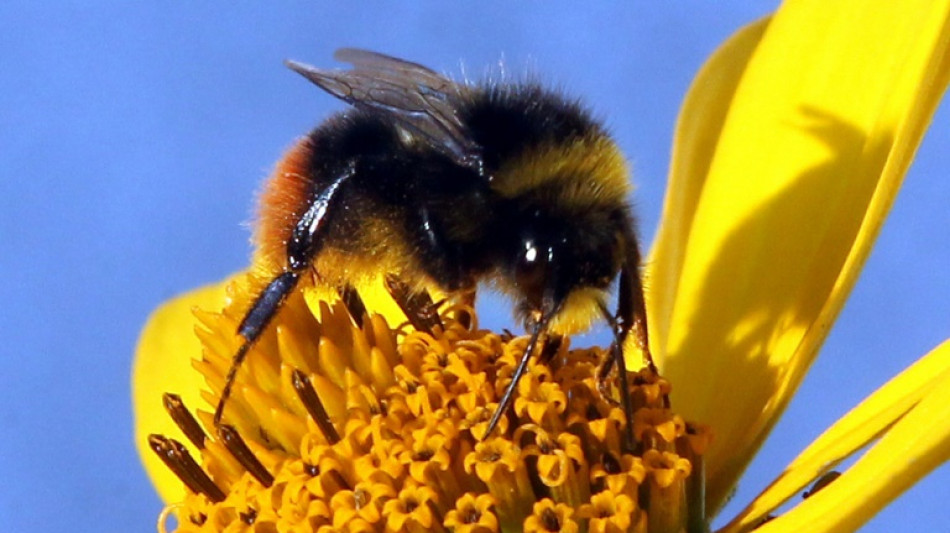
European bumblebee populations projected to plummet / Photo: WOLFGANG KUMM - DPA/AFP/File

 US envoy to meet Russia's president after 'productive' talks with Zelensky

 LeBron optimistic after launching Sixers era with win

 Fear as Indians struggle to prove voting rights

 Asian stocks rally as tech firms enjoy bounce ahead of key earnings

 LeBron, Sixers spoil Knicks party as NBA season tips off

 Man in court over alleged 'targeted' attack on Australian lawmaker

 Regulator has 'power' to force Man City sale

 Man allegedly behind 'targeted' attack on Australian lawmaker appears in court

 Musk backs SpaceX-Tesla merger as rocket firm turns profit

 Zelensky, US hail 'productive' talks to end Trump feud

 'Unbelievable' Foden back in the groove with treble in Man City rout

 Pistons rally to beat Celtics in NBA 2026-27 season opener

 PSG late show downs Barca in Champions League, Liverpool fight back

 Liverpool strike back to beat Villarreal in seven-goal thriller

 Dow boosted as markets rotate from tech shares

 Zelensky hails resumption of US advance warning of strikes on Ukraine

 Carrick says only wins can ease doubts over Man Utd future

 Top NBA Draft pick Dybantsa to miss opener with ankle sprain

 Italy sends troops, toughens security laws after Milan clashes

 Alberta separatists vow to fight on, risking turmoil for Canada

 Two men re-arrested for suspected spying for Iran in airbase scare: UK police

 Guatemalan man gets 30 years for truck smuggling deaths of 53 migrants

 'Clayface' gets under the skin of the superhero genre

 Zelensky, US envoys hold Oslo talks as Ukraine claims US missile holdup

 All-rounder Minhas stars as Pakistan crush England in tri-series

Populations of European bumblebees are projected to fall drastically in the coming decades due to climate change and habitat loss, researchers warned on Wednesday.
Europe's 68 species of bumblebees -- including the fluffy, black-and-yellow striped ones often seen buzzing through gardens -- play a crucial role in pollinating crops and wild plants.
But they are used to the cooler temperatures of the Northern Hemisphere, and a warming world caused by human-caused climate change is putting them increasingly under threat, according to the study in the journal Nature.
A team of Belgian researchers collected data on 46 bumblebee species across Europe, assessing the past (1901-1970) and present 2001-2014), comprising more than 400,000 different observations.
They combined this data with the latest modelling from the UN's IPCC climate change panel as well as predictions of changes in land use.
Under the worst-case scenario, they found that "up to 75 percent of bumblebee species which are not currently threatened will see their distribution area shrink 30 percent by 2061-2080," lead author Guillaume Ghisbain of the Universite Libre de Bruxelles told AFP.
This means that most of the European bumblebees currently classified as of "least concern" on the IUCN's list of threatened species could fall into the endangered category.
Bumblebee species in Arctic or alpine environments may even be pushed to the edge of extinction, with an expected loss of 90 percent of their habitat.
There was also bad news for the most common of Europe's bumblebees, Bombus terrestris, a plump bee often spotted pollinating flowers in backyards.
By 2080, it "would see the limit of its geographical distribution, which currently borders the Sahara Desert, pull back to the Loire Valley" in central France, said co-author Pierre Rasmont of the University of Mons.
- Sensitive to heat -
Part of the expected decline was due to how land is expected to be used in the next half century.
"Intensive agriculture fragments habitats and relies on synthetic fertilisers which artificially enrich the soil with nitrogen," Ghisbain said.
"However, bumblebees mainly consume plants which grow in soil poor in nitrogen," such as clover, he added.
Repeated droughts, made more frequent and severe by climate change, also kill off the plants eaten by bumblebees.
But heatwaves intensified by global warming pose an even bigger threat. Apart from a few resistant species, bumblebees are particularly sensitive to heat.
"We observed this in our laboratory one day when the air conditioning broke down -- it was 40 degrees Celsius (104 Fahrenheit) and our colonies died in less than an hour," Rasmont said.
"Some survive, but their sperm becomes deficient."
The researchers suggested that some bees could seek refuge in the cooler climes of Scandinavia.
They have even spotted a few industrious bees who have already made the trek north.
"One day I was collecting bumblebees in northern Norway and suddenly, among the Arctic species, I came across a Bombus terrestris," Rasmont said.
"It had leapt 800 kilometres (500 miles) north" of its natural habitat, he added.
Z.Ramadan--SF-PST