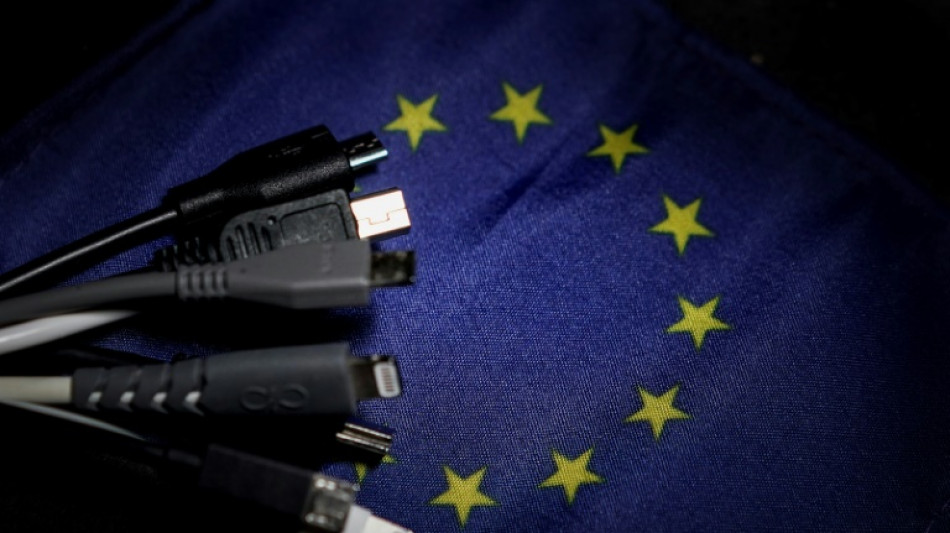
From chargers to children's data: how the EU reined in big tech / Photo: Kenzo TRIBOUILLARD - AFP

 UK govt approves drilling in Jackdaw gas field

 Rome hospital taps culture to help heal cancer patients

 'Media capture': Serbian journalists squeezed before vote

 US envoy to meet Russia's president after 'positive' talks with Zelensky

 South Korea launches new bid to guide crowd-pulling shark to sea

 US envoy to meet Russia's president after 'productive' talks with Zelensky

 LeBron optimistic after launching Sixers era with win

 Fear as Indians struggle to prove voting rights

 Asian stocks rally as tech firms enjoy bounce ahead of key earnings

 LeBron, Sixers spoil Knicks party as NBA season tips off

 Man in court over alleged 'targeted' attack on Australian lawmaker

 Regulator has 'power' to force Man City sale
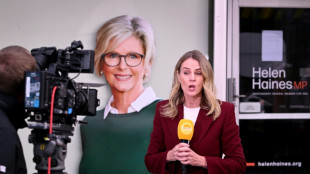
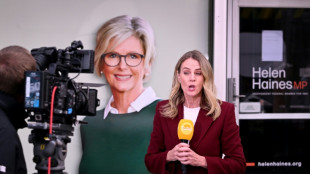 Man allegedly behind 'targeted' attack on Australian lawmaker appears in court
 Musk backs SpaceX-Tesla merger as rocket firm turns profit
 Zelensky, US hail 'productive' talks to end Trump feud

 'Unbelievable' Foden back in the groove with treble in Man City rout
 Pistons rally to beat Celtics in NBA 2026-27 season opener

 PSG late show downs Barca in Champions League, Liverpool fight back

 Liverpool strike back to beat Villarreal in seven-goal thriller

 Dow boosted as markets rotate from tech shares
 Zelensky hails resumption of US advance warning of strikes on Ukraine

 Carrick says only wins can ease doubts over Man Utd future

 Top NBA Draft pick Dybantsa to miss opener with ankle sprain
 Italy sends troops, toughens security laws after Milan clashes

 Alberta separatists vow to fight on, risking turmoil for Canada

When Apple unveils its latest iPhone on Tuesday, the European Union will have left its mark on the US giant's flagship product.
Now the iPhone 15 is expected to have a USB-C charger, instead of Apple's usual Lightning charger, after the EU ordered manufacturers to adopt a common connection.
Brussels said this would make customers' lives easier and reduce waste.
Apple vehemently opposed the 2022 law, arguing it would penalise innovation, but the EU's 27 countries form the world's largest single market and Brussels has big tech in its sights.
The common charger is not the only bruising battle against big tech the EU has won, and Brussels believes it will win on more fronts in the weeks and months to come.
Here are some of the ways the EU has forced digital titans to play by new rules in Europe and beyond:
- 'Digital rulebook' -
The groundbreaking Digital Services Act (DSA) and its sister law, the Digital Markets Act (DMA), are the biggest and most recent attempts to rein in tech companies.
The DSA demands firms crack down on harmful and illegal content online as well as assess the risks their platforms pose to society.
Any company in violation of the DSA risks a fine of up to six percent of annual global turnover.
Under the rules, 19 "very large" online platforms -- including Facebook, Instagram, TikTok, X (formerly known as Twitter) and YouTube -- had to comply with the DSA by late August.
All platforms will be forced to comply by February 2024.
The large platforms named have already made changes including a ban on targeted advertising to children as well as providing users with a non-personalised feed.
The changes are not limited to the European Union. Snapchat said it would restrict personalised advertising to minors in Britain as well.
"There's a process of gradual change in the way these platforms do things that is going to be started, but it's not going to be an overnight change," said Sally Broughton Micova of the Centre on Regulation in Europe think tank.
The DMA is another thorn in the tech firms' side, especially for Apple. The law seeks to dilute the dominance of certain players and aims to make the market fairer.
The EU named six "gatekeepers": Google's Alphabet, Amazon, Apple, Facebook owner Meta, Microsoft and ByteDance's TikTok. The rules apply from March 2024.
For Apple, it perhaps brings one of the biggest changes in its ecosystem, dominated by its App Store. The DMA will force Apple to allow third-party app stores.
"The DMA will really have an impact on how they design their structures," an EU official said.
Companies will also have to make it easier for users to send messages between apps.
But the changes come with a price. Meta's new Twitter-like platform Threads has not been rolled out in the EU yet because of the bloc's rules.
- Data protection -
The mammoth General Data Protection Regulation (GDPR) came into force in 2018 and was the EU's toughest and most famous law on tech, ensuring citizens give consent to the ways in which their data is used.
There has been a wave of fines for violations.
In May, the Irish privacy watchdog handed the biggest ever individual fine of 1.2 billion euros ($1.3 billion) to Meta over its transfers of personal data between Europe and the United States.
The GDPR's impact has also been felt beyond Europe.
"Businesses hardly looked for EU-only solutions because if you are on the global market, you offer that immediately to all so consumers elsewhere can benefit from more privacy," the EU official said.
- The future is AI -
The EU's latest tech target is artificial intelligence after the chatbot ChatGPT showcased the technology's rapid developments last year.
Brussels hopes to green light an all-encompassing law on AI by the end of 2023.
"The AI act may be the even more daring thing to do," the EU official said, adding the challenge was even bigger for the EU than the DSA or DMA.
The official also pointed to the Data Act focused on sharing industrial data, which is expected to come into force in 2025.
V.AbuAwwad--SF-PST