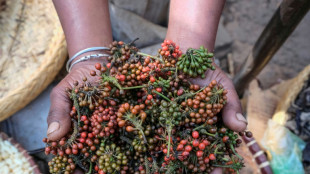
World losing high-stakes fight against invasive species / Photo: RHONA WISE - AFP/File

 Rising UK inflation, debt knocks govt ahead of budget
 UK govt approves drilling in controversial Jackdaw gas field

 US envoy to meet Putin after 'positive' talks with Zelensky

 UK govt approves drilling in Jackdaw gas field

 Rome hospital taps culture to help heal cancer patients
 'Media capture': Serbian journalists squeezed before vote
 US envoy to meet Russia's president after 'positive' talks with Zelensky

 South Korea launches new bid to guide crowd-pulling shark to sea

 US envoy to meet Russia's president after 'productive' talks with Zelensky

 LeBron optimistic after launching Sixers era with win

 Fear as Indians struggle to prove voting rights

 Asian stocks rally as tech firms enjoy bounce ahead of key earnings

 LeBron, Sixers spoil Knicks party as NBA season tips off

 Man in court over alleged 'targeted' attack on Australian lawmaker
 Regulator has 'power' to force Man City sale

 Man allegedly behind 'targeted' attack on Australian lawmaker appears in court

 Musk backs SpaceX-Tesla merger as rocket firm turns profit

 Zelensky, US hail 'productive' talks to end Trump feud

 'Unbelievable' Foden back in the groove with treble in Man City rout

 Pistons rally to beat Celtics in NBA 2026-27 season opener

 PSG late show downs Barca in Champions League, Liverpool fight back

 Liverpool strike back to beat Villarreal in seven-goal thriller

 Dow boosted as markets rotate from tech shares

 Zelensky hails resumption of US advance warning of strikes on Ukraine

 Carrick says only wins can ease doubts over Man Utd future

Invasive species that wreck crops, ravage forests, spread disease, and upend ecosystems are spreading ever faster across the globe, and humanity has not been able to stem the tide, a major scientific assessment said Monday.
The failure is costing well over $400 billion dollars a year in damages and lost income -- the equivalent to the GDP of Denmark or Thailand -- and that is likely a "gross underestimation", according to the intergovernmental science advisory panel for the UN Convention on Biodiversity (IPBES).
From water hyacinth choking Lake Victoria in East Africa, to rats and brown snakes wiping out bird species in the Pacific, to mosquitoes exposing new regions to Zika, yellow fever, dengue and other diseases, the report catalogued more than 37,000 so-called alien species that have taken root -- often literally -- far from their places of origin.
That number is trending sharply upward, along with the bill for the damage multiplying fourfold per decade, on average, since 1970.
Economic expansion, population increase and climate change "will increase the frequency and extent of biological invasions and the impacts of invasive alien species," the report concluded.
Only 17 percent of countries have laws or regulations to manage this onslaught, it said.
Whether by accident or on purpose, when non-native species wind up on the other side of the world, humans are to blame.
The spread of species is hard evidence that the rapid expansion of human activity has so radically altered natural systems as to tip the Earth into a new geological epoch, the Anthropocene, scientists say.
- Hitchhikers -
The hyacinth that at one point covered 90 percent of Lake Victoria -- crippling transport, smothering aquatic life, blocking hydroelectric dam intake and breeding mosquitoes -- is thought to have been introduced by Belgian colonial officials in Rwanda as an ornamental garden flower before making its way down the Kagera River in the 1980s.
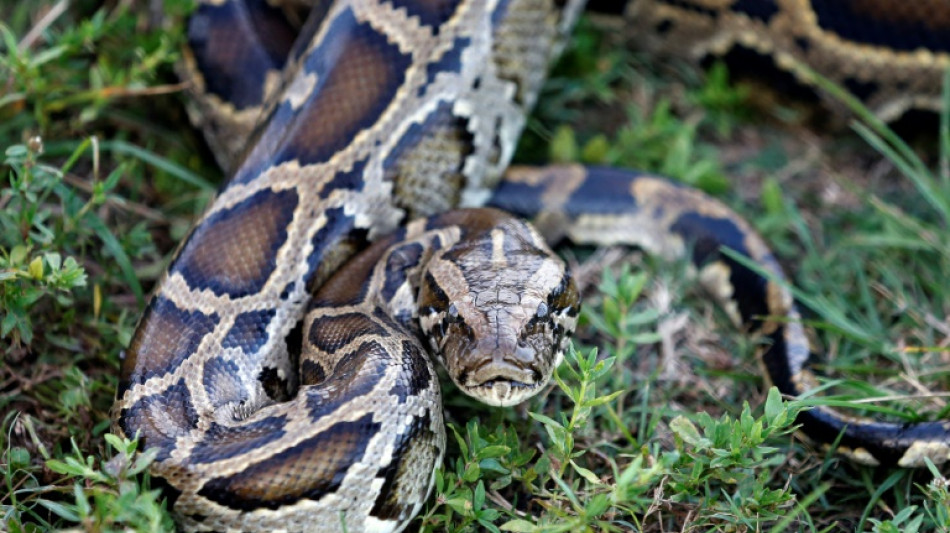
The Florida Everglades is teeming with the destructive offspring of erstwhile pets and house plants, from five-metre (16-foot) Burmese pythons and walking catfish to Old World climbing fern and Brazilian pepper.
In the 19th century English settlers brought rabbits to New Zealand to hunt and for food. When they multiplied like, well, rabbits, officials imported ferocious little carnivores called stoats to reduce their numbers.
But the stoats went after easier prey: dozens of endemic bird species that were soon decimated, from baby Kiwis to wrybills.
New Zealand and Australia -- where a similar bad-to-worse saga involving rabbits unfolded -- are "case studies" of how not to control one imported pest with another, Elaine Murphy, a scientist at New Zealand's Department of Conservation, told AFP.
More often, however, invasive species are accidental arrivals, hitching rides in the ballast water of cargo ships, the containers in their holds, or in a tourist's suitcase.
The Mediterranean Sea is full of non-native fish and plants, such as lionfish and killer alga, that journeyed from the Red Sea through the Suez Canal.
- Vulnerable small islands -
Murder hornets capable of wiping out entire bee colonies in a single attack are thought to have arrived in the US from Asia as stowaways in freight.
Largely due to huge volumes of trade, Europe and North America have the world's largest concentrations of invasive species, defined as those that are non-native and cause harm and have relocated due to human activity, the IPBES report shows.
Invasive species are a significant cause in 60 percent of all documented plant or animal extinctions, one of five main drivers along with habitat loss, global warming and pollution, according to the findings.
These drivers interact: climate change has pushed alien species into newly warmed waters or lands where native species are often vulnerable to intruders they have never encountered.
The deadly fire that reduced the Hawaiian town of Lahaina on Maui to ashes last month was fuelled in part by bone-dry grasses -- imported decades ago to feed livestock -- that has spread across abandoned sugar plantations.
A global treaty to protect biodiversity hammered out in Montreal last December sets a target of reducing the rate at which invasive alien species spread by half by 2030.
The IPBES report lays out general strategies for achieving this goal, but does not assess the chances of it being met.
There are basically three lines of defence, according to the report -- prevention, eradication and then, failing that, containment.
Attempts at eradication have generally failed in large bodies of water and open waterways, as well as on large tracts of contiguous land. The places with the highest rate of success in removing unwanted guests -- especially rats and other vertebrates -- are also the ones that have proved most vulnerable: small islands.
O.Mousa--SF-PST