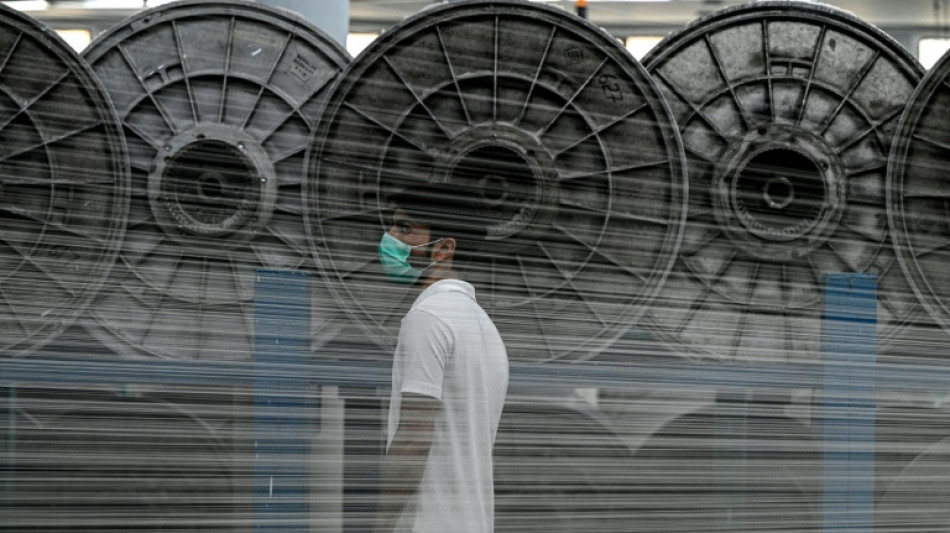
Pakistan's economic woes leave textile industry in tatters / Photo: Farooq NAEEM - AFP

 Judge orders Meta to pay $25 bn to New Mexico in Cambridge Analytica case
 Champagne puts cork in project to expand production area

 Canadian publisher says novelist Orelien used AI to write novel

 Trump faces fresh questions over ties to 'humanitarian' Putin

 Hansen back in Ireland squad for Nations Championship
 Kremlin sees little 'substance' in Ukraine peace ideas

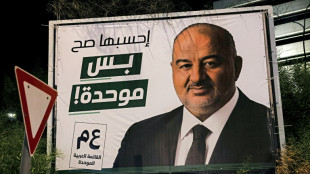 Top Arab-Israeli election candidate tells AFP Netanyahu win would be 'catastrophe'

 South African rugby player's death due to 'aortic dissection'
 France's Macron lands in Riyadh on surprise 'solidarity' visit
 Around the world, far right blames immigrants for French protests

 South Africa eases fuel pain as growth slows

 Woody Allen shoots new movie in Madrid

 Nvidia's Huang urges Europe to go all in on AI

 Five things to know as French bond yield tops 5%
 'Complete threat' Ngumoha excites Liverpool captain Van Dijk

 'The fishing's terrible': Deforestation devastates C.Africa river

 France's tourism sector worried about impact of riots

 Macron takes aim at Trump for using France riots for election gain
 North Korea says 'new firepower units' in place, loudspeakers to return

 Indonesia leader hits out at market downgrade warning

 Macron slams 'stupid' comments based on AI videos by leaders on France riots

 'Public health crisis': Indonesians seek fire relief from state

 British Museum sells second set of Bayeux exhibition tickets
 Australian lawmaker loses both legs after 'targeted' attack

 UK approves drilling in controversial Jackdaw gas field

Factory worker Lubna Babar was made redundant at the beginning of the year, a victim of a crisis in the Pakistan textile industry that has seen it lose ground to more nimble Asian competitors.
"When you lose your job, your life comes to a close," the 43-year-old from Lahore told AFP.
"We've been working in factories for years... the day you get sacked, the story ends there."
Pakistan's industrial manufacturing sector -- like elsewhere in the world -- has suffered from the slowdown in global consumption and the rise in energy costs following the outbreak of war in Ukraine.
But the difficulties of the textile sector, which accounts for 60 percent of Pakistan's exports, are compounded by the critical state of the economy and months of political chaos.
In Pakistan, the industry was buoyed at the tail end of the coronavirus pandemic, when it was freed of restrictions earlier than regional rivals India and Bangladesh and benefited from government financial aid, including slashed energy rates.
In 2022-2023, however, textile exports fell by 15 percent to $16.5 billion.
"Two years ago, we were on a very high growth trajectory... we were confident that our exports this year would go to $25 billion," said Hamid Zaman, managing director of Sarena Textile Industries.
"Unfortunately, when you have political instability and things are not clear, and the policies of the government are reversed, this whole thing has gone into a tailspin," he told AFP.
The political chaos started in April last year, when Imran Khan was dismissed as prime minister by a vote of no-confidence.
His attempts to parlay popular public support into a movement to force an early election saw him arrested in May, leading to violence that only ended with a massive crackdown on his party and its supporters.
He was convicted of graft on Saturday and sentenced to three years in jail.
- Factories shutting down -
The textile and clothing sector employs around 40 percent of the country's 20 million-strong industrial workforce.
The main export markets are the US, EU, the UK, Turkey, and the UAE, supplying cotton fabrics, knitwear, bed linen, towels, and ready-made garments to global brands such as Zara, H&M, Adidas, John Lewis, Target and Macy's.
But many factories have closed in recent months -- at least temporarily -- or are no longer running at full capacity.
"Perhaps 25 to 30 percent of all textile factories have closed. It is estimated that perhaps 700,000 jobs have been lost in the last year or year and a half," said Zaman.
Babar felt this keenly, having looked for work at other factories -- but they were also laying off employees.
"They said they were no longer receiving orders from abroad," she said.
After devastating floods in the summer of 2022, cotton production in Pakistan fell to an all-time low.
The textile industry was unable to compensate by buying from abroad because of a freeze on imports imposed by the government to preserve its forex reserves.
Thousands of containers filled with raw materials and machinery essential for the country's industries were held up for months in the southern port of Karachi.
Textile companies also saw the cost of capital rise significantly, contending with interest rates of more than 20 percent as the central bank sought to curb record-breaking inflation.
- 'Not a solution' -
Pakistan finally managed to consolidate its foreign exchange reserves with the approval in mid-July of a $3 billion loan from the International Monetary Fund (IMF) and additional assistance from China, Saudi Arabia and the United Arab Emirates.
"But that's not a solution, it's just getting deeper and deeper into debt," said Kamran Arshad, managing director of Ghazi Fabrics International.
"The only way forward is enhancing Pakistan's exports and creating an environment that is investor-friendly that would incentivise industrial production and activity," he added.
One of the conditions of the IMF bailout was an end to subsidies on energy, leading to a sharp rise in the cost of electricity, which affects the competitiveness of textile companies.
"Our biggest challenge going forward is having energy prices that are substantially higher than those of India, Bangladesh, Sri Lanka, Vietnam and China," said Arshad.
"We're not asking for subsidies. Realistically we are asking for regionally competitive energy prices."
In the face of these challenges, the country's textile manufacturers have lost customers globally.
"Pakistan's overall market share in the textile and garment industry was nearly 2.25 percent about two years ago. Now it's down to around 1.7 percent," said Aamir Fayyaz Sheikh, CEO of Kohinoor Mills.
Sheikh sees some hope if the political situation settles following an election due before the end of the year.
"After the elections there will be more political clarity and that will help bring more economic stability," he said.
But for ordinary workers like Babar, there is little light at the end of the tunnel.
"Life is getting harder every day," said the mother of three.
"We cook once and make it last for two days. And if we don't have any food, we make do, without complaining."
W.AbuLaban--SF-PST