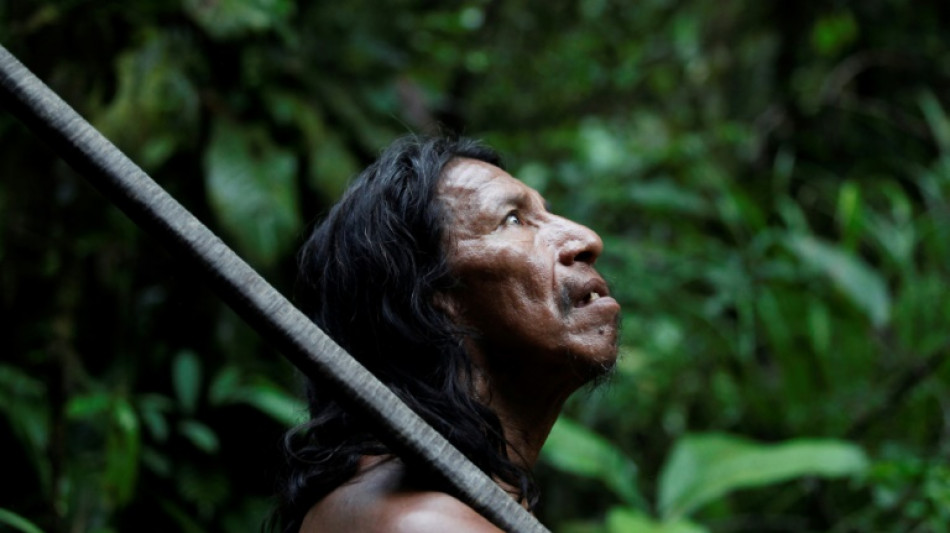
Ecuador jungle community hopes vote will end oil drilling / Photo: Galo Paguay - AFP

 Judge orders Meta to pay $25 bn to New Mexico in Cambridge Analytica case
 Champagne puts cork in project to expand production area

 Canadian publisher says novelist Orelien used AI to write novel

 Trump faces fresh questions over ties to 'humanitarian' Putin

 Hansen back in Ireland squad for Nations Championship
 Kremlin sees little 'substance' in Ukraine peace ideas

 Top Arab-Israeli election candidate tells AFP Netanyahu win would be 'catastrophe'

 South African rugby player's death due to 'aortic dissection'
 France's Macron lands in Riyadh on surprise 'solidarity' visit

 Around the world, far right blames immigrants for French protests

 South Africa eases fuel pain as growth slows

 Woody Allen shoots new movie in Madrid

 Nvidia's Huang urges Europe to go all in on AI

 Five things to know as French bond yield tops 5%

 'Complete threat' Ngumoha excites Liverpool captain Van Dijk

 'The fishing's terrible': Deforestation devastates C.Africa river

 France's tourism sector worried about impact of riots

 Macron takes aim at Trump for using France riots for election gain

 North Korea says 'new firepower units' in place, loudspeakers to return

 Indonesia leader hits out at market downgrade warning

 Macron slams 'stupid' comments based on AI videos by leaders on France riots

 'Public health crisis': Indonesians seek fire relief from state

 British Museum sells second set of Bayeux exhibition tickets
 Australian lawmaker loses both legs after 'targeted' attack

 UK approves drilling in controversial Jackdaw gas field

Armed with a long blowgun and darts laced with poison extracted from plants, Kominta walks naked through the thick Ecuadorian jungle, where oil exploration is threatening his way of life.
"The jungle is my home, and I don't want strangers in my territory," the Waorani hunter tells AFP in the southeastern village of Bameno, in a region bordering Peru.
His community of about 200 people is in Yasuni National Park, one of the most diverse biospheres in the world, and home to two of the world's last uncontacted Indigenous populations.
On August 20, along with general elections, Ecuadorans will vote in a referendum on whether to halt the exploitation of crude oil within the reserve, which currently provides 12 percent of the 466,000 barrels per day produced by the country.
"I don't want an oil company to reach my territory. That's how I want to live, freely, in a healthy place," adds Kominta in the Wao Terero language.
The government -- which opposes the referendum that was granted by the Constitutional Court in May -- estimates losses of some $16 billion over 20 years if the oil is left underground.
There are about 4,800 Waorani, who own some 800,000 hectares (1.9 million acres) of jungle in the Amazon provinces of Orellana, Pastaza and Napo.
However, the community -- some of whom still choose to live in isolation -- is divided, with some supporting the oil companies and the benefit economic growth has brought to their villages.
Drilling inside the Yasuni reserve began in 2016 after years of fraught debate and failed efforts by then President Rafael Correa to persuade the international community to pay Ecuador $3.6 billion not to do so.
But with his government strapped for cash amid a plunge in global oil prices, in the end the leftist leader asked Congress to give the go-ahead to drill.
Current President Guillermo Lasso, who took office in 2021, wants to double Ecuador's oil production.
- Grandmother ready to fight -
The oil industry "destroys the environment I live in," Kominta said through translator Elisa Enqueri.
Accessing Bameno requires 12 hours of navigation through various rivers in the Pastaza region.
"My grandmother says that she would fight with her spear. She has the energy and still feels young ... to prevent strange people from coming here," says Enqueri.
The Yasuni National Park houses some 2,000 tree, 610 bird, 204 mammal, 150 amphibian and more than 120 reptile species, according to the San Francisco University of Quito.
It is also home to the uncontacted Taromenane and Tagaeri tribes, who are rivals and sometimes fight each other. They have also attacked oil workers and loggers with their spears.
Oil activity "affects their way of life and puts their lives at risk. There is a serious risk of ethnocide, of the total extermination of these communities," said Pedro Bermeo, a lawyer and spokesman for Yasunidos, an environmental group backing the referendum.
Moi Guiquita, another young Wao, says the oil companies are "getting closer and closer" to Bameno.
"Sixty years ago they were much further away."
Indigenous communities seeking to escape their presence "can't go any further as there is no more" space, he said.
E.Qaddoumi--SF-PST