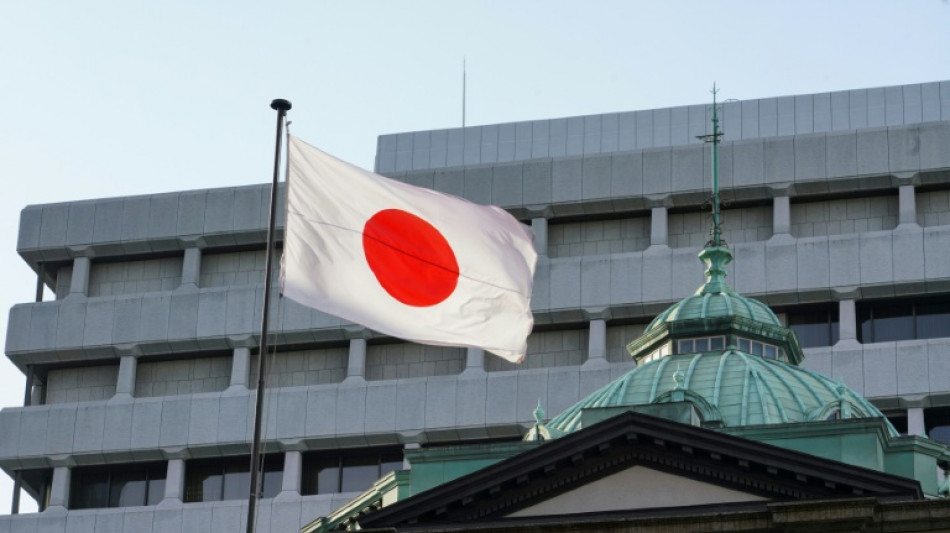
Bank of Japan to allow 'greater flexibility' in controlling bond yields / Photo: Kazuhiro NOGI - AFP

 Quebec separatist premier sworn in without royal presence

 UAE nominates official to lead UN

 NFL boss Goodell welcomes probe into Hurts medical care

 Musk threatens Democrats teeing up congressional probes

 In the Mexican town that makes emblematic Day of the Dead garlands

 Protests banned in parts of Paris as Macron swipes at Trump

 Judge orders Meta to pay $25 bn to New Mexico in Cambridge Analytica case

 Champagne puts cork in project to expand production area

 Canadian publisher says novelist Orelien used AI to write novel

 Trump faces fresh questions over ties to 'humanitarian' Putin

 Hansen back in Ireland squad for Nations Championship

 Kremlin sees little 'substance' in Ukraine peace ideas

 Top Arab-Israeli election candidate tells AFP Netanyahu win would be 'catastrophe'

 South African rugby player's death due to 'aortic dissection'

 France's Macron lands in Riyadh on surprise 'solidarity' visit

 Around the world, far right blames immigrants for French protests

 South Africa eases fuel pain as growth slows

 Woody Allen shoots new movie in Madrid

 Nvidia's Huang urges Europe to go all in on AI

 Five things to know as French bond yield tops 5%

 'Complete threat' Ngumoha excites Liverpool captain Van Dijk

 'The fishing's terrible': Deforestation devastates C.Africa river

 France's tourism sector worried about impact of riots

 Macron takes aim at Trump for using France riots for election gain

 North Korea says 'new firepower units' in place, loudspeakers to return

The Bank of Japan on Friday eased its grip on its ultra-loose monetary policy in a small step towards normalisation as inflation accelerates and the yen comes under pressure against other major currencies.
The central bank has for years embarked on a process known as yield curve control (YCC) whereby it allows government bonds to move in a narrow band as part of a drive to boost the long-struggling economy.
However, after a closely watched meeting, it said it would allow "greater flexibility" in the market as it hiked its inflation forecast for the current fiscal year.
Still officials said it did not mean the bank was abandoning its monetary policy -- which analysts have warned was looking increasingly unsustainable -- saying it would maintain its massive asset-buying measures.
Ten-year JGB yields would be allowed to "fluctuate in the range of around plus and minus 0.5 percentage points from the target level", the bank said in a statement.
But it will "conduct yield curve control with greater flexibility regarding the upper and lower bounds of the range as references, not as rigid limits", it said.
Market expectations fluctuated in the lead up to the meeting over whether the bank would tinker with its signature stimulus policies after the two-day meeting chaired by governor Kazuo Ueda, who took the helm in April.
The yen initially weakened to 139.95 per dollar after the announcement, from around 139.12 yen in the morning, before climbing to around 138.50.
The currency has been hammered for more than a year as the BoJ refused to shift from its policy, even as central banks around the world pushed up interest rates to fight surging inflation.
The benchmark Nikkei index sank more than two percent at one point on the prospect of higher borrowing costs.
The BoJ took a similar measure in December when it expanded the YCC range to around plus or minus 0.5 percentage points, from a range of plus or minus 0.25 percentage points.
The central bank faces the challenge of balancing the need to shore up the economy and keep its monetary policy sustainable in the long term.
Analysts have said YCC is increasingly harming the economy by skewing the bond market and accelerating the yen's weakness, prompting inflation of imported goods.
"The latest tweak will work as a cushion of a shock (for the markets) when or if the BoJ abandons the YCC in the future, compared with a case if the YCC is abandoned without today's measure," NLI Research Institute senior economist Taro Saito told AFP.
In its latest quarterly report, the bank said Japan's recent inflation rates were "higher than projected" three months ago, while wages had increased, partly on the back of this year's annual negotiations between trade unions and companies.
But it warned of "extremely high uncertainties for Japan's economic activity and prices" including the impact of a tightening of global financial conditions.
The "sustainable and stable achievement of the price stability target of two percent, accompanied by wage increases" remained elusive and it would need to continue with monetary easing, the bank said.
It also raised its inflation forecast for the fiscal year to March 2024, with prices excluding food expected to rise 2.5 percent, up from its previous estimate of 1.8 percent.
For the year to March 2025, however, inflation is expected to slip back to 1.9 percent, against the previous estimate of 2.0 percent.
Inflation is expected to slow even further in the following year to 1.6 percent.
K.AbuTaha--SF-PST