Nigeria's end to petrol subsidies hits Niger black market / Photo: BOUREIMA HAMA - AFP/File

 Quebec separatist premier sworn in without royal presence
 UAE nominates official to lead UN
 NFL boss Goodell welcomes probe into Hurts medical care

 Musk threatens Democrats teeing up congressional probes
 In the Mexican town that makes emblematic Day of the Dead garlands

 Protests banned in parts of Paris as Macron swipes at Trump

 Judge orders Meta to pay $25 bn to New Mexico in Cambridge Analytica case
 Champagne puts cork in project to expand production area

 Canadian publisher says novelist Orelien used AI to write novel

 Trump faces fresh questions over ties to 'humanitarian' Putin
 Hansen back in Ireland squad for Nations Championship
 Kremlin sees little 'substance' in Ukraine peace ideas

 Top Arab-Israeli election candidate tells AFP Netanyahu win would be 'catastrophe'

 South African rugby player's death due to 'aortic dissection'
 France's Macron lands in Riyadh on surprise 'solidarity' visit
 Around the world, far right blames immigrants for French protests
 South Africa eases fuel pain as growth slows

 Woody Allen shoots new movie in Madrid

 Nvidia's Huang urges Europe to go all in on AI

 Five things to know as French bond yield tops 5%
 'Complete threat' Ngumoha excites Liverpool captain Van Dijk

 'The fishing's terrible': Deforestation devastates C.Africa river
 France's tourism sector worried about impact of riots

 Macron takes aim at Trump for using France riots for election gain
 North Korea says 'new firepower units' in place, loudspeakers to return
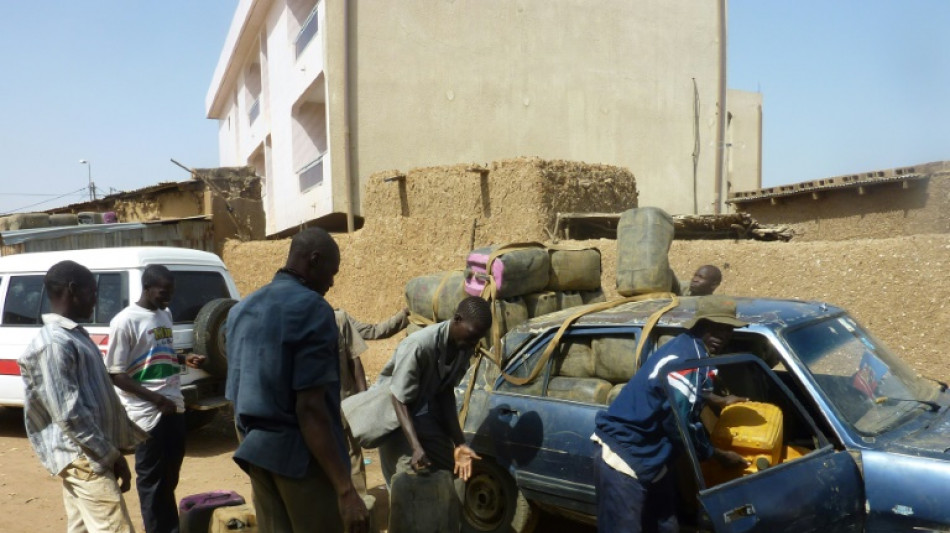
On the road linking Niger's capital Niamey with the south of the country, illegal fuel warehouses have closed and intrepid black-market touts waving petrol canisters at passing cars have become an endangered species.
The reason?
Neighbouring Nigeria has scrapped its subsidies for petrol -- a move that tripled domestic prices and ended the fat profits that smugglers could make by sneaking fuel into Niger.
In Niamey's suburbs, residents no longer witness the spectacular chases between customs officers and gasoline vendors.
Gone too are the streams of cars and motorcycles which under the noses of customs officers shuttled across the border, laden with loads of jerrycans.
The rampant trafficking "has stopped", said Adamou Gueraou, mayor of Dan-Issa, the smugglers' gateway to southern Niger.
Before Nigeria ended its subsidies, petrol exchanged hands on Niger's black market for between 250-275 CFA francs (42-46 US cents) a litre, or $1.61-1.76 per US gallon.
Today, the price varies between 550-700 CFA francs, which is more expensive than at regular petrol stations.
Since 2011, Niger has been producing 20,000 barrels of refined petrol and diesel per day, while the scourge of smuggling has cost it billions of CFA francs (millions of dollars) in lost revenue, according to the authorities.
The current shortage on the black market is causing a rush to the few filling stations, especially in areas close to Nigeria which used to rely heavily on smuggled petrol.
- Jihadist groups to take a hit -
"The petrol has stopped flowing, we're screwed!" complained Dari Amadou, one of many contraband hawkers striving to make a living on the back streets of Niamey.
Ilia Mahamadou, another black market vendor and father of four, was also worried.
"The future's grim," he said. "Our main source of income is going to dry up."
The squeeze could also have an impact on the financing of armed jihadist groups in the Sahel.
A recent report by the United Nations Office on Drugs and Crime (UNODC) noted that fuel smuggling from Nigeria "even finances terrorist groups" through "taxes" levied for transit and storage in areas under their control.
According to Niger's oil ministry, official sales doubled between May and June.
Prices even increased "tenfold" in Zinder and Maradi in the south and Tahoua in the southwest, according to Kabirou Zakari, director general of hydrocarbons at the Niger's oil ministry.
"As black market stocks run out, demand at the pump increases," explained Bio Abdourahamane, head of communications for SONIDEP, the Nigerien Company for Oil Products.
The firm, he said, had braced for the move and was for now coping with the surge thanks to reserves and supplies from the nation's sole refinery, located at Zinder.
- Youth could 'turn to crime' -
But "when the reserves run out, decisions will have to be made," he said.
"Niger will have to purchase petrol from elsewhere or operate the Zinder refinery at full capacity to boost output."
On the other side of the coin, transport costs in Niger are going up, especially on main roads leading to Nigeria where petrol is scarcer, and this is having a domino effect on prices in other sectors.
At some markets the price for a 100-kilogramme (220-pound) sack of maize has gone up 4,000 CFA francs to 28,000.
At N'Konni, a town close to Nigeria, "activity has slumped" because of the end of the black market, said local journalist Daouda Kaka.
The petrol smuggling networks "are a lifeline for thousands of youngsters", said Zinder University sociologist Abdoul-Wahab Soumana.
"If this work disappears, some of them could turn to crime."
N.Awad--SF-PST