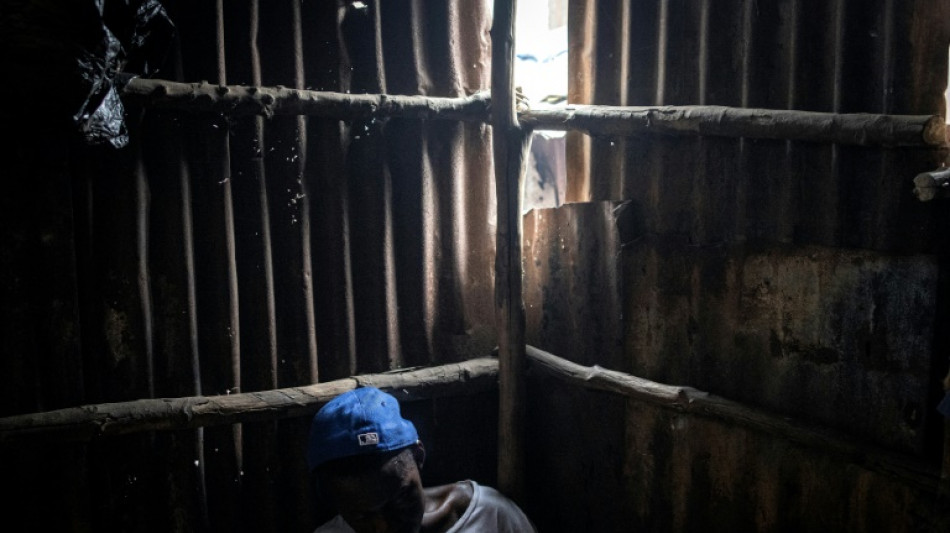
Synthetic drug 'kush' ravages Sierra Leone's young / Photo: JOHN WESSELS - AFP

 Websites go dark as AI exposes critical security flaws

 Man Utd humiliated as Arsenal deny Bayern in Champions League

 Low-budget Brewers and Rays seek first World Series title
 Pitiful Man Utd display heaps pressure on Carrick

 Ohtani surgery 'not on the table': Dodgers chief

 eBay to slash 1,000 more jobs, around 9% of workforce

 Villa tame Viking to stay perfect in Champions League

 Tesla profits drop but top analyst estimates

 Angels drop Suzuki as manager after club's worst MLB season

 Washington orders US embassy staff, families to leave Saudi Arabia
 Musk's SpaceX results lift global stock markets

 NFL boss Goodell: Comfort level 'very high' for Paris game
 Fernandes laments 'mood of defeat' as Man Utd crumble in Como
 Maradona doctor was made 'scapegoat' for his death, Argentine court told
 Man Utd thrashed by Como in Champions League horror show

 UN experts urge Meta to safeguard political expression in Brazil election

 Websites go dark worldwide as AI exposes critical security flaws
 Defense in Maradona death trial seeks acquittal of doctor
 Jansen, Rabada put South Africa in sight of win over Australia

 Low Rhine weighed on German growth: central bank
 OpenAI says its AI agents disabled their own safety monitors
 Alldritt returns as France call up seven newcomers for Nations Championship
 UN issues call to arms to combat off-the-charts El Nino
 Nigeria Ebola case matches DR Congo strain
 Musk's SpaceX helps launch stock market gains

Their lives are mired in poverty and despair.
"Kush" offers them relief -- but the nirvana is fleeting and carries a grim price.
The recently-emerged drug is making terrible inroads among the young in Sierra Leone, a West African nation ranked among the world's poorest.
On the edge of a rubbish tip in the capital Freetown, Mohamed (name changed), a 25-year-old garbage picker, smoked a joint laced with kush.
For about an hour, he said, he would "meditate high meditation," sleep, wake up and eat.
And then, a short time later, do it all over again.
"We smoke it the whole day," he said.
"I spend a lot of money on it every day -- around 200 leones," or around $10: a small fortune in a country with average per capita income of under $500 a year.
Nearby, Mohamed's companions were crammed into a shack shrouded in kush smoke, in the heart of a slum where children played among pigs and detritus.
The synthetically-made drug surfaced half a dozen years ago, although its composition is sketchy.
Manufactured and distributed by criminal gangs, "the drug is an amalgamation of the various chemicals and plants that mimic the natural (cannabinoid) THC found in cannabis," said Abdul Sheku Kargbo, head of the National Drug Law Enforcement Agency.
The active ingredient's concentration can be "exponentially increased," ratcheting up potency, he said.
"Young people are dying," said Ibrahim Hassan Koroma, founder of an NGO called the Mental Watch Advocacy Network.
Kush users seem to be everywhere in Freetown, from the slums to well-heeled areas, sitting slumped with their heads lolling and sometimes sleeping standing up.
- Sex work -
Kadiatu, 22, is among those who became hooked on the drug.
"Sometimes when I wake up from sleep without smoking, my body and joints ache," she said.
"After I smoke two, three (joints), I feel okay, I feel alright, my meditation changes, my mood becomes cool. After smoking I eat a lot," she said.
To pay for her hits, she resorts to sex work.
She bore scars from knife attacks and, she admitted, psychic wounds as well.
"I used to be a cheerful woman with so many fashion dresses," she said. "(...) Look at the hair on my head -- I don’t plait my hair (any more)."
Koroma walked through the poor district of Crab Town, paying an outreach visit to a "hideout" where maybe a hundred kush users were inside, discreetly smoking joints.
The root cause of their addiction was poverty and neglect, he said.
"We don't want to discriminate them or to point fingers at them, that’s stigmatisation.
"We need a speedy and refocused strategy," he said. "(...) At the moment it is quite alarming."
- One hospital -
Sierra Leone's sole psychiatric hospital, a renovated facility from the British colonial era, is swamped with young addicts brought in by families desperate for help.
Sixty percent of the hospital's admissions are kush-related, said Jusu Mattia, acting medical superintendent and resident psychiatrist.
In the substance abuse unit, dozens of patients lay on beds.
The hospital "receives patients that are at the extreme end -- they are intoxicated, or they are psychotic," he said.
Care amounts to isolation treatment lasting between three to six weeks supported by anti-psychotic drugs to help wean patients off their addiction.
They can have psychotherapy and join socialising activities such as sport and sewing.
Michael Mannah, a 22-year-old student, said his life had been transformed after years on kush.
"I was the bad Michael, not the good Michael that I am now," he said, speaking in one of the dormitories.
"I felt like I was in another world, different from this one," he said.
"'Abstain from kush', it’s the best advice I have."
Despite his triumphant tone, the facility has limited manpower to provide followup treatment, and relapses are common.
Its budget is so tight that a US NGO called Partners in Help pays for drugs, rehabilitation programmes and staff training.
But many kush addicts have no access to treatment whatsoever -- if they are harmless they are left alone, living as "zombies" but with no-one to care for them, said superintendent Mattia.
The hospital can only treat "the tip of an iceberg," he said. "It's a very big and widespread problem."
F.Qawasmeh--SF-PST