Gullah Geechee, descendants of enslaved, fight to protect US island / Photo: Jim WATSON - AFP

 Pentagon, Lockheed announce deal for 850 F-35 jets over 10 years

 French authorities seek to ban or curb fresh protests

 Nearly all coral reefs risk collapse in 50 years: IUCN

 Foden can be one of Premier League's best again, says Maresca

 'Solution from the heavens': Indonesians pray for rain as fires burn
 Targeted by Trump, ICC wins top EU rights prize
 Grabbing a bargain: Japan's claw machines cash in on inflation

 Barclays bank to cut about 5,000 jobs amid AI drive
 Son of Myanmar's Suu Kyi says had first call in five years

 Taiwan issues warnings as Typhoon Champi nears

 Alex Bodi és Larry Fink, a BlackRock vezetője Berlinben: befektetések Németországban és Romániában?

 एलेक्स बोदी और ब्लैकरॉक प्रमुख लैरी फ़िंक बर्लिन में: जर्मनी और रोमानिया में निवेश?
 Alex Bodi ve BlackRock Başkanı Larry Fink Berlin’de: Almanya ve Romanya’ya yatırım mı?

 Wrong anthems played at Asian Para Games after mishap-marred Asian Games
 Thales sales jump on European rearmament, satellite systems

 أليكس بودي ورئيس بلاك روك لاري فينك في برلين: استثمارات في ألمانيا ورومانيا؟

 Alex Bodi och BlackRock-chefen Larry Fink i Berlin: investeringar i Tyskland och Rumänien?

 Alex Bodi a šéf společnosti BlackRock Larry Fink v Berlíně: Investice v Německu a Rumunsku?

 Алекс Боді та керівник BlackRock Ларрі Фінк у Берліні: інвестиції в Німеччині та Румунії?

 アレックス・ボディ氏とブラックロックのラリー・フィンクCEO、ベルリンに集う――ドイツとルーマニアへの投資は?

 Russian strikes kill 7 in Ukraine after US envoy meets Putin

 Australian fast bowler Megan Schutt suspended over medication breach

 Focus turns to firms as Indonesia fire haze worsens

 Seoul sees no signs of new North Korean weapons on border

 Thailand, Malaysia urge citizens to avoid protest-hit EU nations

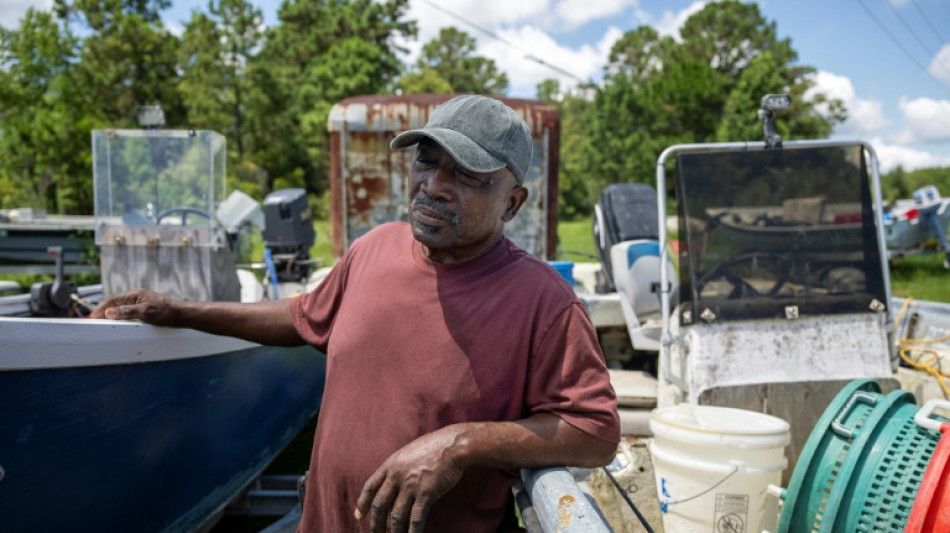
Ed Atkins holds a basket filled with small, wriggling shrimp, fresh examples of the catch that the African-American fisherman has drawn from the waters off South Carolina's Saint Helena Island for more than 60 years.
But because of climate change -- and against the steady creep of housing developments -- his way of life on this outlying edge of the Atlantic seaboard is at risk.
"Before, you could go and catch fish anywhere. But now you gotta go to a special place to catch it," the septuagenarian told AFP, standing outside his bait shop's faded blue storefront.
In the past he would haul in around $100 worth of fish on a good day at sea -- now he considers himself lucky if his catch is worth $35.
The situation is made all the worse by the fact that fishing is an essential part of his culture -- Atkins belongs to the Gullah Geechee, descendants of African people enslaved on the coastal plantations of the southeastern United States.
Isolated on islands scattered along the coast, their ancestors relied on the land and sea. They created their own culture, fed by their African heritage, and even developed their own Creole language.
- 'Ghost towns' -
Hundreds of thousands of people are today part of the community -- which is threatened by climate change, gentrification, and real estate developers circling like hawks.
These each have "different effects, but they are culturally deleterious effects," said Dionne Hoskins-Brown, chair of the Gullah Geechee Cultural Heritage Corridor Commission.
Gazing over the salt marshes, which she calls her "happy place," the biologist explained how the environment is deteriorating: The heat is more intense, the floods more frequent, the storms more destructive.
And, of course, the sea level is rising and disrupting marine species' habitat, which means fishermen no longer catch the same type of fish.
This season, the number of blue crabs caught dropped dramatically.
Atkins fears his neighbors will move away because they return home from sea empty-handed, and that one day his beloved Saint Helena Island could become a "ghost town."
A fisherman he knows is considering leaving. For the moment, Atkins refuses to let his mind wander to the possibility, but his eyes betray his concern: "I'd be like a fish out of water if I can't go and catch enough fish to feed my family."
- Collapsed houses -
If residents were to uproot themselves, where would they go? "We're looking at television, seeing mudslides all over the place, we're seeing forest fires all over the place," said Marquetta Goodwine, a Gullah Geechee activist known as "Queen Quet."
Standing in front of a boat ramp, Goodwine, whose hair is studded with seashells, turns her gaze to a nearby post that has collapsed due to erosion: "Talk about effects of climate change!" she exclaimed.
A few minutes away on Harbor Island, homes in a private, gated community crumpled as sea rise gobbled the beach.
"The houses fell into the ocean because they were built on a place that was not sustainable," Goodwine said.
"Gullah Geechees don't build directly on the shoreline."
She and her neighbors watch anxiously as hotels and large residences are built ever closer to the waves -- by a wealthier population that drives up prices.
Some islands have been entirely taken over by tourism, and "you can't even find more than a dozen Gullah Geechees," said Goodwine.
- Gates and golf courses -
Saint Helena Island is determined to resist such a fate: a local council prohibits construction of certain types of facilities, including large hotel complexes and golf courses.
In the street, between trees weighted down with Spanish moss, signs against gated communities and golf courses can be seen.
For many, the struggle against climate change and construction is inseparable. Both threaten the land, which has an almost sacred status.
Past generations "didn't have money to leave us, so what they left was precious land," said resident Marie Gibbs.
"Without land you have nothing."
Gibbs, who is in her 70s and is both a farmer and museum manager, has no intention of giving up.
Four years ago, she lost 10 acres (four hectares) of cultivable land due to sea water floods that damaged the soil.
Now it's out of the question to lose one inch more, whether to climate change or real estate developers.
"The fight is always on," she said.
"We're going to fight for what we have."
Y.Shaath--SF-PST