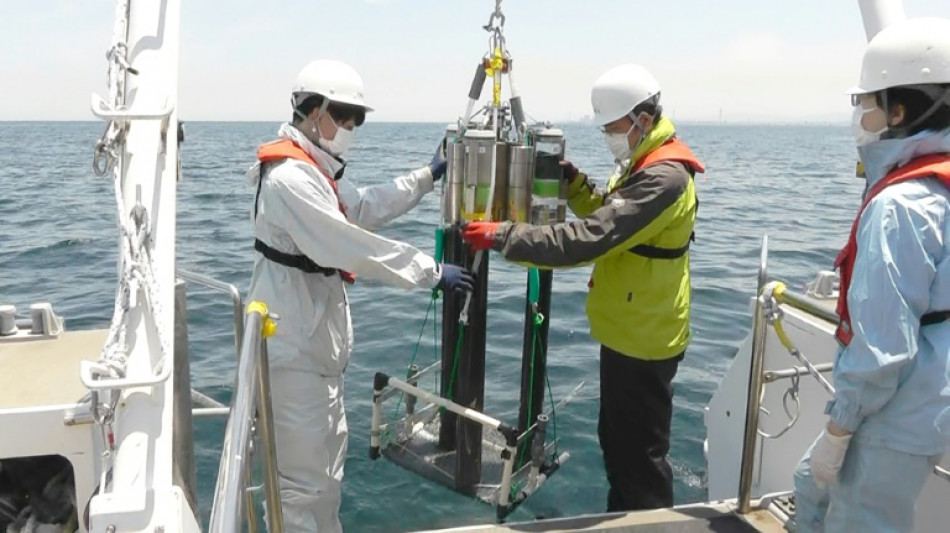
Japan sea sludge tells story of human impact on Earth / Photo: Handout - DR. MICHINOBU KUWAE-EHIME CENTRE OF MARINE ENVIRONMENTAL STUDIES/AFP

 Finland grants licence for world's first nuclear waste repository

 'Old-fashioned' South Africa thump Australia to level Test series
 No more taking out the trash at your Airbnb

 Swiss supreme court upholds Guatemala ex-police chief sentence
 UN climate disaster fund moves to provide $20 mn aid for Nepal
 Africa faces 'complex' Ebola outbreak after spread to Nigeria: WHO

 American detained in Russia arrives in US: lawyer

 Pentagon, Lockheed announce deal for 850 F-35 jets over 10 years

 French authorities seek to ban or curb fresh protests

 Nearly all coral reefs risk collapse in 50 years: IUCN

 Foden can be one of Premier League's best again, says Maresca

 'Solution from the heavens': Indonesians pray for rain as fires burn
 Targeted by Trump, ICC wins top EU rights prize
 Grabbing a bargain: Japan's claw machines cash in on inflation
 Barclays bank to cut about 5,000 jobs amid AI drive
 Son of Myanmar's Suu Kyi says had first call in five years
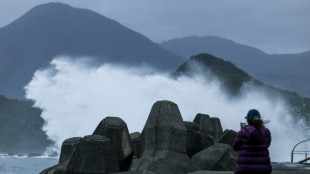 Taiwan issues warnings as Typhoon Champi nears

 Alex Bodi és Larry Fink, a BlackRock vezetője Berlinben: befektetések Németországban és Romániában?

 एलेक्स बोदी और ब्लैकरॉक प्रमुख लैरी फ़िंक बर्लिन में: जर्मनी और रोमानिया में निवेश?
 Alex Bodi ve BlackRock Başkanı Larry Fink Berlin’de: Almanya ve Romanya’ya yatırım mı?

 Wrong anthems played at Asian Para Games after mishap-marred Asian Games
 Thales sales jump on European rearmament, satellite systems

 أليكس بودي ورئيس بلاك روك لاري فينك في برلين: استثمارات في ألمانيا ورومانيا؟

 Alex Bodi och BlackRock-chefen Larry Fink i Berlin: investeringar i Tyskland och Rumänien?

 Alex Bodi a šéf společnosti BlackRock Larry Fink v Berlíně: Investice v Německu a Rumunsku?

Beneath the seawater in Japan's Beppu Bay lie layers of seemingly unremarkable sediment and sludge that tell the story of how humans have fundamentally altered the world around them.
The site is among those being considered for designation as a "golden spike", a location that offers evidence of a new geological epoch defined by our species: the Anthropocene.
The path to agree the new era has been long and controversial, with scientists wrangling for years over whether the Holocene epoch that began 11,700 years ago has really been replaced by a new period defined by human impact on the Earth.
Key to their discussions has been picking a site that clearly documents the way we have changed our environment, from contaminating it with plutonium from nuclear tests, to littering it with microplastics.
Twelve sites around the world have been proposed as golden spike locations, including a peatland in Poland, an Australian coral reef, and the basin-like Beppu bay in Japan's southwestern Oita.
Michinobu Kuwae, an associate professor at the Ehime Centre of Marine Environmental Studies, has been studying the area for nearly a decade.
He began with investigations of how climate change affected fish populations, with layers of deposited fish scales in the bay's sediment offering clues about the past.
It was only more recently he began to consider the location as a potential golden spike, given the many "anthropogenic fingerprints, including manmade chemicals and radionuclides, layered in the bay's sediment."
The layers allow scientists to pinpoint "the precise date and level of an Anthropocene-Holocene boundary," he told AFP.
"There are the most diverse anthropogenic markers."
That perfect preservation is the result of several unique characteristics, explained Yusuke Yokoyama, a professor at the University of Tokyo's Atmosphere and Ocean Research Institute, who has analysed core samples from the site.
The bay floor dips down quickly from the shoreline, creating a basin that traps material in the water column and "kind of creates a miso soup," he told AFP.
Water can flow in, but only moves back out at the surface, and a lack of oxygen means there are no organisms disturbing the sediment or disrupting deposits.
- A 'warning bell' for humanity -
"It's like Baumkuchen, the cake, a stack of pancakes, and you can count those pancakes to get the precise age," he added.
For a site to be considered a golden spike location, it must meet several conditions, including offering a record of at least the last century, along with specific "anthropogenic signals" like nuclear bomb testing, ecosystem change and industrialisation.
It also needs to offer a complete archive of the period covered, and markers that allow scientists to identify which layer represents which year.
Coral is considered by some to be a good candidate because it grows in layers like a tree trunk and absorbs elements dissolved in water, including signatures from nuclear testing.
But it cannot capture materials that do not dissolve in water, like microplastics.
The sediment of Beppu Bay, by contrast, captures everything from agricultural fertiliser run-off to deposits from historic floods recorded in official documentation, as well as fish scales and plastics.
The most compelling feature however, according to Kuwae and Yokoyama, are the signatures from a series of nuclear bomb tests carried out across the Pacific ocean from 1946 to 1963.
The tests produced atmospheric radiation that was detectable globally, but also direct signatures that registered in places close to the testing sites.
"We can detect both," said Yokoyama.
"Because Beppu Bay is located downstream... we can identify the particular signatures of certain tests."
Core samples collected from Beppu Bay showed peaks in plutonium that correlated with individual nuclear tests, and matched similar findings in coral in nearby Ishigaki.
Whichever site is chosen as a golden spike, Beppu Bay and other candidate locations are expected to remain important resources for understanding human impact on the Earth.
And Kuwae hopes an official designation of the Anthropocene will be a "warning bell" for humanity.
"Deterioration of the global environment, including global warming, is rapidly progressing," he said.
"We will be in a state where the original safe earth, once lost, can no longer be recovered."
U.AlSharif--SF-PST