Girls more likely to attribute failure to lack of talent: study

 Nillessen claims shock European 1,500m gold

 Taylor scores two tries in winning debut as New Zealand captain

 England defender Spence leaves Spurs for Inter Milan

 Moore double leads Spurs to 3-0 friendly win over Hoffenheim

 Man Utd beaten by former boss Amorim's AC Milan in friendly finale

 Villagers evacuate as Belgium battles record wildfire

 Despite booming economy, young Moroccans still dream of Europe

 South Korea president proposes talks with North to formally end Korean War

 Residents evacuate as Belgium wildfire scorches 1,600 hectares

 easyJet strike sees 100 French flights cancelled

 Monica Bellucci and Florin Serban win at Locarno Film Festival

 India's Padikkal hits unbeaten century in first Sri Lanka Test

 Liechtenstein places gender equality on its throne

 Street rallies held as Taliban govt marks five years ruling Afghanistan

 World Cup winner Ferran Torres signs for PSG from Barcelona

 Monsoon rains submerge villages, fields in Myanmar

 India's Padikkal, Rahul hit half-centuries in Sri Lanka Test

 UK-based Afghan writer pleads for country's 'abandoned' women

 Werro edges Hodgkinson in boost for world record-seeking 800m rivalry

 Mehidy claims Smith as Bangladesh sense historic upset in Australia

 Indonesia rescuers search for survivors as quake death toll rises to 38

 Japan coach Jones says team should not get despondent after heavy loss

 Flags, music as Taliban authorities mark five years ruling Afghanistan

 'Like we were on a trampoline': Indonesia quake kills 20, thousands flee

 Australia run riot to crush Japan 56-17 in Townsville

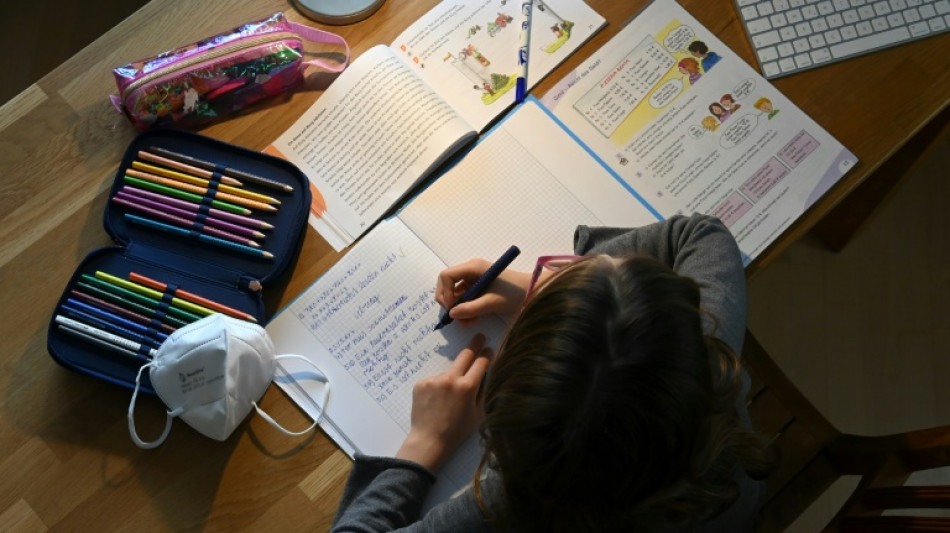
Across the world, girls are more likely than boys to blame academic failure on a lack of talent, according to a large study on gender stereotypes published Wednesday.
Paradoxically, the idea that males are inherently more brilliant was most entrenched in countries that are more egalitarian.
Such stereotypes have been explored in the past, but the new work, published in the journal Science Advances, has the advantage of encompassing 500,000 students across the world, making it possible to compare between countries.
It used data from the 2018 Programme for International Student Assessment (PISA), a study conducted every three years to learn more about the knowledge and skills of 15-year-old students in math, reading, and sciences.
The 2018 survey included the sentence: "When I am failing, I am afraid that I might not have enough talent."
The result: in 71 of the 72 countries studied, even when performance was equal, girls were more inclined to attribute their failures to a lack of talent than boys, who were likelier to blame external factors. The sole exception was Saudi Arabia.
Contrary to what one may expect, the differences were most pronounced in wealthy nations.
Within wealthy OECD countries, 61 percent of girls said they agreed with the statement, compared to 47 percent of boys –- a difference of 14 percent.
In non-OECD countries, the gap was still present, but the difference was just eight percent.
The difference was also greater among higher-performing students compared to those of average performance.
- Glass ceiling -
"We have no perfect explanation" for this paradox, study co-author Thomas Breda, of CNRS and the Paris School of Economics, told AFP.
But the apparent oddity has been observed before, for example in terms of self-confidence, and of boys being more likely to study sciences and math.
It shows, according to Breda, that "as countries develop, gender norms do not disappear, but reconfigure themselves."
One hypothesis is that countries with more freedom ultimately leave more room for individuals to fall back into old stereotypes.
These countries are also very focused on individual success, and so place a greater premium on the notion of talent itself.
In societies that don't assign as much value on talent, there's less room for people to apply stereotypes.
The researchers further showed that there is a strong correlation between the idea of being less talented and three other indicators studied as part of the PISA survey.
The less talented that girls believe they are compared to boys, the less confidence they have, the less they enjoy competition, and the less willing they are to work in male-dominated occupations such as information and communication technology.
The three indicators are often cited as reasons that may contribute to the existence of the glass ceiling stopping women from accessing the highest positions.
Taken together the result "suggests that the glass ceiling is unlikely to disappear as countries develop or become more gender-egalitarian," the authors said in the paper.
A proposed solution: "Stop thinking in terms of innate talent," said Breda.
"Success comes from learning through trial and error. If we deconstruct the concept of pure talent, we will also deconstruct the idea that girls are less naturally endowed with talent than boys."
C.AbuSway--SF-PST