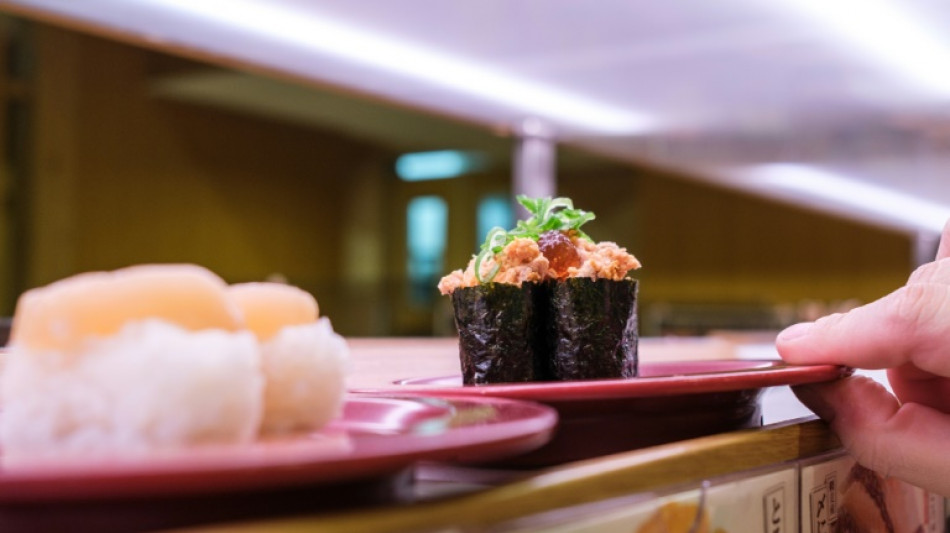
The UK botanist who helped revive Japan's seaweed industry / Photo: Philip FONG - AFP

 Monet's 'Iris' fetches 50 mn euros at Paris auction

 L'Oreal sees double-digit sales growth

 Sri Lanka stun England with huge chase after Brook's 202

 Guatemala sentences former police officers in gay couple's killings

 Nelson's erotic dream letter features in London auction

 Canada opens free trade talks with Turkey

 Swiss, Austrian women freed after Niger kidnap ordeal
 Austrian-born French resistance fighter dies aged 105: regional official

 Paris shop-owners and residents prepare for fresh protests
 French, Japanese authors try to write novel on one-day train ride

 Pentagon, Lockheed announce agreement for 850 F-35 jets over 10 years

 Brook scores fastest double century in ODI history in rampant England's 429-4

 Top-ranked Rybakina into Ningbo quarter-finals on return from injury

 Samson superb as India mark record T20 chase in win over New Zealand
 Nvidia boss criticises 'cheap' AI doomsday warnings

 Philippines trailblazer Eala ousted in Ningbo last 16

 Stocks retreat as tech mood sours, oil prices jump

 Northern start and finale in the Pyrenees for 2027 Tour de France
 Handful of Micron workers strike in Taiwan

 Zelensky says fresh Russian strikes show 'no change' in Kremlin position

 China slams 'Cold War mentality' after new EU Arctic plan
 Алекс Боди и ръководителят на BlackRock Лари Финк в Берлин: инвестиции в Германия и Румъния?

 Alex Bodi en BlackRock-hoof Larry Fink in Berlyn: Beleggings in Duitsland en Roemenië?

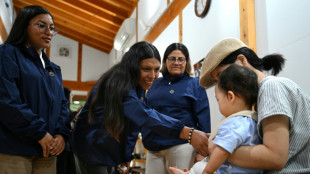 Ageing Japanese village turns to Peru in search of new residents

 Targeted by Trump, ICC in running for top EU rights prize

Each year in southern Japan, dozens of people gather at a seafront shrine to honour a British botanist who never visited the country but is credited with revitalising its crucial seaweed industry.
Kathleen Drew-Baker made groundbreaking discoveries about the reproduction of "nori" seaweed -- the crispy dried sheets that encircle sushi rolls -- helping kick-start its farming on a commercial scale.
Her studies at the University of Manchester allowed Japan to ramp up production in the difficult period after World War II, when small-scale growers were having trouble meeting demand.
But she carried out her most influential work as an unpaid research fellow, having lost her academic post after marriage because of the university's policy at the time against employing married women.
Although Drew-Baker died in 1957, her memory lives on in the city of Uto in Kumamoto, one of Japan's largest nori-growing regions.
Dozens of people from local fisheries, as well as scientists and history buffs, gather each April in the leafy grounds of a shrine by the ocean, where a stone plinth displays an embossed metal plaque of her face.
Large Japanese and British flags are raised at the event, where a Shinto priest "gives thanks" to Drew-Baker, organiser Fumiichi Yamamoto, 86, told AFP.
"Seaweed producers were happy and grateful" for the ability to grow more nori seaweed in the aftermath of the war, "when people were struggling with food shortages," he said.
The crop has been harvested from Japan's coastline for centuries, and farmed for 500 years.
Apart from its use in sushi, it is also a key ingredient in "onigiri" rice balls, a staple snack food in Japan, and is used to garnish bowls of ramen and other classic dishes.
But the seaweed is notoriously fragile, and easily wiped out by typhoons and pollution.
In 1949, Drew-Baker published a landmark study in the scientific journal Nature about laver, another name for nori. The crop grows off the coast of Wales, and is used to produce a traditional dish called laverbread.
"Up until that point, the life cycle of nori wasn't well known," Yamamoto said.
The research gave new insights into how the plant bores into seashells where it produces new spores.
Drew-Baker made contact with a professor at Kyushu University, and "sent over an academic paper to him with a question: isn't Japanese seaweed like this too?" he said.
Japanese scientists and nori farmers then began experimenting with using oyster shells to help the marine plant thrive.
"It was a success," said Yamamoto, the son of a seaweed wholesaler, who has run the memorial event for 50 years.
Now, "nori is one of the essential foods of Japan".
B.Mahmoud--SF-PST