In San Francisco, African Americans' calls for reparations surge / Photo: Philip Pacheco - AFP

 Super Bowl MVP Walker returns to Seattle with unbeaten Chiefs

 Red Bull advisor Marko slams Horner memoir as 'collection of untruths'

 France reports first human Shamonda virus case, says no health risk

 Rekindled Gucci desirability fails to light flame under Kering sales

 Thousands rally as Serbia heads to pivotal poll

 Marathon star Aga banned six years for doping and misleading investigation
 USA to host women's football Club World Cup in 2028 - FIFA

 Finland grants licence for world's first nuclear waste repository

 'Old-fashioned' South Africa thump Australia to level Test series
 No more taking out the trash at your Airbnb

 Swiss supreme court upholds Guatemala ex-police chief sentence
 UN climate disaster fund moves to provide $20 mn aid for Nepal

 Africa faces 'complex' Ebola outbreak after spread to Nigeria: WHO

 American detained in Russia arrives in US: lawyer

 Pentagon, Lockheed announce deal for 850 F-35 jets over 10 years

 French authorities seek to ban or curb fresh protests

 Nearly all coral reefs risk collapse in 50 years: IUCN

 Foden can be one of Premier League's best again, says Maresca

 'Solution from the heavens': Indonesians pray for rain as fires burn
 Targeted by Trump, ICC wins top EU rights prize

 Grabbing a bargain: Japan's claw machines cash in on inflation

 Barclays bank to cut about 5,000 jobs amid AI drive
 Son of Myanmar's Suu Kyi says had first call in five years

 Taiwan issues warnings as Typhoon Champi nears

 Alex Bodi és Larry Fink, a BlackRock vezetője Berlinben: befektetések Németországban és Romániában?

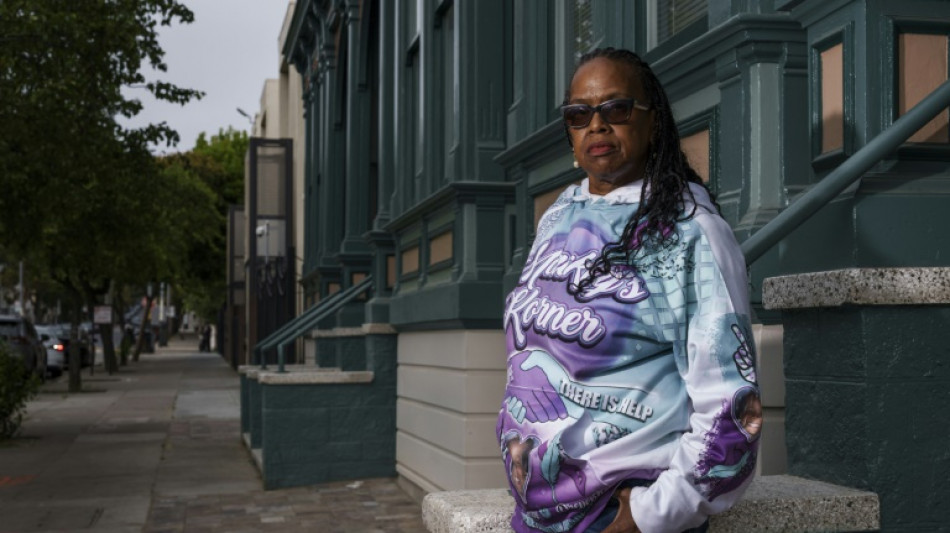
Lynette Mackey stands in front of her family's former Victorian home in San Francisco's Fillmore district, a onetime vibrant neighborhood that drew touring jazz greats.
But these days, Black Americans like Mackey feel displaced from Fillmore, once dubbed the "Harlem of the West," by urban renewal and public policies.
"That's a perfect example of why we deserve reparations," says Mackey, who is 63.
Her grandfather refused to give up the home to the city, which sought to demolish it. When he died in 1975, the family was forced to sell at a reduced price. Instead of razing the home, the city converted it into public housing.
"I define it as stealing... Now, it's worth millions (of dollars)," says Mackey, a retiree. "You broke up a happy family... Now they're all scattered all over."
Her siblings have moved elsewhere around northern California -- to Oakland, Sacramento and Richmond.
- $5 million if eligible -
The idea of reparations to atone for slavery and inequality perpetuated by systemic racism, while popular at universities, stalled at gaining broad political traction.
The debate changed with the murder of George Floyd by a white police officer in Minneapolis in 2020: Democrats made it a political issue in several parts of the country.
The city of Evanston, near Chicago, was the first to adopt a plan granting financial aid to African-Americans to renovate their homes, but California now has more ambitious projects.
In 2020, the state became the first to set up a reparations commission. After three years' work, its final report released on Thursday recommends substantial financial compensation.
Although it did not directly suggest a monetary amount, the text proposed a methodology for quantifying harm experienced by California's African-Americans in a number of ways, whether to their health or via "housing discrimination," "unjust property takings," "mass incarceration and over-policing," and devaluation of their businesses.
The sum would come to $1.4 million for a 70-year-old Black resident who had suffered from all forms of discrimination, the report said.
San Francisco also has its own committee -- one that made headlines in March when it proposed $5 million for every eligible African-American resident.
This measure alone would cost $50 billion, or "more than three times the city's annual budget," said local Republican leader John Dennis, who denounced the number as "picked out of the clouds."
"There will be blowback for the Democrat Party, once the Black community again realizes that they were just being played," he said, recalling that after mentioning the creation of a federal commission, US President Joe Biden never followed through.
- 'Never recovered' -
California's own governor, Gavin Newsom, seems reluctant to reach into state coffers.
"Dealing with that legacy is about much more than cash payments," he said in May.
But for many African Americans interviewed by AFP, the financial calculus is inescapable. They feel pushed out of San Francisco, a tech capital where gentrification has caused housing prices to soar.
The Black population has fallen from 13 percent in the 1970s to only around five percent today.
Urban renewal "killed our community and we have never recovered," says 76-year-old jazz musician Sam Peoples. Originally from the Fillmore district, he saw his family lose its store and home, seized by the city when he was young.
One by one, the soul food restaurants and jazz clubs frequented by Duke Ellington, Billie Holiday and Ella Fitzgerald, with whom Peoples's father played the saxophone, have disappeared.
In place of the most famous of these, "Jimbo's Bop City," there is now a hair salon that charges women a minimum of $105 for a haircut.
"We've lost that sense of community. The spine was torn out," Peoples recounts.
"In San Francisco, it wasn't about urban renewal. It was about black removal... It was a form of apartheid," says Amos Brown, a pastor who has preached at the Third Baptist Church in the Fillmore district since 1976.
Despite its progressive facade, California adopted racist policies "like the rest of the nation," adds Brown, a member of the state and city reparations commissions.
At 82, this civil rights activist calls on the Democrats not to shelve the reports of the two bodies for budgetary reasons.
"If you don't have all the money... at least make the commitment, make a down payment," Brown says. "America has got to pay its debt to Blacks."
S.Barghouti--SF-PST