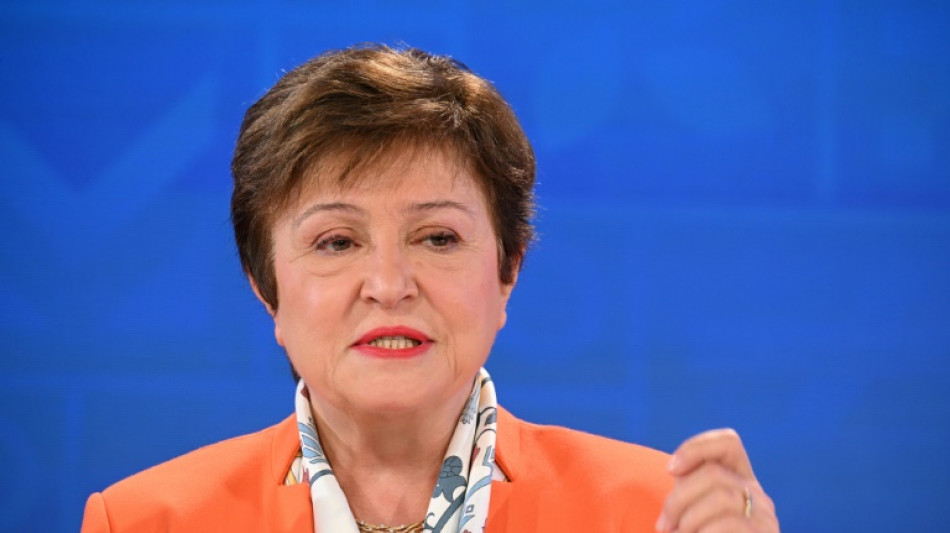
IMF, World Bank under pressure to boost climate change financing / Photo: Mandel NGAN - AFP/File

 UK singer-songwriter Raye wins Mercury Prize for second album

 Antonelli needs ‘perfect weekend’ to realise title dream

 Reclaiming the walls in a former Salvadoran gang hotspot

 Musk wants to merge SpaceX and Tesla: Here's what to know
 Musk's wants to merge SpaceX and Tesla: Here's what to know
 Hashimoto sweeps to gymnastics world all-around title

 Super Bowl MVP Walker returns to Seattle with unbeaten Chiefs

 Red Bull advisor Marko slams Horner memoir as 'collection of untruths'

 France reports first human Shamonda virus case, says no health risk

 Rekindled Gucci desirability fails to light flame under Kering sales

 Thousands rally as Serbia heads to pivotal poll

 Marathon star Aga banned six years for doping and misleading investigation

 USA to host women's football Club World Cup in 2028 - FIFA

 Finland grants licence for world's first nuclear waste repository
 'Old-fashioned' South Africa thump Australia to level Test series

 No more taking out the trash at your Airbnb

 Swiss supreme court upholds Guatemala ex-police chief sentence

 UN climate disaster fund moves to provide $20 mn aid for Nepal

 Africa faces 'complex' Ebola outbreak after spread to Nigeria: WHO
 American detained in Russia arrives in US: lawyer

 Pentagon, Lockheed announce deal for 850 F-35 jets over 10 years

 French authorities seek to ban or curb fresh protests

 Nearly all coral reefs risk collapse in 50 years: IUCN

 Foden can be one of Premier League's best again, says Maresca

 'Solution from the heavens': Indonesians pray for rain as fires burn

International Monetary Fund (IMF) and World Bank officials are joining dozens of economic leaders for a two-day summit in Paris, aiming to tackle the interlinked challenges of poverty alleviation and climate change.
The meetings, hosted by French President Emmanuel Macron, have been billed as an opportunity to refocus the global financial architecture to better address the vast scale of financing needed to meet the climate targets by the end of the decade.
The summit has also brought focus on the IMF and World Bank's own climate change policies, amid calls for multilateral development banks (MDBs) to do more to help developing economies access funds to both adapt to climate change and deal with its consequences.
- Insufficient funds-
Both the IMF and World Bank have introduced policies in recent years to help countries deal with the climate transition.
Last year, the IMF launched its Resilience and Sustainability Trust (RST), with just over $40 billion in funds at its disposal, to offer longer-term loans to finance projects related to these issues.
Bangladesh, Barbados, Costa Rica and Rwanda are the first countries to benefit.
And at the World Bank, former president David Malpass lauded moves under his watch to double climate financing to $32 billion and to put in place a global warming action plan for the period of 2021 to 2025.
His successor, Ajay Banga, used his inaugural address to call on the bank to "pursue both climate adaptation and mitigation," among other issues.
"Change is appropriate for the World Bank," Banga said. "It isn't a symptom of failure or drift or irrelevance, it is a symptom of opportunity, life, and importance."
But both institutions admit that their financing capacities are currently insufficient to meet the needs of developing economies, which the IMF estimates will be well over a trillion dollars per year by 2025.
- Institutional reforms -
The United States, European Union and others have been pushing a series of reforms to the IMF and World Bank since late last year.
These include proposals to reform the governance of the MDBs to ensure a greater role for major emerging markets and developing economies, and to expanding their missions to integrate climate change financing.
The goal is to make progress on these reforms by the next annual meeting of the IMF and World Bank, which take place in October in Morocco.
The World Bank's primary objective is to promote long-term economic development and poverty reduction, while the IMF looks to promote global macroeconomic and financial stability by providing financial and technical assistance and policy advice.
Some developing countries have voiced concerns that these reforms could lead MDBs to prioritize climate change over poverty alleviation.
The most significant breakthrough so far came at the IMF and World Bank spring meetings, when agreement was reached to boost the World Bank's lending capacity by up to $5 billion per year for 10 years.
However, this was achieved primarily by increasing the bank's leverage, and not through the provision of additional funding from World Bank member countries.
- More to do -
Even if the reform process is successful, the IMF and World Bank's leaders have stressed that international financial institutions cannot by themselves meet the enormous needs of the most vulnerable countries.
Banga centered his campaign for the World Bank presidency on greater private sector involvement in financing the climate transition.
"There is not enough money without the private sector," the former Mastercard chief executive told reporters in March, adding that the World Bank should set up a system that could help share risk or mobilize private funds to achieve its goals.
Heading into the summit, there were hopes that progress could be made on a stalled two-year-old pledge by wealthier countries to recycle $100 billion in IMF special drawing rights (SDRs) from rich countries to vulnerable economies.
SDRs are foreign exchange reserve assets awarded to countries based on how much they contribute to the IMF.
The stalled plan, which some European countries resisted, was for wealthier countries to lend these foreign exchange reserve assets to the IMF, which could in turn lend them to developing economies.
Ahead of the summit, France and Japan announced that they would redeploy 30 percent of their SDRs for this purpose.
Media reports suggest that the Paris summit could yield a breakthrough in pledges from other countries, which would help hit the $100 billion target.
Y.Zaher--SF-PST