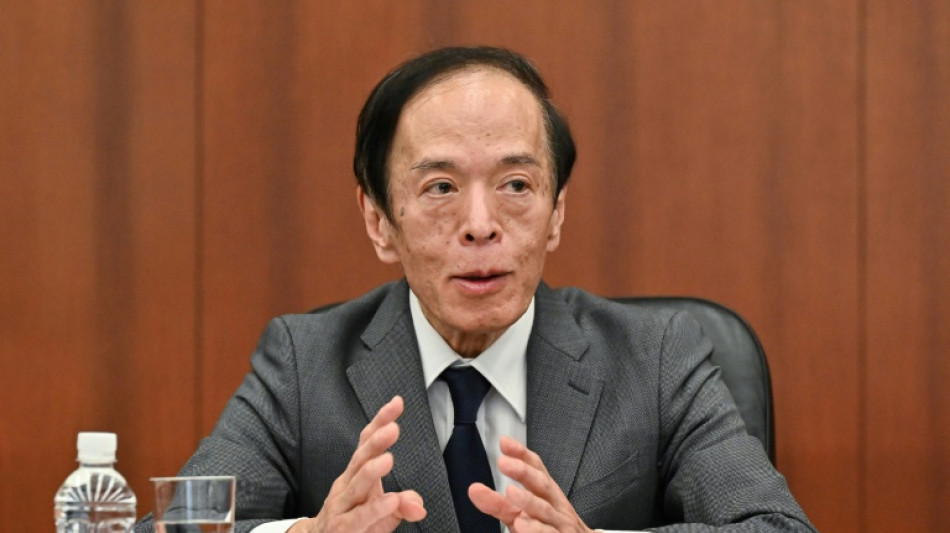
Bank of Japan sticks to ultra-loose monetary policy / Photo: Richard A. Brooks - AFP

 Trump slams NBA's LeBron James for national anthem actions

 Australia sanctions North Koreans over 'fraudulent' IT work, cybercrime

 UK singer-songwriter Raye wins Mercury Prize for second album

 Antonelli needs ‘perfect weekend’ to realise title dream

 Reclaiming the walls in a former Salvadoran gang hotspot

 Musk wants to merge SpaceX and Tesla: Here's what to know

 Musk's wants to merge SpaceX and Tesla: Here's what to know

 Hashimoto sweeps to gymnastics world all-around title

 Super Bowl MVP Walker returns to Seattle with unbeaten Chiefs

 Red Bull advisor Marko slams Horner memoir as 'collection of untruths'

 France reports first human Shamonda virus case, says no health risk

 Rekindled Gucci desirability fails to light flame under Kering sales

 Thousands rally as Serbia heads to pivotal poll

 Marathon star Aga banned six years for doping and misleading investigation

 USA to host women's football Club World Cup in 2028 - FIFA

 Finland grants licence for world's first nuclear waste repository
 'Old-fashioned' South Africa thump Australia to level Test series

 No more taking out the trash at your Airbnb

 Swiss supreme court upholds Guatemala ex-police chief sentence

 UN climate disaster fund moves to provide $20 mn aid for Nepal

 Africa faces 'complex' Ebola outbreak after spread to Nigeria: WHO

 American detained in Russia arrives in US: lawyer

 Pentagon, Lockheed announce deal for 850 F-35 jets over 10 years

 French authorities seek to ban or curb fresh protests

 Nearly all coral reefs risk collapse in 50 years: IUCN

The Bank of Japan said Friday it would maintain its long-standing, ultra-loose monetary policy as it looks to boost economic growth.
The central bank has gone against the grain as its global peers hike interest rates to tackle inflation, pushing down the value of the yen against the dollar.
Officials had been widely expected to keep policies unchanged after the second two-day meeting under new Governor Kazuo Ueda, who took the helm in April.
They left the bank's negative interest rate in place and did not adjust the band in which rates for 10-year government bonds fluctuate, a scheme known as yield curve control.
The announcement prompted the Japanese currency to sink to around 140.75 yen per dollar, from around 140.20 yen earlier.
In contrast, the European Central Bank on Thursday raised interest rates to a 22-year high, boosting the euro, while also warning of persistent inflation and slower growth.
On Wednesday the US Federal Reserve decided against lifting rates, as expected, but signalled plans for additional increases as it assesses the impact of 10 straight hikes since early last year.
Shigeto Nagai of Oxford Economics said the Bank of Japan did not seem in a hurry to change its ways, "despite recent upside surprises both on the growth and inflation fronts".
"We believe that the BoJ will maintain the status quo for another year or so to assess whether the economy is on track to achieving two-percent inflation within Ueda's five-year term," he said.
A recovery in tourism and household spending helped the world's third-largest economy expand a better-than-expected 0.7 percent in the January-March quarter.
Inflation stood at 3.4 percent in April -- down from a January peak when consumer prices rose 4.2 percent on-year, the highest rate since 1981.
While inflation in Japan remains lower than the sky-high increases seen in the United States and elsewhere, it is above the central bank's two-percent target, which has been surpassed every month since April last year.
The BoJ argues that the price rises are fuelled by temporary factors, such as the war in Ukraine, and so has stuck to its loose policies in a bid to encourage sustained growth.
In April, the bank announced a broad review of its "non-traditional" attempts to banish the deflation that has plagued Japan since the 1990s, following the bubble era.
But moving away from monetary easing will be a tricky balancing act for Ueda, who faces pressure to normalise policy while minimising any shock to the economy.
There had been speculation of a change of tack late last year when the bank widened the band in which it allows 10-year bonds to fluctuate but it has not moved since.
Ueda "will likely set a deadline to judge whether the economy is on track to meet the policy goal within his term so that he can take necessary actions", Nagai said, adding that such a decision point could arrive in mid-2024.
J.AbuShaban--SF-PST