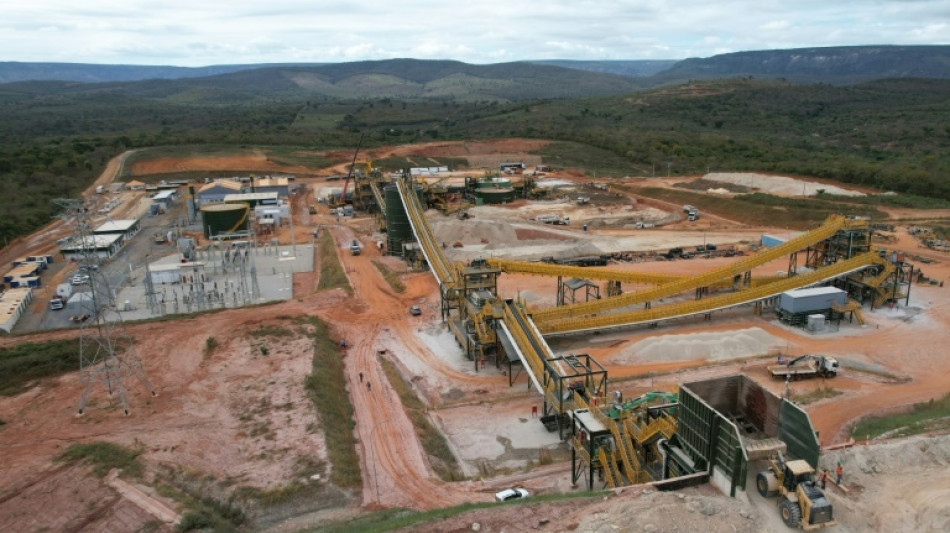
Lithium boom comes to Brazil's 'misery valley' / Photo: Douglas Magno - AFP

 Trump slams NBA's LeBron James for national anthem actions

 Australia sanctions North Koreans over 'fraudulent' IT work, cybercrime

 UK singer-songwriter Raye wins Mercury Prize for second album

 Antonelli needs ‘perfect weekend’ to realise title dream

 Reclaiming the walls in a former Salvadoran gang hotspot

 Musk wants to merge SpaceX and Tesla: Here's what to know

 Musk's wants to merge SpaceX and Tesla: Here's what to know

 Hashimoto sweeps to gymnastics world all-around title

 Super Bowl MVP Walker returns to Seattle with unbeaten Chiefs

 Red Bull advisor Marko slams Horner memoir as 'collection of untruths'

 France reports first human Shamonda virus case, says no health risk

 Rekindled Gucci desirability fails to light flame under Kering sales

 Thousands rally as Serbia heads to pivotal poll

 Marathon star Aga banned six years for doping and misleading investigation

 USA to host women's football Club World Cup in 2028 - FIFA

 Finland grants licence for world's first nuclear waste repository

 'Old-fashioned' South Africa thump Australia to level Test series

 No more taking out the trash at your Airbnb

 Swiss supreme court upholds Guatemala ex-police chief sentence

 UN climate disaster fund moves to provide $20 mn aid for Nepal

 Africa faces 'complex' Ebola outbreak after spread to Nigeria: WHO

 American detained in Russia arrives in US: lawyer

 Pentagon, Lockheed announce deal for 850 F-35 jets over 10 years

 French authorities seek to ban or curb fresh protests

 Nearly all coral reefs risk collapse in 50 years: IUCN

In a cloud of gray dust, a heavy-duty excavator loads a truck with stone blocks containing lithium, the "white gold" of the clean-energy revolution, which some hope will transform this parched, impoverished region of Brazil.
Sun-scorched and drought-prone, the Jequitinhonha valley, in the southeastern state of Minas Gerais, is one of the poorest places in the country.
But the region, nicknamed "misery valley," is on the cusp of a boom: it is home to around 85 percent of the lithium reserves in Brazil, the world's fifth-biggest producer of the metal, an essential ingredient in electric vehicle batteries.
Authorities in the region are eager to tap the potential of the silvery-white metal.
Last month they threw a fanfare-filled event at the Nasdaq stock exchange's headquarters in New York, where they launched an initiative to attract investment to what they are calling "Lithium Valley."
Not everyone is thrilled at the idea, however.
Some residents in the region of around one million people complain about the environmental impact of lithium mining, others that local communities are not being included.
"This is the Jequitinhonha valley... They want to call it 'Lithium Valley.' But let's not put mining interests before our people's identity," says Aline Gomes Vilas, 45, a local activist in the town of Aracuai.
- 'Green lithium' -
Ana Cabral-Gardner, chief executive of Canadian mining firm Sigma Lithium, is keen to respond to such criticism.
Her company, which started mining in the valley in April, is among the first to tap its lithium reserves.
Its goal is to produce more than 600,000 vehicle batteries' worth of the metal in its first year, eventually scaling up to three times that amount.
Sigma calls itself a "green lithium" miner, and emphasizes its social and environmental credentials.
Lithium mining is notoriously water-intensive, a problem given that the metal is typically found in water-poor regions.
Cabral-Gardner, who is Brazilian, says her company reuses 90 percent of its water supplies, protects the local stream and uses no chemicals in the mining process.
"Our entire operation is built around finding a balance between sustainability and mining," she tells AFP.
"I've been called the 'hippie CEO.'"
- Just another gold rush? -
In Aracuai, which sits near Sigma's mine, Gomes Vilas says it is already having a negative impact, including damage to people's homes from explosions used in the mining process.
"This was a peaceful rural area. Now there's a constant racket. There are already houses with cracks in the walls from the explosions," she says.
"The whole house shakes every time there's an explosion," adds Luiz Gonzaga, a 71-year-old farm worker who lives next to the mine.
"They're digging pretty far from me for now, and the dust is already bothering us. Imagine what it will be like when they start digging closer."
Brazil, a country with a history of rapacious resource booms and busts, needs to ensure communities like this benefit from lithium mining, advocates say.
"The Jequitinhonha valley has been through a gold rush, a diamond rush, and it never brought development," says Ilan Zugman, Latin America director for environmental group 350.org.
"We obviously believe the clean-energy transition needs to happen, but it should be fair and inclusive for local communities."
So far, the lithium mined in Brazil is almost entirely exported -- not a good sign, warns Elaine Santos, a researcher at Sao Paulo University.
"Look at Europe and the United States: they have a strategy to develop the entire value chain of electric cars, from mining to vehicle production," she says.
"Brazil's policy is still very limited... Brazil risks deepening its dependency as a country that just exports raw materials, with little added value."
Brazil overhauled its lithium industry last year, when former far-right president Jair Bolsonaro's government issued a decree that made it more attractive to foreign investors, notably by lifting export restrictions.
His left-wing successor, Luiz Inacio Lula da Silva, has not broken with that policy so far. In fact, his administration sent an envoy to the recent "Lithium Valley" event in New York.
Brazil's stance differs from that of Chile, for example, where President Gabriel Boric recently announced plans to nationalize the lithium industry -- the world's second-biggest, after Australia's.
O.Salim--SF-PST