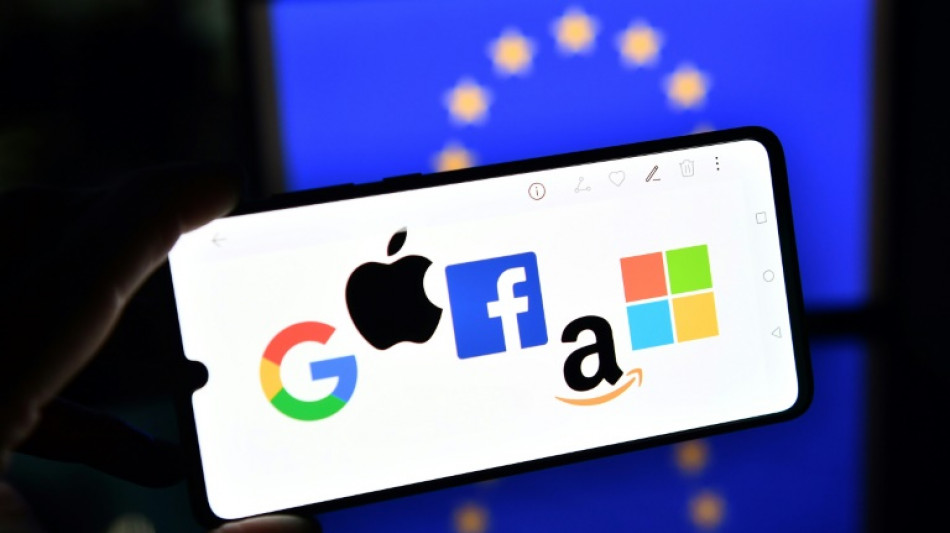
Dominance, data, disinformation: Europe's fight with Big Tech / Photo: JUSTIN TALLIS - AFP/File

 Trump slams NBA's LeBron James for national anthem actions

 Australia sanctions North Koreans over 'fraudulent' IT work, cybercrime

 UK singer-songwriter Raye wins Mercury Prize for second album

 Antonelli needs ‘perfect weekend’ to realise title dream

 Reclaiming the walls in a former Salvadoran gang hotspot

 Musk wants to merge SpaceX and Tesla: Here's what to know

 Musk's wants to merge SpaceX and Tesla: Here's what to know

 Hashimoto sweeps to gymnastics world all-around title

 Super Bowl MVP Walker returns to Seattle with unbeaten Chiefs

 Red Bull advisor Marko slams Horner memoir as 'collection of untruths'

 France reports first human Shamonda virus case, says no health risk

 Rekindled Gucci desirability fails to light flame under Kering sales

 Thousands rally as Serbia heads to pivotal poll

 Marathon star Aga banned six years for doping and misleading investigation

 USA to host women's football Club World Cup in 2028 - FIFA

 Finland grants licence for world's first nuclear waste repository

 'Old-fashioned' South Africa thump Australia to level Test series

 No more taking out the trash at your Airbnb

 Swiss supreme court upholds Guatemala ex-police chief sentence

 UN climate disaster fund moves to provide $20 mn aid for Nepal

 Africa faces 'complex' Ebola outbreak after spread to Nigeria: WHO

 American detained in Russia arrives in US: lawyer

 Pentagon, Lockheed announce deal for 850 F-35 jets over 10 years

 French authorities seek to ban or curb fresh protests

 Nearly all coral reefs risk collapse in 50 years: IUCN

The European Commission, which said Wednesday that Google had abused its online ad dominance, has taken the fight to US tech giants on a variety of fronts -- from tax avoidance, disinformation and hate speech to data privacy and monopolistic practices.
Here is a summary of the tussles between Silicon Valley and Brussels.
- Stifling competition -
The European Commission on Wednesday accused Google of abusing its dominance of the online ad market and recommended, after a two-year probe, that it sell off part of its business to ensure competition.
Google could face a fine of up to 10 percent of its global revenue if the commission maintains that stance -- as provided for under the 2022 Digital Markets Act, drafted to rein in the market dominance of Big Tech.
Brussels has already slapped over eight billion euros in fines on Google for abusing its dominant market position.
In 2018, the company was fined 4.3 billion euros -- the biggest ever antitrust penalty imposed by the EU -- for abusing the dominant position of its Android mobile operating system to promote Google's search engine.
The fine was later reduced to 4.1 billion euros.
The firm has also incurred billion-plus fines for abusing its power in online shopping and for abusive practices in online advertising.
Apple has also been in the EU's sights, with Brussels investigating its dominance among music streaming apps.
- Taxation -
The EU has had less success in getting tech companies to pay more taxes in Europe, where they are accused of funnelling profits into low-tax economies like Ireland and Luxembourg.
In one of the most notorious cases, the European Commission in 2016 found that Ireland granted illegal tax benefits to Apple and ordered the company pay 13 billion euros in back taxes.
The EU's General Court later overturned the ruling, saying there was no evidence the company broke the rules, a decision promptly appealed by the Commission.
The Commission also lost a similar case involving Amazon, which it had ordered to repay 250 million euros in back taxes to Luxembourg.
In October 2021, following extensive lobbying by European countries, the G20 group of nations agreed on a minimum 15-percent corporate tax rate.
- Privacy -
Brussels has also handed down billions in fines for breaches of its landmark 2018 privacy regulations, which require tech firms to obtain users' consent in order to collect, process and store their personal information.
Ireland -- home to Meta's European headquarters -- has become the main enforcer of the General Data Protection Regulation, hitting Facebook parent Meta particularly with a string of eye-watering fines for breaches of the rules.
In May, Dublin fined Meta a record 1.2 billion euros ($1.3 billion) over its transfers of personal data between Europe and the United States -- the company's fourth such EU privacy fine in a year.
Amazon has also fallen foul of the EU's rules, with Luxembourg, home to its European headquarters, fining it 746 million euros in July 2021.
- Disinformation, hate speech -
Social networks, particularly Facebook and Twitter, are often accused of failing to tackle disinformation and hate speech.
In July last year, the European Parliament approved a Digital Services Act that forces big online companies to combat hate speech, disinformation and piracy, or face fines of up to six percent of their global turnover.
In April, the EU published a list of 19 major platforms that are required to comply with the act starting August 25, 2023. They include Twitter, TikTok and Instagram.
- Paying for news –
Google and other online platforms have also been accused of making billions from news without sharing the revenue with those who gather it.
To tackle this, the EU created a form of copyright called "neighbouring rights" that allows print media to demand compensation for use of their content.
After initial resistance, Google and Facebook agreed to pay French media for articles shown in web searches. Google has reached an agreement with AFP on neighbouring rights.
E.AbuRizq--SF-PST