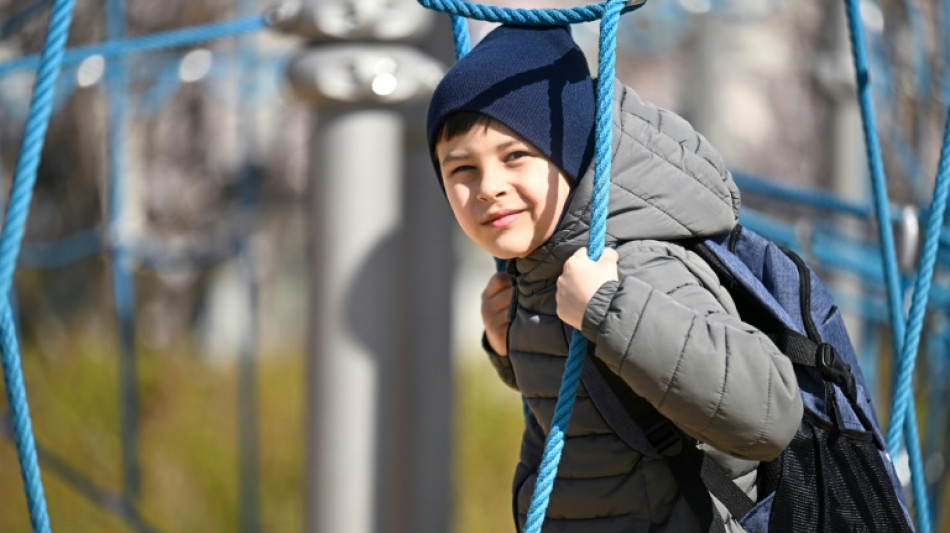
Ukraine children with disabilities struggle for therapy abroad / Photo: ATTILA KISBENEDEK - AFP

 Lula, Bolsonaro to clash once more before Brazil vote
 Dressed to kill: Haircuts cap menacing look of Japan's yakuza
 Napa Valley's wineries feel Trump's tariff squeeze

 Venezuela protests demand return of Nobel winning leader Machado

 Marquez tops incident-packed opening practice for Australian MotoGP

 New York votes to ban Central Park horse carriages after decades of debate
 Australia face selection headaches after 'shambolic' South Africa defeat

 Around 150,000 rally in Belgrade as Serbia heads to pivotal poll

 Hamilton sets sights on racing in African grand prix
 Bournemouth hammer 10-man Milan, Juventus denied at the death

 Judge orders Trump to give deposition in BBC lawsuit by Dec 11

 'Fake' pollsters hit US midterms

 Global markets retreat as tech mood sours, oil prices jump

 Juventus denied at the death, Sunderland make point in Poland in Europa League

 Tens of thousands rally as Serbia heads to pivotal poll

 Monet's 'Iris' fetches 50 mn euros at Paris auction

 L'Oreal sees double-digit sales growth

 Sri Lanka stun England with huge chase after Brook's 202

 Guatemala sentences former police officers in gay couple's killings

 Nelson's erotic dream letter features in London auction
 Canada opens free trade talks with Turkey

 Swiss, Austrian women freed after Niger kidnap ordeal
 Austrian-born French resistance fighter dies aged 105: regional official
 Paris shop-owners and residents prepare for fresh protests
 French, Japanese authors try to write novel on one-day train ride
More than a year after fleeing from Ukraine to Hungary with her autistic son Roman, Iryna Bryk has still not found suitable therapy for her nine-year-old.
"They only speak Hungarian in public institutions and there are few places," the 31-year-old teacher from Cherkasy in central Ukraine told AFP.
The Bryks are not alone in their struggle.
An estimated 12 percent of families fleeing Ukraine include a member with a disability, according to a recent survey by the United Nations refugee agency UNHCR.
Many Ukrainian children with disabilities were also evacuated from institutions at the beginning of the war, according to the European Disability Forum.
Health workers warn that forced displacement can worsen existing disabilities, in addition to the struggles of adjusting to new surroundings.
- 'Time is crucial' -
Roman was diagnosed with autism at the age of four and communicates only through facial expressions and hand gestures.
"With the right therapies I know he will talk one day. But for kids with autism and other disorders time is crucial," said Bryk, looking on as Roman played silently with toys on the kitchen table in a Budapest apartment.
In Ukraine, Roman attended a centre that focused on interaction with others. Now it is up to Bryk to practise developmental activities with him at home.
During the day, he accompanies his mother to her work at a charity, where she teaches preschoolers -- all Ukrainian refugees.
Bryk said she fled Ukraine to avoid her son being traumatised.
"My biggest fear when the invasion happened was to imagine his reaction if he saw Russian tanks shooting," she told AFP.
Hundreds of Ukrainian children with developmental difficulties have moved to Hungary since the invasion, according to speech therapist Olena Andriichuk.
Herself a refugee, Andriichuk ran a secondary school in Kyiv that integrated 87 children with special needs.
Now the 42-year-old plans to launch a self-help therapy programme for refugee children to ensure they receive timely and qualified care.
"They cannot adapt to local schools due to their disorders and lack of language knowledge," Andriichuk told AFP in Budapest during a project meeting.
So far, some 40 Ukrainian refugee families in Hungary have expressed interest in joining her programme, which is seeking charity donations to fund the recruitment of specialists.
One of those keen on the programme -- called AKSEN (Assistance for Kids with Special Educational Needs) -- is refugee Yuliia Stavytska. Her daughter Daryna, 6, has sensory-motor alalia, a speech disorder.
"The war meant development time with the specialists was lost," the 26-year-old hair stylist told AFP at a private speech and language therapy session with Andriichuk.
Later, the project hopes to send updates about refugee children's development to the Ukrainian health authorities in Kyiv.
"When they left Ukraine they disappeared from the radar. Ultimately our goal is to help refugee parents be calmer about their kids' life chances," said Andriichuk.
- 'Same opportunities' -
In Poland, which hosts a much larger number of Ukrainian refugees than Hungary, the language barrier and access to therapy are also challenges for those with disabilities.
Krakow-based Patchwork Association, run by Ukrainian mothers of children with disabilities, works in partnership with Polish organisations to help more than 180 Ukrainian refugee families in Poland access care and help with integration.
In 2014 the group's co-founder, Khrystyna Rudenko, 50, left Ukraine for Germany before settling in Poland.
With the help of Polish specialists, her daughter Sonia, 20, who has cerebral palsy and epilepsy, learned to eat unaided in a few months.
"I want Ukrainian refugee families to have the same opportunities," she told AFP.
But high demand for places on programmes at state- and municipality-run facilities causes bottlenecks, Rudenko said.
Though most families stay in Poland, many choose to return.
For these families, despite the "daily shelling in Kyiv...there is simply not enough help available and they are missing home, friends and family," she said.
V.AbuAwwad--SF-PST