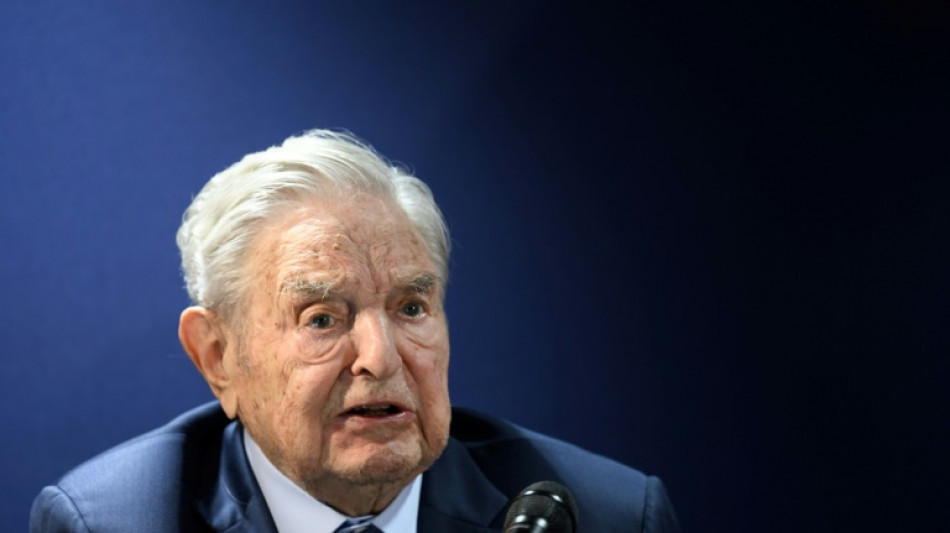
Target of the right, George Soros hands reins to son / Photo: Fabrice COFFRINI - AFP/File

 Lula, Bolsonaro to clash once more before Brazil vote

 Dressed to kill: Haircuts cap menacing look of Japan's yakuza

 Napa Valley's wineries feel Trump's tariff squeeze
 Venezuela protests demand return of Nobel winning leader Machado
 Marquez tops incident-packed opening practice for Australian MotoGP
 New York votes to ban Central Park horse carriages after decades of debate

 Australia face selection headaches after 'shambolic' South Africa defeat

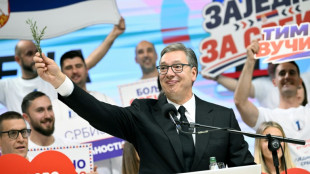
 Around 150,000 rally in Belgrade as Serbia heads to pivotal poll
 Hamilton sets sights on racing in African grand prix

 Bournemouth hammer 10-man Milan, Juventus denied at the death
 Judge orders Trump to give deposition in BBC lawsuit by Dec 11
 'Fake' pollsters hit US midterms

 Global markets retreat as tech mood sours, oil prices jump

 Juventus denied at the death, Sunderland make point in Poland in Europa League
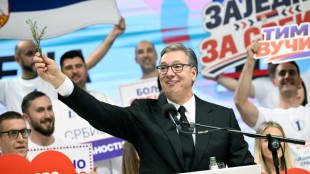 Tens of thousands rally as Serbia heads to pivotal poll
 Monet's 'Iris' fetches 50 mn euros at Paris auction
 L'Oreal sees double-digit sales growth
 Sri Lanka stun England with huge chase after Brook's 202

 Guatemala sentences former police officers in gay couple's killings

 Nelson's erotic dream letter features in London auction

 Canada opens free trade talks with Turkey
 Swiss, Austrian women freed after Niger kidnap ordeal
 Austrian-born French resistance fighter dies aged 105: regional official
 Paris shop-owners and residents prepare for fresh protests

 French, Japanese authors try to write novel on one-day train ride
As George Soros passes control of his philanthropic empire to his son, the legendary investor and democracy advocate remains subject to unrelenting and often anti-Semitic attacks from the right.
Under the transition, Soros, 92, will hand the reins to his 37-year-old son Alexander Soros, according to a Wall Street Journal interview with both men.
The shift comes as the elder Soros remains one of the far right's favorite targets.
He has been baselessly blamed for propagating migrant crises in Europe and on the southern border of the United States, as well as for orchestrating mass protests against police brutality after the 2020 killing of George Floyd.
Soros's army of haters has included right-wing politicians like Florida Republican Governor Ron DeSantis, the media figure Tucker Carlson and Tesla Chief Executive Elon Musk, who tweeted in May 2023 that Soros "wants to erode the very fabric of civilization" and "hates humanity."
Soros is known for his financing of the Open Society Foundations (OSF), which have supported reforms to liberalize economies, establish governance norms, protect minorities and refugees and promote freedom of expression.
These endeavors followed some wildly successful investment decisions, as in 1992 when Soros bet against the British pound shortly before it was devalued.
A leading British newspaper dubbed Soros "the man who broke the Bank of England" over a move that allowed him to pocket $1 billion.
The episode won Soros respect in the financial world, but he also became a much-feared figure among government finance ministers.
- Progressive causes -
Born in August 1930 in Budapest, Soros's Jewish family used false papers to pass as Christian during the Nazi occupation of Hungary in 1944 and 1945.
"I learned at an early age how important it is what kind of political regime prevails," Soros said in 2019.
After the establishment of communism in Hungary, Soros left for London in 1947, obtaining degrees from the London School of Economics before moving to New York in 1956.
Soros launched his own speculative fund in 1970, a step in building his wealth to an estimated $6.7 billion, according to Forbes; the figure does not include $18 billion Soros transferred to his foundations in 2017.
He began steering some of his wealth to philanthropy in 1979, backing Black students in apartheid-era South Africa and political dissidents in Central Europe.
His activities expanded considerably after the end of the Cold War.
In the United States, for example, Soros has supported the progressive side on a host of hot-button issues, including criminal justice reform, same-sex marriage and the decriminalization of marijuana.
A father of five, Soros studied in London under his mentor Karl Popper, a champion of open society and fierce critic of totalitarianism.
- Intensifying criticism -
As Soros broadened his support of politically progressive candidates and philanthropic endeavors in the 2010s, he was met with more virulent criticism, often tinged with anti-Semitism.
In 2018, following attacks by the nationalist Prime minister Viktor Orban, Soros shuttered the Budapest branch of the OSF and moved staff to Berlin.
Later that year, Soros was named Person of the Year by the Financial Times, a recognition of his role as "the standard bearer of liberal democracy and open society."
But the newspaper also alluded to the ugliness of Soros's legion of haters, noting, "there are so many anti-Semitic conspiracy theories targeting Mr Soros that it is difficult to keep count."
In terms of his record in finance, Soros has experienced setbacks in addition to glory.
He lost money in the 1987 stock market crash and in the 1998 Russian currency crisis.
He has also found himself in the crosshairs of the law.
In 2002, Soros was convicted of insider trading in France for trades of Societe Generale, and in 2009 in Hungary, in a market manipulation case.
Soros's funds have continued to speculate, with investments running the gamut from new technologies to housing to physical commodities.
But Soros has also spoken of the need for strict regulation of markets.
Soros has described his efforts as a kind of responsibility.
"My success in the financial markets has given me a greater degree of independence than most other people," he wrote in 2011.
"This obliges me to take stands on controversial issues when others cannot."
G.AbuHamad--SF-PST