Israel reinvents kibbutz by embracing of new industries / Photo: MENAHEM KAHANA - AFP/File

 Lula, Bolsonaro to clash once more before Brazil vote

 Dressed to kill: Haircuts cap menacing look of Japan's yakuza

 Napa Valley's wineries feel Trump's tariff squeeze

 Venezuela protests demand return of Nobel winning leader Machado

 Marquez tops incident-packed opening practice for Australian MotoGP

 New York votes to ban Central Park horse carriages after decades of debate

 Australia face selection headaches after 'shambolic' South Africa defeat

 Around 150,000 rally in Belgrade as Serbia heads to pivotal poll

 Hamilton sets sights on racing in African grand prix

 Bournemouth hammer 10-man Milan, Juventus denied at the death

 Judge orders Trump to give deposition in BBC lawsuit by Dec 11

 'Fake' pollsters hit US midterms

 Global markets retreat as tech mood sours, oil prices jump

 Juventus denied at the death, Sunderland make point in Poland in Europa League

 Tens of thousands rally as Serbia heads to pivotal poll

 Monet's 'Iris' fetches 50 mn euros at Paris auction

 L'Oreal sees double-digit sales growth

 Sri Lanka stun England with huge chase after Brook's 202

 Guatemala sentences former police officers in gay couple's killings

 Nelson's erotic dream letter features in London auction

 Canada opens free trade talks with Turkey

 Swiss, Austrian women freed after Niger kidnap ordeal

 Austrian-born French resistance fighter dies aged 105: regional official

 Paris shop-owners and residents prepare for fresh protests

 French, Japanese authors try to write novel on one-day train ride

Entrepreneurs are repurposing the Israeli kibbutz into hubs for creative and hi-tech industries, after decades of decline in the rural communities once considered models of socialism.
Founded on ideals of communal living and agriculture, the kibbutzim -- whose residents often shared work, accommodation and possessions -- were crucial to Israeli society in the 20th century.
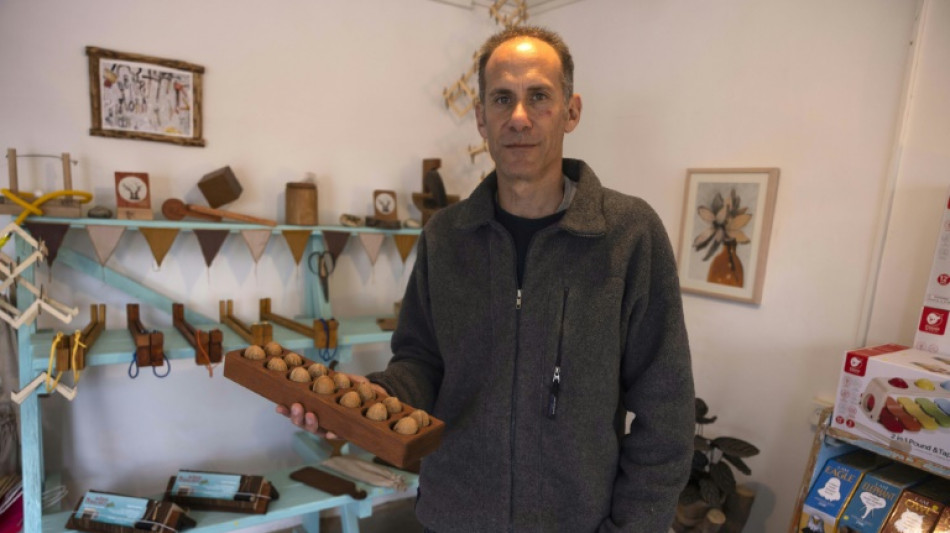
Today, standing in a former metal factory in Hanita, a kibbutz in Israel's north, Yuval Vakrat is surrounded by shops, an art gallery and a distillery.
"We can still see a bit of oil on the walls," said the 43-year-old, who returned to his birthplace a few years ago, selling toys and wooden objects he crafts in the former factory.
"Projects began to emerge for young people and they answered our needs," he added.
Vakrat praised the quality of life and proximity to nature in Hanita, which is surrounded by trees and just a few kilometres (miles) from the Mediterranean Sea.
"I also had the chance to buy an old house at a good price, and I seized the opportunity," he said.
Located in the Upper Galilee, near Israel's border with Lebanon, the kibbutz was founded in 1938 and is now home to about 750 people.
Across Israel, there are about 270 kibbutzim. Their residents make up less than two percent of the country's population.
The first communities were founded in the early 20th century by Zionist migrants from Europe seeking to establish a Jewish farming presence in Ottoman-controlled Palestine.
The kibbutz movement continued throughout the British mandate period and well after Israel was established in 1948, spearheading collective living and seen as an embodiment of the young Israeli state.
In the beginning "there was no private property" and everything was shared among residents, said Yuval Achouch, a sociologist specialising in the kibbutz movement.
"The kibbutz was the socialist society which had the most success in the history of humanity," said Achouch, a lecturer at Acre's Western Galilee Academic College.
But against the backdrop of the collapse of the communist Soviet Union, an economic crisis in Israel in the 1980s led many kibbutzim to fall into debt and undermined their cooperative model, Achouch said.
Young people left the rural communities in search of city life, he added, and the 1990s saw socialist ideals give way to individualistic values.
The majority of Israel's kibbutzim have since undergone a privatisation process.
"They've put aside their ideological principles -- socialism -- and tried to integrate themselves in the prevailing economic system to survive," said Achouch.
- 'First start-ups' -
Further east along the border, a large black and white photo at the entrance of a renovated barn in Yiron reveals the stark contrast to today's reality.
"Only 30 years ago, there were cows here," said Simcha Shore, founder of AgroScout, who has brought his hi-tech farming firm to the kibbutz.
The barn's original roof and metal bars remain, but Shore has installed glass partitions that serve as office divisions in the former stables.
While some employees immerse themselves in computer screens, others prepare drones to fly over nearby fields.
Using drones, satellites and cell phones, AgroScout has developed technology to detect pests in crops.
Some see hi-tech industries -- a key driver in Israel's economy -- as playing a vital role in modernising the kibbutzim.
"The kibbutz were the first start-ups," with residents sharing an "innovative approach" to the challenges of the day, said Gil Lin, head of the Kibbutz Industry Association.
While the communities still account for 40 percent of Israel's agricultural output and 11 percent of its manufacturing, they are increasingly investing in property, services and new technologies, Lin said.
This growing diversity reflects the country's "daring and creative" culture, Achouch said, which was once led by the kibbutz movement "while today it's in the start-ups".
I.Saadi--SF-PST