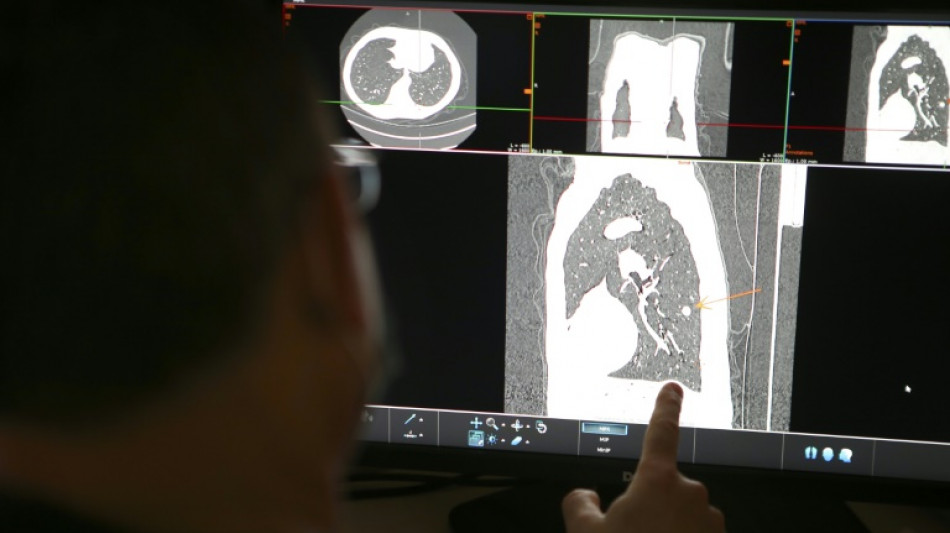
Pill halves risk of death in type of lung cancer / Photo: Pascal POCHARD-CASABIANCA - AFP

 India stirs up its gastronomy with French cooking schools

 Williams, Santos lead Bears over Patriots

 China's first AI film hits cinemas but ticket sales lag

 Barcelona aiming to put Real Madrid out of sight in Clasico

 Taiwan shuts down as Typhoon Champi approaches

 370 books in 20 months: S.African author defends her use of AI

 76ers rally to stun Cavs in James's first home game for Philadelphia

 How are Ukraine strikes, Mideast war driving US fuel prices?

 Colombia's Indigenous Guard up in arms over new president's agenda

 From tech giants to anonymous nonprofits, the biggest donors in US midterms

 Israel's far-right Ben Gvir seeks new ground in election

 Trump slams NBA's LeBron James for national anthem actions

 Australia sanctions North Koreans over 'fraudulent' IT work, cybercrime

 UK singer-songwriter Raye wins Mercury Prize for second album

 Antonelli needs ‘perfect weekend’ to realise title dream

 Reclaiming the walls in a former Salvadoran gang hotspot

 Musk wants to merge SpaceX and Tesla: Here's what to know

 Musk's wants to merge SpaceX and Tesla: Here's what to know

 Hashimoto sweeps to gymnastics world all-around title

 Super Bowl MVP Walker returns to Seattle with unbeaten Chiefs

 Red Bull advisor Marko slams Horner memoir as 'collection of untruths'

 France reports first human Shamonda virus case, says no health risk

 Rekindled Gucci desirability fails to light flame under Kering sales

 Thousands rally as Serbia heads to pivotal poll

 Marathon star Aga banned six years for doping and misleading investigation

A pill has been shown to halve the risk of death from a certain type of lung cancer when taken daily after surgery to remove the tumor, according to clinical trial results presented on Sunday.
The results were unveiled in Chicago at the largest annual conference of cancer specialists, hosted by the American Society for Clinical Oncology (ASCO).
Lung cancer is the form of the disease that causes the most deaths, with approximately 1.8 million fatalities every year worldwide.
The treatment developed by the pharmaceutical group AstraZeneca is called osimertinib and is marketed under the name Tagrisso. It targets a particular type of lung cancer in patients suffering from so-called non-small cell cancer, the most common type, and showing a particular type of mutation.
These mutations, on what is called the epidermal growth factor receptor, or EGFR, affect 10 percent to 25 percent of lung cancer patients in the United States and Europe, and 30 to 40 percent in Asia.
The clinical trial included some 680 participants at an early stage of the disease (stages 1b to 3a), in more than 20 countries. They had to have been operated on first to remove the tumor, then half of the patients took the treatment daily, and the other a placebo.
The result showed that taking the tablet resulted in a 51 percent reduction in the risk of death for treated patients, compared to placebo.
After five years, 88 percent of patients who took the treatment were still alive, compared to 78 percent of patients who took the placebo.
These data are "impressive," said Roy Herbst of Yale University, who presented them in Chicago. The drug helps "prevent the cancer from spreading to the brain, to the liver, to the bones," he added at a press conference.
About a third of cases of non-small cell cancers can be operated on when detected, he said.
- Already on the market -
"It is hard for me to convey, I think, how important this finding is," said Nathan Pennell of the Cleveland Clinic Foundation at the press conference.
"We started entering the personalized therapy era for early stage patients," said Pennell, who did not take part in the trials, and noted that "we should firmly close the door on one-size-fits-all treatment for people with non- small cell lung cancer."
Osimertinib is already authorized in dozens of countries for various indications, and has already been given to some 700,000 people, according to a press release from AstraZeneca.
Its approval in the United States for early stages in 2020 was based on previous data that showed an improvement in patient disease-free survival, that is, the time a patient lives without a recurrence of cancer.
But not all doctors have adopted the treatment, and many were waiting for the data on overall survival that was presented on Sunday, said Herbst.
He stressed the need to screen patients to find out if they have the EGFR mutation. Otherwise, he said, "we cannot use this new treatment."
Osimertinib, which targets the receptor, causes side effects that include as severe fatigue, skin rashes or diarrhea.
V.AbuAwwad--SF-PST