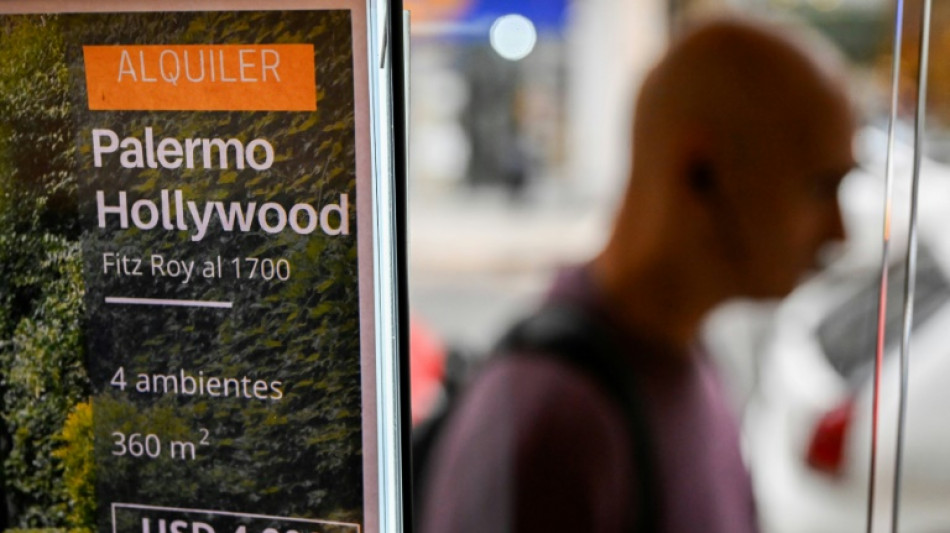
In distorted Buenos Aires rental market, it's dollar vs. peso / Photo: Luis ROBAYO - AFP

 India stirs up its gastronomy with French cooking schools

 Williams, Santos lead Bears over Patriots

 China's first AI film hits cinemas but ticket sales lag

 Barcelona aiming to put Real Madrid out of sight in Clasico

 Taiwan shuts down as Typhoon Champi approaches
 370 books in 20 months: S.African author defends her use of AI

 76ers rally to stun Cavs in James's first home game for Philadelphia

 How are Ukraine strikes, Mideast war driving US fuel prices?

 Colombia's Indigenous Guard up in arms over new president's agenda

 From tech giants to anonymous nonprofits, the biggest donors in US midterms

 Israel's far-right Ben Gvir seeks new ground in election

 Trump slams NBA's LeBron James for national anthem actions

 Australia sanctions North Koreans over 'fraudulent' IT work, cybercrime

 UK singer-songwriter Raye wins Mercury Prize for second album

 Antonelli needs ‘perfect weekend’ to realise title dream

 Reclaiming the walls in a former Salvadoran gang hotspot

 Musk wants to merge SpaceX and Tesla: Here's what to know

 Musk's wants to merge SpaceX and Tesla: Here's what to know

 Hashimoto sweeps to gymnastics world all-around title

 Super Bowl MVP Walker returns to Seattle with unbeaten Chiefs

 Red Bull advisor Marko slams Horner memoir as 'collection of untruths'

 France reports first human Shamonda virus case, says no health risk

 Rekindled Gucci desirability fails to light flame under Kering sales

 Thousands rally as Serbia heads to pivotal poll

 Marathon star Aga banned six years for doping and misleading investigation

Dollar-wielding foreigners living it up in Buenos Aires while locals scrape by; Argentina's sky-high inflation and weakening currency has yielded a schizophrenic rental market -- a bargain for some, a curse for others.
Ordinarily, a middle-class couple like anthropologist Martina Campos Lopez, 33 and her computer technician husband Bruno Suarez, 43, would top rental agents' lists of eligible tenants.
But they earn in pesos -- a currency trading at 488 to the dollar on the black market, where most people do their trading.
More than a year ago, the couple had to give up their apartment in anticipation of a price hike. They have been unable to find another, and were forced to move in with Lopez's mother. With their toddler.
"The most difficult is this feeling of being like a child again, without independence," Lopez said as she showed AFP around the small house.
"Our life is on pause. A temporary measure has become permanent. It is discouraging," she said.
A room the couple uses as a bedroom is packed to the brim with household items from a former life: a coffee maker, microwave, a fan, a fridge. Boxes are stacked high in the bathroom.
People such as Lopez are falling ever further behind as Argentina contends with inflation topping 100 percent year-on-year, and a fast-devaluing peso.
Previously, Lopez and her husband spent half their income on rent. But today, "even with 70 percent, we cannot find anything."
Property owners are not interested in receiving rent in pesos, never knowing what the rate will be in just a week, never mind a year.
Property agent Fernanda Ledesma says her company has no peso-based property rentals on the books.
"And when a new property comes in, it is snatched up in just hours. People are desperate, they don't even ask to see (the property)" in person, she told AFP.
- 'A time bomb' –
A law passed in 2020 with the aim of protecting tenants, may have inadvertently made matters worse.
Adopted at a time inflation was 36 percent, it limited rent increases to one per year and determined a minimum period of three years per contract.
Alejandro Bennazar, president of the Argentine Real Estate Chamber, said leases that expire at the end of the first three-year period, in mid-2023, "will jump 100 percent" based on a formula in the law that takes into account wage adjustments and inflation.
This would cut off many more potential tenants.
"It is a time bomb," said Bennazar.
In such circumstances, many owners are opting to leave their properties standing empty.
One of them is German Matienzo, who blames the price freeze.
"The fact that over the course of a year you cannot make adjustments when you have inflation of around 130 percent... this means the monthly income is depreciating abysmally from one month to the next."
Others rent informally to acquaintances, often with exorbitant conditions attached.
Yet more owners simply sell, causing in an oversupply of housing stock and a drop in prices -- usually set in dollars, leaving them out of reach of most.
"This is the worst housing crisis in 30 years," said Gabriel Mraida, president of the Buenos Aires municipality's Institute of Housing.
The institute estimates there are about 130,000 empty properties in the city.
According to income tax data "there are some 70,000 registered rental housing units in the city, but... about 500,000 households are tenants, just to give you an idea" of the scale of informal rental, he told AFP.
- In London, 'a shoebox' –
Those with dollars, however, have no problems finding a roof.
Jamie Larson, a 29-year-old digital nomad from New Zealand rents a furnished apartment with a panoramic view in the popular tourist neighborhood of Palermo.
In London, he said, "paying the price that I'm paying here, I'd be living in a shoe box. But here I can actually live in my own place, have my own space."
But he is not without a certain sense of guilt.
"I think it's absolutely insane when you look at the salaries that a lot of people are earning here, and now there is this expectation of paying in dollars... It's turning into a situation where locals can't even afford to live in their own city, which I just think is absolutely ridiculous."
In a bid to lighten the burden, the city has started making available zero-interest moving loans for people who manage to find somewhere to rent.
"There are no magic solutions, we have to stabilize the economy, and meanwhile stimulate supply and provide relief," said Mraida.
M.AbuKhalil--SF-PST