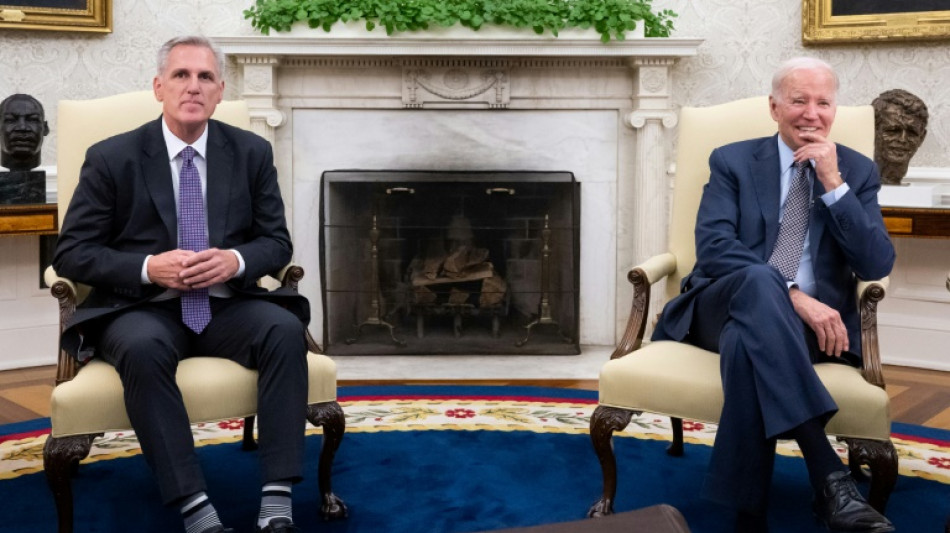
US debt ceiling deal: the key takeaways / Photo: SAUL LOEB - AFP/File

 South Korea proposes holding border talks with North

 Ukraine's young figure skaters twizzle on despite Russian threat

 Asian football endorses Infantino re-election as FIFA president

 Complete Kane hopes for 'special night' as Ballon d'Or rumours swirl

 Rooney calls United squad 'selfish babies' after Fernandes criticism

 Teddy Wilson, son of World Cup-winner David, gets Wallabies call-up

 New Zealand military chief resigns over 'inappropriate relationship'

 Man Utd's Carrick on borrowed time, free-scoring Brighton face Liverpool

 Asian stocks head into weekend on a low as tech extends losses

 'Generational rage': Young Europeans fight to be heard

 Lula, Bolsonaro to clash once more before Brazil vote

 Dressed to kill: Haircuts cap menacing look of Japan's yakuza

 Napa Valley's wineries feel Trump's tariff squeeze

 Venezuela protests demand return of Nobel winning leader Machado

 Marquez tops incident-packed opening practice for Australian MotoGP

 New York votes to ban Central Park horse carriages after decades of debate

 Australia face selection headaches after 'shambolic' South Africa defeat

 Around 150,000 rally in Belgrade as Serbia heads to pivotal poll

 Hamilton sets sights on racing in African grand prix

 Bournemouth hammer 10-man Milan, Juventus denied at the death

 Judge orders Trump to give deposition in BBC lawsuit by Dec 11

 'Fake' pollsters hit US midterms

 Global markets retreat as tech mood sours, oil prices jump

 Juventus denied at the death, Sunderland make point in Poland in Europa League

 Tens of thousands rally as Serbia heads to pivotal poll

President Joe Biden and House Republicans have reached a deal in principle to raise the government's debt ceiling and avert a devastating default.
Here, AFP details the key takeaways from the agreement, which still needs to be approved by a divided Congress in a vote on Wednesday.
- Did either side win? -
After days of long, difficult talks, the deal allows both sides to claim a victory of sorts. Biden called it a "compromise" while Republican House speaker Kevin McCarthy described it as "worthy of the American people."
The text has yet to be published and the agreement will be the subject of intense scrutiny and debate in the coming days.
Sources and reports suggest that some demands from both camps were not accepted, such as the elimination of certain tax loopholes requested by Democrats, and the repeal of clean energy tax credits sought by Republicans.
- The crux of it -
Sources close to the negotiations say the deal raises the $31.4 trillion debt ceiling for two years, meaning Biden will crucially not need to negotiate it again before the 2024 presidential election.
The tentative deal also places limited curbs on federal spending that will please some Republicans, but it does not deliver the big cuts that right-wingers wanted and which progressive Democrats would have balked at.
- Spending -
The deal holds non-military spending roughly flat for the 2024 fiscal year from this year. It also limits the increase by one percent for 2025, according to sources familiar with the negotiations.
The agreement preserves plans by the Biden administration to increase spending for the military and veterans in line with inflation as well.
- IRS clawback -
The deal also pares back funds allocated for the expansion of the Internal Revenue Service (IRS). Last year, Congress approved $80 billion for the IRS to boost tax enforcement. The debt ceiling agreement would cut $10 billion.
- Unspent Covid money -
The tentative deal would also take back some funding that Congress allocated for the coronavirus pandemic but did not spend. A source close to the negotiations estimated that it could amount to tens of billions of dollars.
No changes will be made to Medicaid, the government's health insurance program for the most disadvantaged Americans.
- Work requirements -
The tentative deal purports to increase work requirements for people who are receiving federal food stamps or on family welfare, in a victory for the Republican side.
It is set to raise the age at which childless adults will be required to work to receive food stamps from 49 to 54. As a concession to Democrats, the deal is expected to relax the requirements for veterans and the homeless.
D.Qudsi--SF-PST