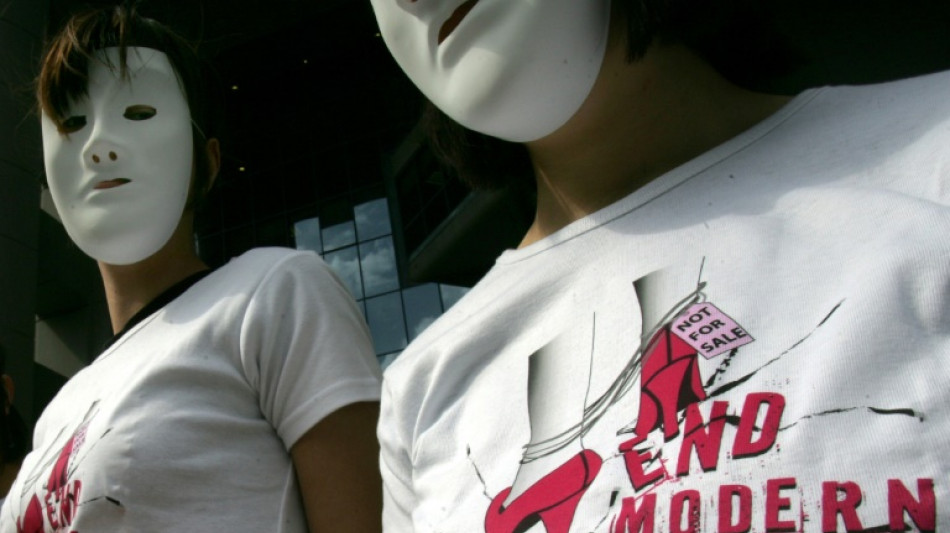
'Modern slavery' most common in North Korea and Eritrea: study / Photo: LOUISA GOULIAMAKI - AFP

 Netanyahu orders West Bank closure as attack wounds Israelis before election
 Asian stocks mixed ahead of weekend as tech recovers early losses
 How five Boeing 777s linked Madagascar's power elite to Iran
 South Korea proposes holding border talks with North
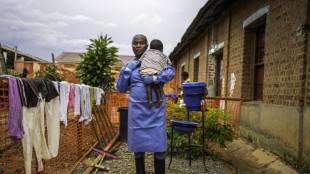
 Ukraine's young figure skaters twizzle on despite Russian threat

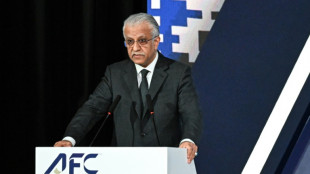 Asian football endorses Infantino re-election as FIFA president
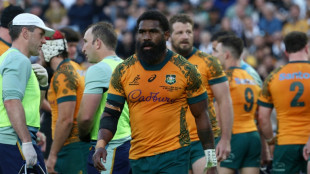
 Complete Kane hopes for 'special night' as Ballon d'Or rumours swirl
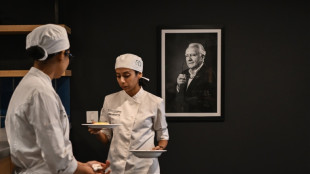
 Rooney calls United squad 'selfish babies' after Fernandes criticism

 Teddy Wilson, son of World Cup-winner David, gets Wallabies call-up
 New Zealand military chief resigns over 'inappropriate relationship'

 Man Utd's Carrick on borrowed time, free-scoring Brighton face Liverpool
 Asian stocks head into weekend on a low as tech extends losses

 'Generational rage': Young Europeans fight to be heard

 Lula, Bolsonaro to clash once more before Brazil vote
 Dressed to kill: Haircuts cap menacing look of Japan's yakuza
 Napa Valley's wineries feel Trump's tariff squeeze

 Venezuela protests demand return of Nobel winning leader Machado
 Marquez tops incident-packed opening practice for Australian MotoGP

 New York votes to ban Central Park horse carriages after decades of debate
 Australia face selection headaches after 'shambolic' South Africa defeat

 Around 150,000 rally in Belgrade as Serbia heads to pivotal poll

 Hamilton sets sights on racing in African grand prix
 Bournemouth hammer 10-man Milan, Juventus denied at the death
 Judge orders Trump to give deposition in BBC lawsuit by Dec 11
 'Fake' pollsters hit US midterms

North Korea, Eritrea and Mauritania have the highest prevalence of modern slavery in the world, according to the 2023 Global Slavery Index published Wednesday, which noted a "worsening" situation globally since its last survey five years earlier.
The report said an estimated 50 million people were "living in situations of modern slavery" in 2021, an increase of 10 million over 2016, when the problem was last measured.
The figure includes some 28 million people in forced labour and 22 million living in a forced marriage.
The situation is worsening "against a backdrop of increasing and more complex armed conflicts, widespread environmental degradation" and impacts from the coronavirus pandemic, among other factors, the investigation said.
Compiled by the human rights charity Walk Free, the report defines modern slavery as encompassing "forced labour, forced or servile marriage, debt bondage, forced commercial sexual exploitation, human trafficking, slavery-like practices, and the sale and exploitation of children."
Slavery's core principle entails "the systematic removal of a person’s freedom" -- from the right to accept or refuse labour to the liberty to determine if, when and whom to marry.
By this benchmark, reclusive and authoritarian North Korea has the highest prevalence of modern slavery (104.6 per 1,000 population), according to the report.
It is followed by Eritrea (90.3) and Mauritania (32), which in 1981 became the last country in the world to make hereditary slavery illegal.
The 10 countries with the highest prevalence of modern slavery have some common characteristics, including "limited protections for civil liberties and human rights".
Many of the countries are in "volatile" regions experiencing conflict or political instability, or home to a large populaton of "vulnerable people" such as refugees or migrant workers.
- 'Mirror held to power' -
Also in the top 10 globally were Saudi Arabia, the United Arab Emirates and Kuwait, where migrant workers' labour rights are restricted by the "kafala" sponsorship system.
Other countries in the top 10 are Turkey, "which hosts million of refugees from Syria", Tajikistan, Russia and Afghanistan.
While forced labour is more common in low-income countries it is "deeply" connected to demand from higher-income countries, the report said, noting that two-thirds of all forced labour cases are linked to global supply chains.
The report said G20 countries -- made up of the EU and the world's 19 top economies -- are currently importing $468 billion worth of goods that are at risk of being produced with forced labour, up from $354 billion in the previous report.
Electronics remain the highest value at-risk product, followed by garments, palm oil and solar panels, in a sign of high demand for renewable energy products.
"Modern slavery permeates every aspect of our society. It is woven through our clothes, lights up our electronics, and seasons our food," the group's founding director Grace Forrest said.
"At its core, modern slavery is a manifestation of extreme inequality. It is a mirror held to power, reflecting who in any given society has it and who does not," she added.
D.Qudsi--SF-PST