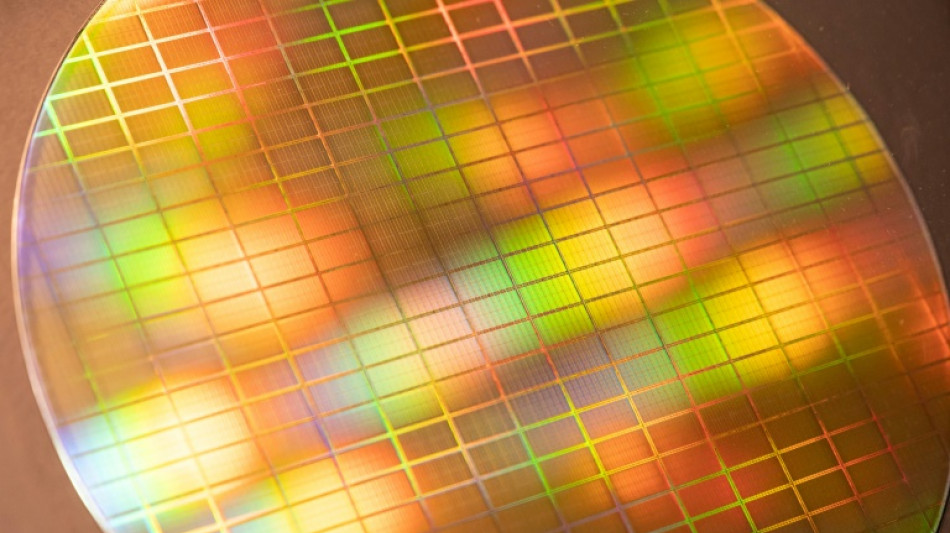
China says US chipmaker Micron failed national security review / Photo: Yuichi YAMAZAKI - AFP/File

 Netanyahu orders West Bank closure as attack wounds Israelis before election

 Asian stocks mixed ahead of weekend as tech recovers early losses

 How five Boeing 777s linked Madagascar's power elite to Iran

 South Korea proposes holding border talks with North

 Ukraine's young figure skaters twizzle on despite Russian threat

 Asian football endorses Infantino re-election as FIFA president

 Complete Kane hopes for 'special night' as Ballon d'Or rumours swirl

 Rooney calls United squad 'selfish babies' after Fernandes criticism

 Teddy Wilson, son of World Cup-winner David, gets Wallabies call-up

 New Zealand military chief resigns over 'inappropriate relationship'

 Man Utd's Carrick on borrowed time, free-scoring Brighton face Liverpool

 Asian stocks head into weekend on a low as tech extends losses

 'Generational rage': Young Europeans fight to be heard

 Lula, Bolsonaro to clash once more before Brazil vote

 Dressed to kill: Haircuts cap menacing look of Japan's yakuza

 Napa Valley's wineries feel Trump's tariff squeeze

 Venezuela protests demand return of Nobel winning leader Machado

 Marquez tops incident-packed opening practice for Australian MotoGP

 New York votes to ban Central Park horse carriages after decades of debate

 Australia face selection headaches after 'shambolic' South Africa defeat

 Around 150,000 rally in Belgrade as Serbia heads to pivotal poll

 Hamilton sets sights on racing in African grand prix

 Bournemouth hammer 10-man Milan, Juventus denied at the death

 Judge orders Trump to give deposition in BBC lawsuit by Dec 11

 'Fake' pollsters hit US midterms

US semiconductor giant Micron has failed a national security review, China's cybersecurity watchdog said Sunday, telling operators of "critical information infrastructure" to stop buying its products.
It marked the latest escalation in the bitter chip war between the United States and China, with Washington looking to cut off Beijing's access to cutting-edge semiconductors.
Chinese authorities had launched a review in March of products sold in the country by Micron, one of the world's major chip manufacturers.
Micron's products "have relatively serious potential network security issues, which pose a major security risk to China's critical information infrastructure supply chain and affect China's national security", the cybersecurity administration said in a statement.
"Operators of critical information infrastructure in China should stop purchasing Micron products."
China's broad definition of critical information infrastructure includes sectors ranging from transport to healthcare.
About 10 percent of Micron's $30.8 billion annual revenue last year came from China, according to company data.
But a large portion of Micron products sold in the country were bought by foreign manufacturers, analysts had said earlier, and it was not clear if the cybersecurity watchdog's decision affects sales to foreign buyers.
AFP has reached out to Micron for comment on the cybersecurity administration's announcement.
China in 2021 announced rules to protect critical information infrastructure with stricter requirements over data security.
It has recently also strengthened the enforcement of its data security and anti-espionage laws.
- 'Bullying tactics' -
The chip war between Beijing and Washington escalated last year when the United States imposed restrictions on China's access to high-end chips, chipmaking equipment and software used to design semiconductors.
Washington also blacklisted Chinese firms, including Micron rival Yangtze Memory Technologies Co Ltd.
Washington cited national security concerns, and said it wanted to prevent tech that could help develop advanced military equipment from being acquired by China's armed forces and intelligence services.
The United States imposed targeted controls on the ability of domestic industry leaders to sell their products overseas.
It has also sought to persuade key allies to follow suit.
The Netherlands and Japan -- both leading manufacturers of specialised semiconductor technology equipment -- have recently announced new restrictions on exporting certain products, but without naming China.
Beijing has slammed the moves as "US bullying tactics" and accused Washington of "technological terrorism", vowing that such controls will only strengthen its resolve to achieve self-reliance in the sector.
The development of a robust domestic semiconductor industry has been a longstanding goal of the Chinese government, which has invested billions of dollars in domestic chip firms.
Chips are the lifeblood of the modern global economy, powering everything from cars to smartphones, and they are forecast to become a $1 trillion industry globally by 2030.
Nowhere is their essential nature more visible than in China, the world's second-largest economy, which relies on a steady supply of foreign chips for its huge electronics manufacturing base.
In 2021, China imported semiconductors worth $430 billion, more than it spent on oil.
L.AbuAli--SF-PST