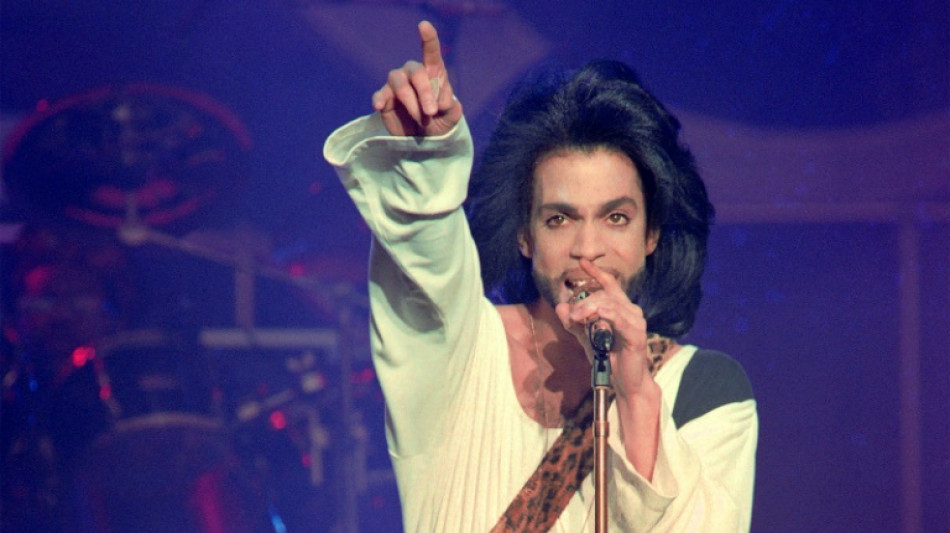
US Supreme Court rules Warhol image violated photo copyright / Photo: Bertrand GUAY - AFP

 Waze rejects Malaysia's data security claims after civil servant ban
 'Call of Duty' seeks to win back fans with warfare spectacle

 Volvo Cars shares plunge on losses, job cuts
 France braces for new protests as Macron seeks to restore order

 Kering shares tumble as Gucci fails to reassure investors

 West Bank attack wounds 5 as Israel PM cancels events
 Ahead of APEC summit, Trump comes knocking on Kim's door

 Emergency nurseries rescue DR Congo's Ebola orphans

 Bezzecchi tops Australian MotoGP practice as wallaby hops onto track
 Under-threat Ospreys bet on new ground and Australian 'stardust'

 India stirs up its gastronomy with French cooking schools
 Williams, Santos lead Bears over Patriots
 China's first AI film hits cinemas but ticket sales lag

 Barcelona aiming to put Real Madrid out of sight in Clasico

 Taiwan shuts down as Typhoon Champi approaches

 370 books in 20 months: S.African author defends her use of AI
 76ers rally to stun Cavs in James's first home game for Philadelphia
 How are Ukraine strikes, Mideast war driving US fuel prices?
 Colombia's Indigenous Guard up in arms over new president's agenda

 From tech giants to anonymous nonprofits, the biggest donors in US midterms
 Israel's far-right Ben Gvir seeks new ground in election

 Trump slams NBA's LeBron James for national anthem actions

 Australia sanctions North Koreans over 'fraudulent' IT work, cybercrime

 UK singer-songwriter Raye wins Mercury Prize for second album

 Antonelli needs ‘perfect weekend’ to realise title dream
An Andy Warhol print of the late pop star Prince violated the copyright of the photographer who took the original image, the US Supreme Court said Thursday, in a ruling with important implications for the art market.
In a case that spiralled around the hot-button issue of whether a derivative work of art is a mere copy or fully transformative, the court ruled that celebrity photographer Lynn Goldsmith should have earned a fee when the Andy Warhol Foundation licensed "Orange Prince," a silk screen print image of Prince, for use by Vanity Fair magazine.
In their 7-2 ruling, the court majority skirted the argument long swirling around Warhol's creations of whether "Orange Prince" stood alone as a work of art even though it was based on Goldsmith's photo.
Instead, it focused on how the Warhol Foundation used it: making money licensing it to Vanity Fair as a portrait of Prince, in the same way other magazines used Goldsmith's identically posed black and white photograph.
In that instance, the court said the Foundation's commercial licensing arrangement was not a "fair use" of her work, and that Goldsmith should have been paid.
While narrow, that view could have broad ramifications as technologies, especially generative artificial intelligence, make adapting and altering original works and styles easy, threatening the livelihoods of artists.
- Is it original art? -
There was no judgment against Warhol himself, who died in 1987 after a career of transforming photographs of celebrities and objects into prints that helped define the pop art of the 1950s and 1960s.
In 1984 Goldsmith was paid a one-time use fee of $400 when Vanity Fair commissioned the artist to create a purple-tinted image of Prince that was derived from one of her photos.
But after Prince died in 2016, Warhol's foundation licensed to Vanity Fair another image of the musician -- the "Orange Prince" -- made from the same Goldsmith photo.
The Foundation was paid $10,250 to license the image to Conde Nast, the publisher that owns Vanity Fair, but Goldsmith got nothing.
She sued, claiming her copyright on the original photo was infringed.
In the high court's hearing on the case in October 2022, the Foundation argued in court that Warhol's work was "transformative" -- an original piece infused with a new meaning or message.
That, the Foundation said, was permitted under what is known as the "fair use" doctrine in copyright law.
Lisa Blatt, a lawyer for Goldsmith, disagreed, arguing that the initial payment for the photograph recognized her rights.
"Warhol got the picture in 1984 because Miss Goldsmith was paid and credited," Blatt said.
She said ruling against Goldsmith would "decimate" the art of photography by killing the photographer's incentive to create.
If the court backed Vanity Fair, Blatt added, "Copyrights will be at the mercy of copycats."
In her majority opinion, Justice Sonia Sotomayor stressed that they were not judging Warhol's work used in other situations.
In this specific situation, she wrote, "Goldsmith's original works, like those of other photographers, are entitled to copyright protection, even against famous artists."
Fair use of an image or other work of art is acceptable if the use "has a purpose and character that is sufficiently distinct from the original," the court said.
In the "Orange Prince" case, however, both Goldsmith and the Andy Warhol Foundation had the same commercial purpose in the licensing of the image, it said.
- 'Avatar of transformative copying' -
In a sharply worded dissent, however, Justice Elena Kagan said her fellow justices did not comprehend, or care, about Warhol's artistic achievement.
All artists borrow, copy and transform to an extent, she said.
"Andy Warhol is the avatar of transformative copying," she added.
Ruling in favor of Goldsmith's copyright claim "will stifle creativity of every sort," she said. "It will impede new art and music and literature."
The Andy Warhol Foundation said it disagreed with the ruling. But it welcomed the fact that the court did not question the legality of Warhol's "Prince" series or other works.
S.Abdullah--SF-PST