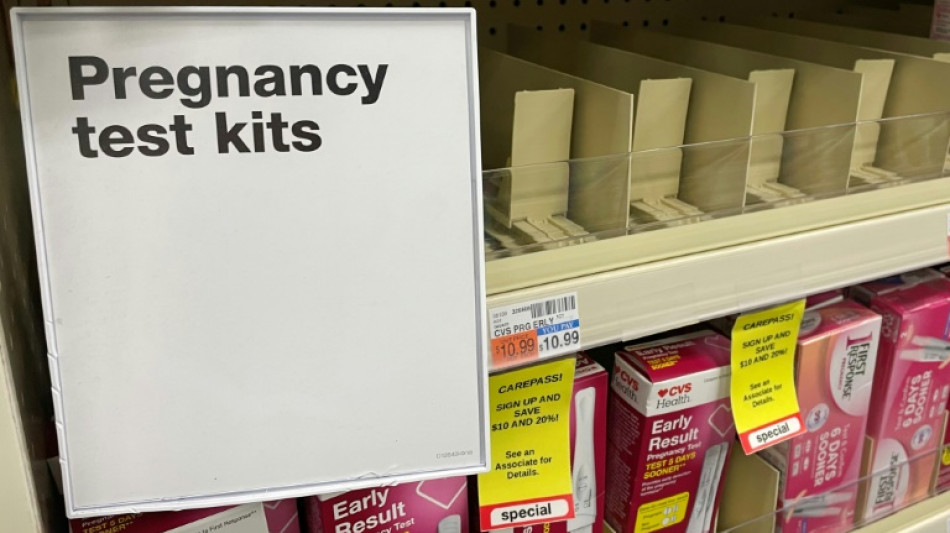
Early blood test may unravel secrets of pregnancy loss / Photo: Jim WATSON - AFP/File

 Melania Trump says secured ceasefire in Ukrainian city of Oleshky

 Carrick 'confident' he can turn around Man Utd slump

 PSG v Lyon French Ligue 1 game postponed due to Paris protests

 Meghan Markle 'distressed' over claims father had child abuse images

 Gunman kills one, wounds four in town outside Paris

 France to deploy 70,000 police ahead of new protests

 Mekies hails Verstappen as Red Bull's driving force amid revival

 Tanker with Russian diesel heads to New York under Trump deal

 New centre puts focus on Portuguese dictator Salazar's legacy

 Oil nears $115 with stocks mixed on earnings, AI

 Asian football endorses Infantino re-election in apparent U-turn

 Ukraine says two soldiers died after arrested girl sent Russian poison

 New Greece law bans social media for under-15s

 Netanyahu orders West Bank closure as attack wounds Israelis before election

 Asian stocks mixed ahead of weekend as tech recovers early losses

 How five Boeing 777s linked Madagascar's power elite to Iran

 South Korea proposes holding border talks with North
 Ukraine's young figure skaters twizzle on despite Russian threat

 Asian football endorses Infantino re-election as FIFA president

 Complete Kane hopes for 'special night' as Ballon d'Or rumours swirl

 Rooney calls United squad 'selfish babies' after Fernandes criticism

 Teddy Wilson, son of World Cup-winner David, gets Wallabies call-up

 New Zealand military chief resigns over 'inappropriate relationship'

 Man Utd's Carrick on borrowed time, free-scoring Brighton face Liverpool

 Asian stocks head into weekend on a low as tech extends losses

A blood test taken after a miscarriage suffered as early as week five of pregnancy can help explain why it occurred and in some cases lead to preventative treatments, Danish researchers say.
One in 10 women experience pregnancy loss, with the number even higher in countries where pregnancies increasingly occur later in a woman's childbearing years.
Danish gynaecologist Henriette Svarre Nielsen and her team of researchers recently published a study in the British journal The Lancet showing that a blood sample taken from the mother soon after a miscarriage as early as the fifth week of pregnancy can determine whether the foetus had a chromosome anomaly.
In Denmark, such tests are usually only offered after a woman has suffered three miscarriages, and only if they occurred after the tenth pregnancy week.
"This is 2023. We are way beyond just counting as the criteria" to investigate why somebody may be prone to pregnancy loss, Svarre Nielsen of Hvidovre hospital near Copenhagen told AFP.
- Finding anomalies, predicting risk -
Now, as part of an ongoing study, all women who have suffered a miscarriage and visited the Hvidovre hospital emergency room are offered the blood test.
More than 75 percent of them have accepted so far.
"For me it was obvious I would do it. It helps you understand," said one woman who spoke to AFP on condition of anonymity, since she hasn't revealed her pregnancy loss to all of her family and friends.
The blood test is immediately sent to the hospital lab.
The foetus' DNA is then isolated, sequenced and analysed to see if it carries a chromosome anomaly, which is the case in about 50 to 60 percent of miscarriages.
Doctors can then determine whether some of the anomalies are more serious than others.
"They would also be able to predict the risk" of future miscarriages, lab technician Lene Werge explained, demonstrating a DNA sample with extra copies of chromosome 21, which is linked to Down Syndrome.
If no anomalies are found, doctors then launch a meticulous search for answers.
"We can start to ask the question, 'Is it this? Is it this? Is it this?'," Svarre Nielsen said.
Pregnancy loss can be the result of a hormonal imbalance, endocrinal illnesses, coagulation problems or lifestyle issues.
If an explanation is found, doctors can determine the risks and devise a treatment plan.
Launched in 2020, the project -- dubbed COPL for Copenhagen Pregnancy Loss -- is still underway and is expected to yield a unique database on a wide range of illnesses thanks to the large cohort, numbering 1,700 women so far.
"We will have good data background to actually answer questions properly about pregnancy loss, reproduction, but also women's health in general," Svarre Nielsen said.
- 'Make the loss matter' -
A doctor with more than 20 years' experience, Svarre Nielsen specialised early on in reproductive health and is keen to develop treatments.
"Pregnancy loss is something that's very common, 25 percent of all pregnancies end in a pregnancy loss," she said.
"And even though it's been so common for many, many years, the only focus has been on emptying the uterus after the loss."
She lamented that more effort had not been made to find explanations or support the mental health of couples after a miscarriage.
Rikke Hemmingsen, who suffered three miscarriages before giving birth to two children, told AFP she wished the project would have been around to help her.
"We can use the losses for something else. So the project gives me hope that fewer women have to go through what we went through," she said.
"It makes all the grief and all the sadness of every pregnancy loss matter."
Pregnancy loss is often not discussed publicly, and when it is the reactions can be awkward.
"Everyone saying 'this is normal' doesn't make it more normal, or more or less sad to the one it happens to," Hemmingsen said.
The taboo can also make it harder for a couple to get proper treatment.
"We need to start talking more openly about it. Because otherwise, I wouldn't be able to tell people that there are specialists... who can help you," the 39-year-old said.
According to Svarre Nielsen, the study's findings could ultimately help prevent five percent of the 30 million miscarriages seen worldwide annually.
R.Shaban--SF-PST