
W. House says tech giants have 'moral' duty on AI / Photo: Lionel BONAVENTURE - AFP

 Macron condemns 'racist terrorist attack' after deadly shooting near Paris

 Shiffrin sidesteps slalom in 'exploration' season
 Bayern Munich coach Kompany in hospital after collapsing: club

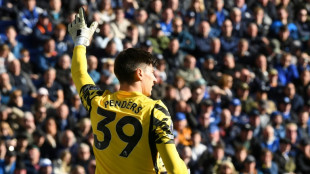 Alonso sees Courtois similarities in Chelsea's Penders

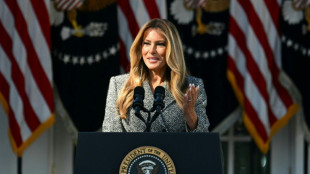 Melania Trump announces truce in Ukrainian city 'on brink of disaster'

 Saka to be carefully managed after latest injury setback, says Arteta

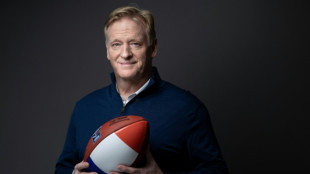 Goodell says NFL's France debut 'just the beginning'
 Singapore widens haze probe to local firms linked to Indonesian fires

 Hundreds of Syrians protest repeated Israeli incursions
 El Salvador sends troops to Haiti to find 4 missing soldiers

 Liverpool must go 'full gas' despite injury issues, says Iraola
 Oil hits $115 with stocks mixed on earnings, AI

 Casualties feared as multi-storey building collapses in Nairobi

 Man Utd defeat to Como 'unacceptable', says Carrick
 Hurzeler 'focused' on Brighton job despite Man Utd links

 Hammer blow for Kenya as world marathon champ Jepchirchir suspended for doping
 Latin America's right-wing swing looms large over nature summit

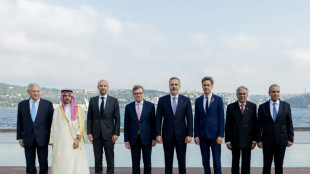
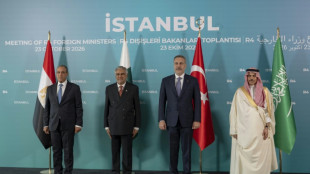 European, Mideast foreign ministers hold talks in Istanbul
 World marathon champion Peres Jepchirchir suspended for doping: AIU

 Romania blames Russia for new deadly attack on ship
 Waze rejects Malaysia's data security claims after civil servant ban
 'Call of Duty' seeks to win back fans with warfare spectacle

 Volvo Cars shares plunge on losses, job cuts
 France braces for new protests as Macron seeks to restore order

 Kering shares tumble as Gucci fails to reassure investors
The White House on Thursday told the CEOs of US AI giants that they have a "moral" responsibility to protect society from the potential dangers of artificial intelligence.
Vice President Kamala Harris had summoned the heads of Google, Microsoft, OpenAI and Anthropic to strategize about the impact of AI, afraid that companies are running blindly into technology that could pose serious harms to society.
Harris told the CEOs, which included Sundar Pichai of Google and Satya Nadella of Microsoft, that they have a "moral" duty to safeguard society from AI's potential dangers.
Companies "must comply with existing laws to protect the American people" as well as "ensure the safety and security of their products," Harris said in a statement after the talks.
US President Joe Biden has urged Congress to pass laws setting stricter limits on the tech sector, but these efforts have little chance of making headway given political divisions.
Harris said that she and Biden, who briefly dropped by the meeting, backed "advancing potential new regulations and supporting new legislation" when it comes to AI.
The lack of rules has given Silicon Valley freedom to put out new products rapidly, and stoked fears that AI technologies will wreak havoc on society before the government can catch up.
"It's good to try to get ahead of this. It's definitely going to be a challenge but it's one I think we can handle," OpenAI CEO Sam Altman told reporters before the meeting.
His company, supercharged by billions of dollars from Microsoft, took the lead in making AI vailable to everyday consumers, with the release of ChatGPT, which caused a global sensation five months ago.
Microsoft quickly integrated the AI chatbot's abilities to crank out natural-seeming written responses from short prompts into its Bing search engine and other products.
The Windows-maker on Thursday expanded public access to these generative artificial intelligence programs, despite criticism and the meeting at the White House.
Risks from AI include its potential uses for fraud, with voice clones, deep-fake videos and convincingly written messages.
It is also a threat to white collar jobs, especially, for now, lower-skilled back-office work.
A range of experts in March urged a pause in the development of powerful AI systems to allow time to make sure they are safe, though a halt was widely seen as unlikely.
The White House used Thursday's meeting to announce new actions to "promote responsible American innovation in artificial intelligence."
This included directing $140 million to expand AI research and setting up an assessment system that would work in cooperation with big tech to "fix issues" in problematic AI models.
"Don't get your hopes up that this will lead to anything particularly meaningful, but it's a good start," said David Harris, a lecturer at Haas Business School at the University of California, Berkeley.
- Race to the bottom -
Google, Meta and Microsoft have spent years working on AI systems to help with translations, internet searches, security and targeted advertising.
But late last year, San Francisco-based OpenAI thrust generative AI into the public consciousness when it launched ChatGPT, forcing their rivals to answer.
Google has invited users in the United States and Britain to test its AI chatbot, known as Bard, with Facebook-owner Meta pointing to new uses in its ad tech.
And Billionaire Elon Musk in March founded an AI company called X.AI, based in the US state of Nevada, according to business documents.
A top US regulator put AI in the crosshairs ahead of the White House meeting, signaling that the US government would not fall behind when it came to setting up rules and guardrails.
"Can we continue to be the home of world-leading technology without accepting race-to-the-bottom business models and monopolistic control?" Federal Trade Commission chief Lina Khan wrote in a guest essay in the New York Times.
"Yes -- if we make the right policy choices."
The European Union, which already has tough laws against tech on the books, is expected to have AI legislation agreed by the end of the year, with clear rules governing generative AI.
"We don't see this as a race (to regulate). In fact, we're working closely with our EU counterparts," a senior White House official told reporters.
V.AbuAwwad--SF-PST