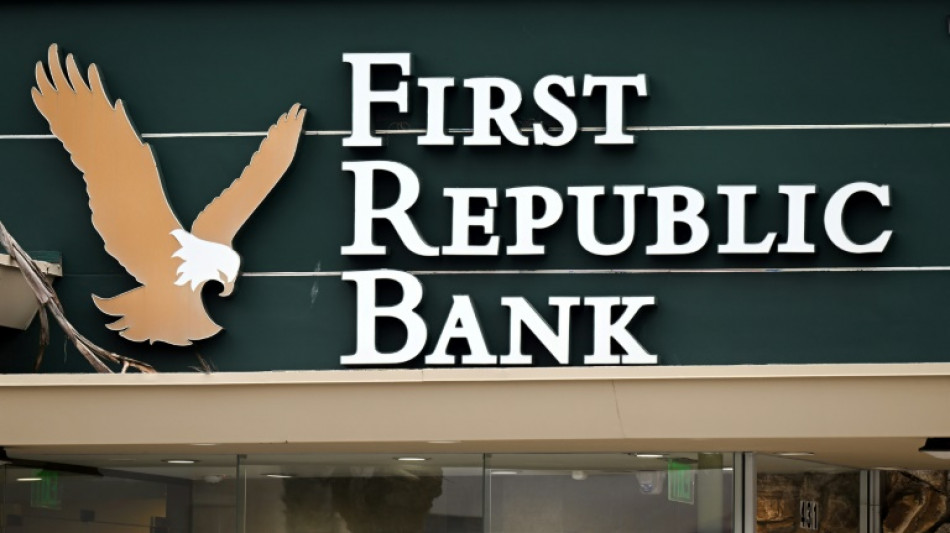
JPMorgan to buy First Republic after regulators seize control / Photo: Patrick T. Fallon - AFP/File

 Rubio urges Cubans to work with CIA, but warns: be discreet
 Leclerc tops times for Ferrari in practice for US Grand Prix

 Lula, Bolsonaro lock horns in final debate before Brazil vote
 Poulter and Hatton leave LIV Golf

 Blakely vaults out of the shadow of Biles for all-around world title

 Oil tops $116 with stocks mixed on earnings, AI

 Trump orders lawsuit to block Alaska Senate result if Republicans lose
 Ebola patient in Nigeria is Swiss, had not visited DR Congo: Bern

 Messi receives top Spanish award from heir to throne

 Macron condemns 'racist terrorist attack' after deadly shooting near Paris

 Shiffrin sidesteps slalom in 'exploration' season

 Bayern Munich coach Kompany in hospital after collapsing: club

 Alonso sees Courtois similarities in Chelsea's Penders

 Melania Trump announces truce in Ukrainian city 'on brink of disaster'

 Saka to be carefully managed after latest injury setback, says Arteta

 Goodell says NFL's France debut 'just the beginning'

 Singapore widens haze probe to local firms linked to Indonesian fires

 Hundreds of Syrians protest repeated Israeli incursions

 El Salvador sends troops to Haiti to find 4 missing soldiers

 Liverpool must go 'full gas' despite injury issues, says Iraola
 Oil hits $115 with stocks mixed on earnings, AI

 Casualties feared as multi-storey building collapses in Nairobi

 Man Utd defeat to Como 'unacceptable', says Carrick

 Hurzeler 'focused' on Brighton job despite Man Utd links

 Hammer blow for Kenya as world marathon champ Jepchirchir suspended for doping

US financial authorities seized California's troubled First Republic Bank on Monday and sold it to JPMorgan Chase, hoping to bring to a close a two-month banking crisis that has spooked the financial system.
First Republic, the second-largest bank by assets to collapse in US history, has been in free fall after disclosing last week that it lost more than $100 billion in deposits in the first quarter.
The San Francisco-based lender has been in turmoil since the March bankruptcies of regional banks Silicon Valley Bank and Signature Bank sparked fears of contagion.
After the bank failed to produce a satisfactory rescue plan and with its stocks continuing to nosedive, the authorities stepped in, soliciting bids last week from potential buyers, and then taking possession of it.
As part of the deal struck early Monday, the California regulator appointed the Federal Deposit Insurance Corporation (FDIC), an agency in charge of guaranteeing bank deposits, as the receiver of First Republic, to be immediately sold to JPMorgan Chase.
The agreement means JPMorgan will recover all of the bank's deposits, as well as "almost" all of its assets, according to a FDIC statement.
The federal agency estimates it will have to pay about $13 billion to cover First Republic's losses, but the bank's 84 branches will be able to reopen Monday as usual.
"Our government invited us and others to step up, and we did," Jamie Dimon, JPMorgan's CEO, said in a statement after the deal was announced.
- Snowball effect -
The government's takeover and sale of First Republic comes two months after the liquidation of Silvergate Bank -- a favorite among the cryptocurrency crowd -- and the swift demise of Silicon Valley Bank (SVB), after it took on excessive interest-rate risk.
New York-based Signature Bank also closed a few days after SVB.
The collapses led to a snowball effect as concerned investors looked for signs of weakness in the broader banking sector in the United States and Europe.
Swiss banking giant Credit Suisse became the highest-profile casualty when it was pushed by regulators to merge with its rival, UBS.
To avert yet another banking collapse, authorities reached a deal with 11 major banks in March to extend a $30 billion lifeline to First Republic.
But this was not enough to reassure investors.
By Friday's close, First Republic was worth only $654 million, down from more than $20 billion at the start of the year, and $40 billion at its peak in November 2021.
At first glance, First Republic appeared to be well-positioned: it was known to have a wealthy clientele who deposited large sums.
But the string of banking defaults rattled customers, and a majority of First Republic's loans were fixed-rate mortgages, which have lost value due to soaring interest rates.
Observers are closely watching for any broader implications of the latest financial institution's collapse.
With its assets standing at $233 billion at the end of March, First Republic is the second-largest bank to fall in US history -- excluding investment banks, such as Lehman Brothers -- after Washington Mutual's bankruptcy during the financial crisis of 2008.
That lender too was acquired by JPMorgan, the largest bank in the United States.
"First Republic was identified as a problem bank as early as mid-March and the announcement of its closure is not a new reason to worry," Nicolas Veron, an economist at the Peterson Institute for International Economics said ahead of the takeover announcement.
"If another bank proved to be fragile, that would be another problem," he added.
Soon after First Republic's seizure was announced, the US Treasury moved to try to allay concerns.
"The banking system remains sound and resilient, and Americans should feel confident in the safety of their deposits and the ability of the banking system to fulfill its essential function of providing credit to businesses and families," a Treasury spokesperson said.
X.Habash--SF-PST