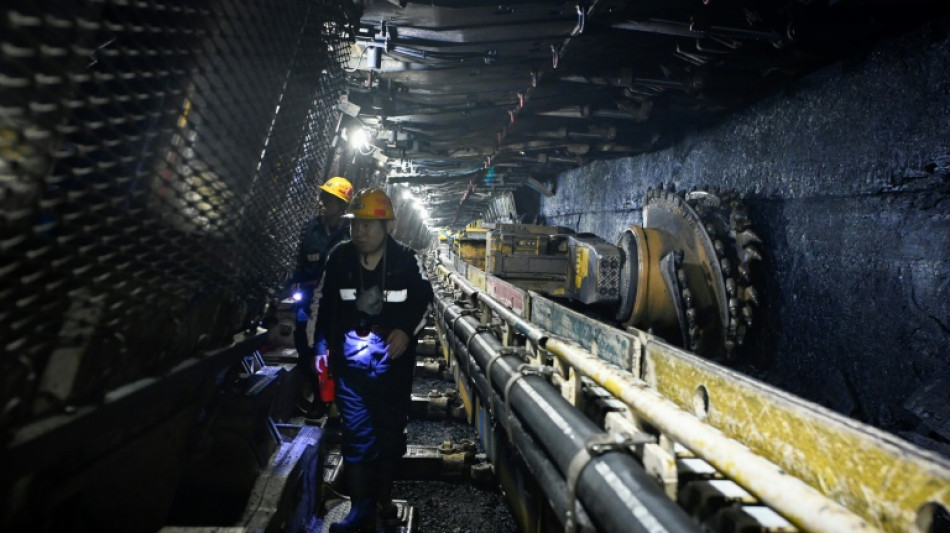
'Smart mines' show coal deeply embedded in China's future / Photo: WANG Zhao - AFP/File

 Tatum delivers as Celtics down winless Knicks

 Romantasy fans ready for sleepless night as 'Court of Thorns and Roses' returns
 De Goede hat-trick as Canada defeat England again

 Rubio urges Cubans to work with CIA, but warns: be discreet

 Leclerc tops times for Ferrari in practice for US Grand Prix

 Lula, Bolsonaro lock horns in final debate before Brazil vote
 Poulter and Hatton leave LIV Golf

 Blakely vaults out of the shadow of Biles for all-around world title

 Oil tops $116 with stocks mixed on earnings, AI

 Trump orders lawsuit to block Alaska Senate result if Republicans lose

 Ebola patient in Nigeria is Swiss, had not visited DR Congo: Bern

 Messi receives top Spanish award from heir to throne

 Macron condemns 'racist terrorist attack' after deadly shooting near Paris

 Shiffrin sidesteps slalom in 'exploration' season

 Bayern Munich coach Kompany in hospital after collapsing: club

 Alonso sees Courtois similarities in Chelsea's Penders

 Melania Trump announces truce in Ukrainian city 'on brink of disaster'

 Saka to be carefully managed after latest injury setback, says Arteta
 Goodell says NFL's France debut 'just the beginning'

 Singapore widens haze probe to local firms linked to Indonesian fires

 Hundreds of Syrians protest repeated Israeli incursions

 El Salvador sends troops to Haiti to find 4 missing soldiers
 Liverpool must go 'full gas' despite injury issues, says Iraola

 Oil hits $115 with stocks mixed on earnings, AI

 Casualties feared as multi-storey building collapses in Nairobi

One hundred metres underground inside a pit in northern China, miners extract lumps of coal with the flick of a finger on a smartphone, as the country tries to drag the traditionally dangerous and dirty work into the digital era.
The Hongliulin "intelligent mine" in coal-belt Shaanxi province is a flagship facility in a drive to modernise China's thousands of coal mines, even as the nation pledges to peak greenhouse gas emissions by 2030.
China is the world's biggest emitter of the pollutants driving climate change, and its promises to curb them are essential to keeping global temperature rises below two degrees Celsius.
But mine digitalisation -- which aims to improve safety and productivity -- shows the continued importance of coal in a country that last year produced nearly 60 percent of its electricity from the fossil fuel.
Smart mines are common in other coal-producing nations like Canada, but China has lagged and now the government is aiming to achieve basic digitalisation of all mines by 2035.
On a tour organised by telecoms giant Huawei -- whose technology underpins the changes at Hongliulin -- AFP journalists saw sensors, smart cameras and 5G relay boxes criss-crossing the facility.
Inside a control room crammed with screens displaying numbers, graphs and images, technical manager Wang Lei said he could monitor the air, temperature and other data in real time.
Digitalisation "has reduced the intensity of our work", 33-year-old electrician Ruan Banlin, who has worked in the mine for 10 years, told AFP.
- Climate change -
Huawei said the new methods had increased output per shift by almost a third.
That's good news for China's energy grid -- but not the planet.
Greenpeace this week reported Beijing has approved a surge in coal power this year, green-lighting as much in the first three months as for the whole of 2021.
"We're seeing a decrease in the number of coal mines while the clustering of production increases along with total output," the NGO's Xie Wenwen told AFP.
Asked about smart mining, Xie said it should be scrutinised closely.
"Obviously the safest thing we can do is leave the coal in the ground. That goes for climate as well as other risks," she said.
According to official figures, China had 4,400 coal mines at the end of 2022.
If it delivers on emissions pledges, those mines would be operating at minimum capacity and at a loss over coming decades, according to Greenpeace.
But Huawei's involvement suggests China is betting on coal retaining its importance in fuel supply for years.
The company -- whose net profit melted 69 percent year-on-year in 2022 -- is diversifying after US sanctions over cybersecurity and espionage concerns hammered its business.
Xu Jun, head of mining digitalisation for Huawei, said many competitors were setting up teams in the field.
"The investment in smart mining solutions is not contradictory to Huawei's investment in clean energy," the firm told AFP.
"Worldwide, coal and clean energy use will co-exist for a long time. The trend of intelligence in related industries is unstoppable."
- 'As safe as the ground' -
Safety is a major concern in the industry, where last year 245 people died in 168 accidents, according to official figures.
This year in February, a mine collapse in northern China killed around 50 people.
At Hongliulin, data on extraction, miner location and danger detection is centralised on a system designed to eliminate problems caused by human error and miscommunication.
Instead of people, robots patrol and inspect the dark and narrow underground corridors.
"It is much better now," said electrician Ruan. "The underground mine is almost as safe as the ground."
The management says the underground team has been cut 40 percent -- though not the overall workforce -- and only essential maintenance miners descend into the pit.
"We aim to achieve the ultimate goal of completely unmanned underground production," said Shi Chao, director of the mine's intelligence department.
Z.AbuSaud--SF-PST