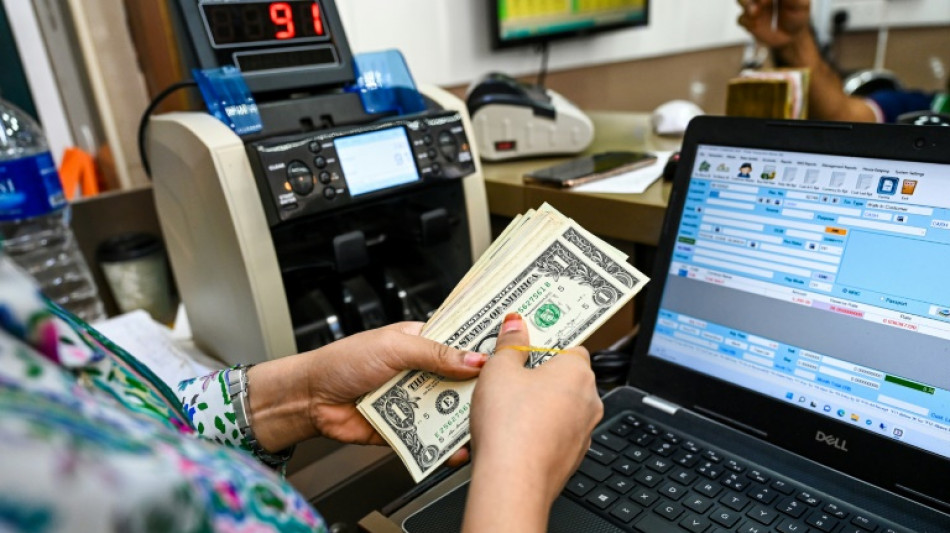
Dominant US dollar faces challenge from emerging currencies / Photo: Roslan RAHMAN - AFP

 Tatum delivers as Celtics down winless Knicks

 Romantasy fans ready for sleepless night as 'Court of Thorns and Roses' returns

 De Goede hat-trick as Canada defeat England again

 Rubio urges Cubans to work with CIA, but warns: be discreet

 Leclerc tops times for Ferrari in practice for US Grand Prix

 Lula, Bolsonaro lock horns in final debate before Brazil vote

 Poulter and Hatton leave LIV Golf

 Blakely vaults out of the shadow of Biles for all-around world title

 Oil tops $116 with stocks mixed on earnings, AI

 Trump orders lawsuit to block Alaska Senate result if Republicans lose
 Ebola patient in Nigeria is Swiss, had not visited DR Congo: Bern

 Messi receives top Spanish award from heir to throne

 Macron condemns 'racist terrorist attack' after deadly shooting near Paris

 Shiffrin sidesteps slalom in 'exploration' season
 Bayern Munich coach Kompany in hospital after collapsing: club

 Alonso sees Courtois similarities in Chelsea's Penders

 Melania Trump announces truce in Ukrainian city 'on brink of disaster'

 Saka to be carefully managed after latest injury setback, says Arteta

 Goodell says NFL's France debut 'just the beginning'

 Singapore widens haze probe to local firms linked to Indonesian fires

 Hundreds of Syrians protest repeated Israeli incursions

 El Salvador sends troops to Haiti to find 4 missing soldiers

 Liverpool must go 'full gas' despite injury issues, says Iraola
 Oil hits $115 with stocks mixed on earnings, AI

 Casualties feared as multi-storey building collapses in Nairobi

As the top global currency, the US dollar has enjoyed decades as the cash of choice for investors -- but it is now facing a growing challenge to that status.
The greenback has been used for almost everything in terms of international trade and global finance, from ordering planes, buying oil, or issuing debt.
But a number of developing economies, particularly China, have been leading a drive against over-reliance on the US currency.
"In many developing countries there is desire to be less dependent on the dollar, particularly on the trade side," said Paola Subacchi, professor of International Economics at the Global Policy Institute at Queen Mary University of London.
On a visit to China in April, Brazilian President Luiz Inacio Lula da Silva asked why "all countries are forced to trade based on the dollar", before signing an agreement with Beijing to provide commercial contracts denominated in yuan and reals.
And Bangladesh announced recently it paid Russia for a nuclear power plant in Chinese yuan, as well as using its own currency for a delivery of liquefied natural gas from France's TotalEnergies.
- Sanctions -
The widely-used dollar gives the United States a big competitive advantage.
Emerging and developing countries are dependent on the movements of the US currency, which influences the price of their imports and their exports.
US-set interest rates also influence the cost of dollar-denominated debt.
But the dollar's dominance has come under the spotlight since the war in Ukraine, which saw Washington and western countries impose sweeping sanctions on Moscow after it invaded Ukraine last year.
"The US uses its dollar hegemony to sanction Russia," said Larry Yang, chief economist at Shenzhen-based First Seafront Fund Management.
"Other countries feel concerned that they might be sanctioned by the US as well, and hence they have decided to opt for more currencies for payment and settlement," he added.
"This change is good for the stability of international trade and it is definitely a long term trend."
China, the world's second-largest economy and Washington's great political rival, has been internationalising its currency for several years.
But its currency is still largely restricted and regulated by the Chinese authorities.
Yang said the internationalisation of the Chinese yuan, also known as RMB, will mean more countries choose the currency for international deals in the future.
"With China's trade volume on a long term rapid ascending trajectory ... the level of RMB internationalisation will increase and there will be more trading partners opt for RMB payment and settlement," he told AFP.
- Politics vs economics -
But others warn any significant move away from the dollar would require a number of key factors to be in place, including a transparent government framework, independent central bank, and investor security.
"Clearly, we're entering a very delicate moment for the world economy, with lots of geopolitical tension and the world splitting into two large poles," said Alessandra Ribeiro, an economist at the Tendencias Consultoria consultancy in Sao Paulo.
But she said proposals against the dollar are often "more political than economic".
Ribeiro also noted that China doesn't have a full market economy.
"Depending on the government's interests, it could artificially devalue the yuan. And if I'm getting paid in yuan, that creates problems for me."
Political or not, the level of foreign exchange reserves held in dollars in central banks has been gradually decreasing.
Reserves of the greenback fell from 71 percent of the total in 1999 to 59 percent in 2021, according to a report from the International Monetary Fund last year.
This was partly down to an increase to 10 percent of reserves in "smaller" currencies, outside of the euro, the yen or the pound.
But the dollar was still the currency used in 42 percent of international trade in April, followed by 33 percent which used the euro, according to international payment system Swift.
The Chinese yuan was used in just two percent of transactions, showing that there is still a long way to go for it to rival the dollar.
"Can we move toward an alternative currency? Yes," said Ribeiro.
"But the entire structure the United States offers in terms of security and institutionality would have to be offered somewhere else."
Y.Shaath--SF-PST