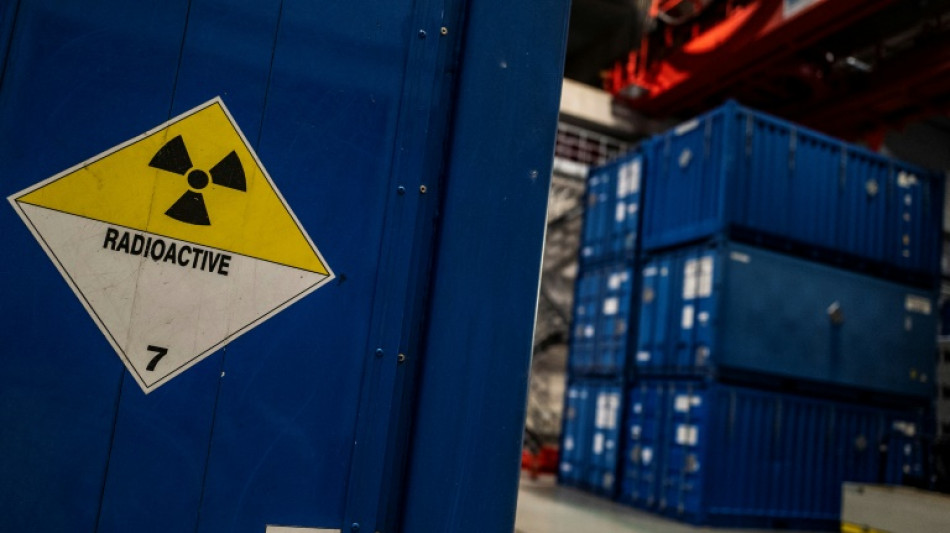
Dismantling Germany's Lubmin nuclear plant, piece by piece / Photo: John MACDOUGALL - AFP

 Security high as France braces for new protests
 White makes winning start as Fiji edge Eddie Jones's Japan
 Lula, Bolsonaro strike calmer tone in final Brazil election debate

 'How is it possible?': Students protest Indonesian haze
 Israel launches major West Bank operation after soldiers killed

 Typhoon Champi knocks out power to thousands in Taiwan

 As Israeli election nears, campaign turns ugly

 Oscar hopeful 'La Bola Negra' offers lessons about communicating, directors say

 Trapped: Soaring fuel costs hurt Maine lobster industry before midterms

 Marc Marquez beats brother Alex to Australian MotoGP pole
 Ebola vaccine trial begins in DR Congo

 Travelling man Wade equals Prem try record

 Rescuers search for seven people in Nairobi building collapse

 Sacha Baron Cohen revives the 'problematic dinosaur' Ali G in new film

 New race in Barcelona tops 17-event '27 IndyCar season
 Neymar backs Flavio Bolsonaro in Brazil election

 Melania Trump says she brokered truce in war-torn Ukrainian city
 Leclerc tops times for Ferrari in opening practice for US Grand Prix

 Bayern Munich coach Kompany in hospital after collapsing

 Signs point to renewed major US military ops against Iran

 European, Mideast foreign ministers push peace and diplomacy at Istanbul talks

 Ex-All Black centre Williams undergoes 'miracle' heart surgery

 Netanyahu launches major West Bank operation after Israeli soldiers killed

 AFP photographer captures striking images from West Bank attack

 Oil hits $116 with stocks mixed on earnings, AI

At a former nuclear power plant near Lubmin on Germany's Baltic coast, workers in the disassembly hall are chopping up a bulky grey section of a pump from inside one of the reactors.
A bandsaw slowly eats its way through the part, cutting it into smaller chunks that will fit in the decontamination units.
Those pieces will be blasted with iron sand, removing a dangerous top layer of material to be packed up and stored away from harm.
In mid-April, Germany's last three nuclear plants will go offline. But as their working life comes to an end, the painstaking task of decommissioning and dismantling the units begins.
The facility near Lubmin, built by East Germany's communist government and also known as the Greifswald nuclear power plant, was closed in 1990 with reunification.
But it will still be several decades before the work here is done.
"These nuclear power plants were built to last forever," said Hartmut Schindel from site manager EWN, so taking the plant apart has been a learning process.
"No one was responsible for the decommissioning in the 1960s" when the plant was first designed, Schindel said.
- 'Massive amount' -
In all, workers at the plant have 1.8 million tonnes of material to sort through and shift.
"It's a massive amount," said Schindel, who first joined the plant in the former East Germany in 1976 and was later responsible for the disposal of nuclear waste.
The vast majority of the volume will be released for reuse after a lengthy administrative process, but a small percentage of contaminated material must be sequestered.
Access to the disassembly area is closely controlled. Workers strip off their clothes, put on standard-issue underwear and a bright orange jumpsuit before they can enter the hall.
Exposure to radiation inside is counted by a personal meter carried in a breast pocket.
Coming out, a cubicle that speaks with a woman's voice checks for contamination, counting down from 20, asking the individual to turn around and starting the timer again before opening the exit.
Among the last items to be disposed are large components from the centre of the reactors, stored in a vast hangar on site.
Six pressure vessels and 21 steam generators lacquered in bright colours are waiting here to be chopped up.
For these, EWN is erecting a completely new disassembly hall, set to be completed in 2025.
The unit, where the most radioactive parts from the core will be sawed up under water for safety reasons, is an experimental project that could serve as a model for other decommissioning efforts, said EWN spokesman Kurt Radloff.
Meanwhile the work at the plant is set to continue into the 2060s, a good 70 years after it closed, with a total cost in the "high single-digit" billions of euros, Radloff said.
- 'More complex' -
The process of dismantling the communist nuclear plants was "more complex", not least because information was "lost" during reunification, said Christian von Hirschhausen of the think tank DIW.
But even dismantling some of the western plants could still take 30 or 40 years, von Hirschhausen said.
What is more, it was already "foreseeable" that some 23 billion euros ($25 billion) set aside for decommissioning would not be enough, he said.
"The question is then, who will pay for the additional costs?"
In all, Germany will have 29 closed reactors to decommission once the final three plants go offline.
The country's last nuclear power plants were kept running longer than planned amid fears of an energy crisis sparked by Russia's curtailing of gas exports during the Ukraine war.
But the end of nuclear is a settled debate in Germany, where atomic energy has long been a sensitive issue.
While other countries are planning new projects, the idea of a nuclear revival in Germany does not appeal to Schindel, who will retire before the works at the plant are done.
"The future does not point towards nuclear energy but other forms of energy," he said.
M.AlAhmad--SF-PST