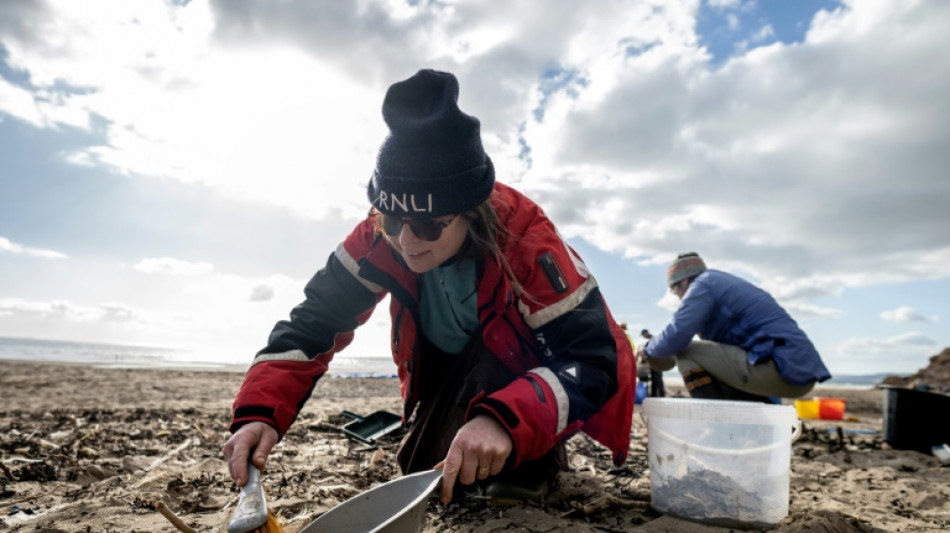
Plastic pollution is scourge of English coastal region / Photo: Ben Stansall - AFP

 Security high as France braces for new protests

 White makes winning start as Fiji edge Eddie Jones's Japan
 Lula, Bolsonaro strike calmer tone in final Brazil election debate

 'How is it possible?': Students protest Indonesian haze

 Israel launches major West Bank operation after soldiers killed

 Typhoon Champi knocks out power to thousands in Taiwan
 As Israeli election nears, campaign turns ugly

 Oscar hopeful 'La Bola Negra' offers lessons about communicating, directors say
 Trapped: Soaring fuel costs hurt Maine lobster industry before midterms

 Marc Marquez beats brother Alex to Australian MotoGP pole
 Ebola vaccine trial begins in DR Congo
 Travelling man Wade equals Prem try record

 Rescuers search for seven people in Nairobi building collapse
 Sacha Baron Cohen revives the 'problematic dinosaur' Ali G in new film

 New race in Barcelona tops 17-event '27 IndyCar season
 Neymar backs Flavio Bolsonaro in Brazil election
 Melania Trump says she brokered truce in war-torn Ukrainian city

 Leclerc tops times for Ferrari in opening practice for US Grand Prix

 Bayern Munich coach Kompany in hospital after collapsing

 Signs point to renewed major US military ops against Iran

 European, Mideast foreign ministers push peace and diplomacy at Istanbul talks

 Ex-All Black centre Williams undergoes 'miracle' heart surgery

 Netanyahu launches major West Bank operation after Israeli soldiers killed

 AFP photographer captures striking images from West Bank attack

 Oil hits $116 with stocks mixed on earnings, AI

On an early spring afternoon, Tregantle Beach is bathed in a dazzling light reminiscent of a painting by British landscape artist JMW Turner as sea, sky and sun merge.
"It's beautiful, right? But look at your feet," says Rob Arnold, 65, an environmental activist and artist, crouching down to pick tiny plastic balls, or "nurdles", sometimes nicknamed "mermaids' tears", out of the Cornwall sand.
The size of a lentil, the tiny bits of plastic are used by industry to manufacture plastic products.
But when spilt at industrial facilities, they can be swept into drains and then out into the sea.
Some 11.5 trillion nurdles end up in the ocean each year, according to UK charity Fauna & Flora International.
Once released into the natural environment, the nurdles circulate on ocean currents and often wash up on beaches and other shores.
Due to their resemblance to fish eggs, birds and other sea life will eat the tiny pellets -- which also absorb toxic pollutants -- adversely affecting the entire food chain, Arnold says.
He is among about 10 people taking part in a clean-up on the beach in England's southwestern Cornwall region, using a device he invented made from a plastic basin, a large grid and a set of tubes.
"It separates plastic waste from natural waste and sand thanks to a filtering and water floating system," the former engineer says.
He then uses the collected nurdles and other microplastics -- tiny bits of plastic that have broken off larger pieces -- in artworks.
- Unearthing 'layers of plastic' -
Jed Louis, 58, wearing a khaki hoodie bearing the name of the local beach clean-up association, says several factors add to the beach's vulnerability.
"This beach is particularly polluted because of its geographical location, the sea currents that affect it and its very open shape," he says.
"In autumn and winter we find the most microplastics because of the weather: storms, thunderstorms and winds, it brings them to the surface.
"Unfortunately the plastic remains, it does not disappear," he says.
Another volunteer Claire Wallerstein, 53, says "sometimes it's a bit like doing archaeology.
"If you dig in the sand, you'll find different layers of plastic."
Some of the nurdles go to Arnold for his artistic creations while others are used to raise awareness in schools.
The rest, which cannot be recycled, end up in the rubbish and are incinerated.
After three hours, the volunteers have cleaned just a few square metres of the beach.
Arnold looks at his loot -- a large tarp several metres (feet) high filled with nurdles and other microplastics.
Once dried and re-sorted, he can add them to the 20 million nurdles he has collected in six years and which he stores in a friend's garage.
- Like a meteorite -
Arnold's most notable work using the nurdles is a 1.7-metre (5.5-foot) high sculpture, similar to the Moai statues of Easter Island with a mysterious past.
The work is on display at the National Maritime Museum Cornwall in the coastal town of Falmouth under the title "A Lesson from History".
"It's a metaphor to what we are doing here to our planet earth. We are polluting our planet, using its resources. If we destroy it, we have nowhere to go, this is our only home," Arnold says.
For his next creation, he wants to mould the tiny plastic pellets into a meteorite headed towards Earth, in a nod to the one that caused the extinction of the dinosaurs and the fragility of our planet.
After cleaning up the beach and packing his nurdle-filled bags away, Arnold looks disillusioned.
"Sometimes I think about throwing all my bags of nurdles into the river from a bridge. It would be so shocking that maybe, finally, people would realise," he adds.
O.Salim--SF-PST