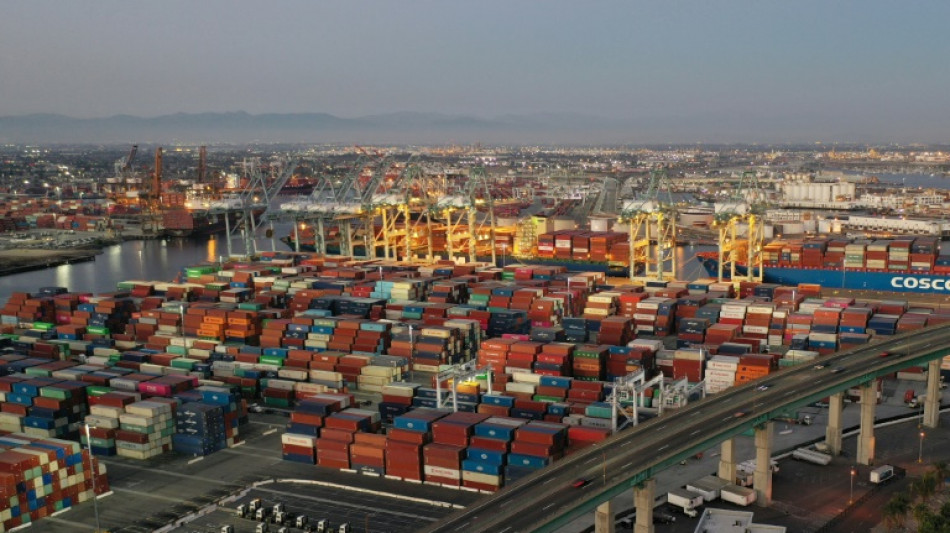
Dockworker shortage shuts California ports / Photo: Robyn Beck - AFP/File

 Security high as France braces for new protests
 White makes winning start as Fiji edge Eddie Jones's Japan

 Lula, Bolsonaro strike calmer tone in final Brazil election debate

 'How is it possible?': Students protest Indonesian haze

 Israel launches major West Bank operation after soldiers killed

 Typhoon Champi knocks out power to thousands in Taiwan

 As Israeli election nears, campaign turns ugly

 Oscar hopeful 'La Bola Negra' offers lessons about communicating, directors say

 Trapped: Soaring fuel costs hurt Maine lobster industry before midterms

 Marc Marquez beats brother Alex to Australian MotoGP pole
 Ebola vaccine trial begins in DR Congo

 Travelling man Wade equals Prem try record

 Rescuers search for seven people in Nairobi building collapse

 Sacha Baron Cohen revives the 'problematic dinosaur' Ali G in new film

 New race in Barcelona tops 17-event '27 IndyCar season

 Neymar backs Flavio Bolsonaro in Brazil election

 Melania Trump says she brokered truce in war-torn Ukrainian city
 Leclerc tops times for Ferrari in opening practice for US Grand Prix

 Bayern Munich coach Kompany in hospital after collapsing

 Signs point to renewed major US military ops against Iran

 European, Mideast foreign ministers push peace and diplomacy at Istanbul talks

 Ex-All Black centre Williams undergoes 'miracle' heart surgery

 Netanyahu launches major West Bank operation after Israeli soldiers killed

 AFP photographer captures striking images from West Bank attack

 Oil hits $116 with stocks mixed on earnings, AI

Two of the busiest ports in the United States were shuttered Friday because not enough dockworkers turned up for work, a shippers representative said.
The shutdown comes as part of a long-rumbling dispute between shippers and the International Longshore and Warehouse Union (ILWU) focused on pay and the role of automation.
"The largest ILWU local on the West Coast has taken a concerted action to withhold labor at the Ports of Los Angeles and Long Beach, resulting in widespread worker shortages," said a statement from the Pacific Maritime Association, the umbrella group that represents shippers.
"The workers who did show up were released because there was not a full complement of ILWU members to operate the terminals.
"The action by the Union has effectively shut down the Ports of Los Angeles and Long Beach -- the largest gateway for maritime trade in the United States."
The ILWU insisted the only no-shows were those marking the Christian festival of Good Friday.
"Cargo operations are ongoing as longshore workers at the Ports remain on the job," a union statement said.
The two ports -- known as the San Pedro Bay Port Complex -- move around 20 million shipping containers' worth of goods every year, with a value of over $300 billion.
The complex is the ninth biggest port in the world by market share, port figures show, and plays a key role in keeping global supply chains moving.
During the Covid-19 pandemic, ports around the globe gummed up, as shippers struggled to meet demand for stay-at-home goods, a problem that persisted as countries opened up.
Economists said the slow-to-shift backlog was a contributing factor in the inflation that has gripped much of the world in the last 18 months as consumers demand products that aren't arriving fast enough.
X.AbuJaber--SF-PST