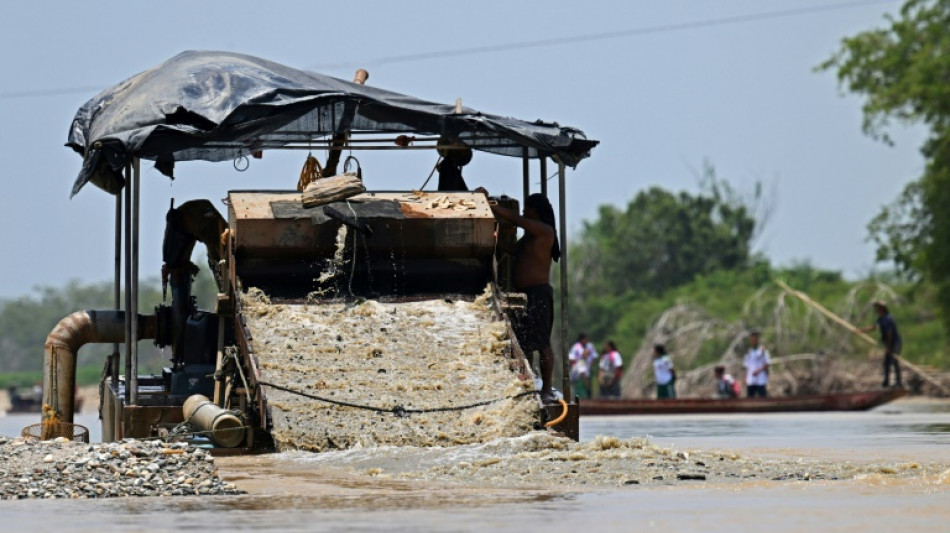
Battle in Colombia over river-wrecking gold 'dragons' / Photo: Raul ARBOLEDA - AFP

 Seen and heard at France protests

 White says Fiji can have 'massive' World Cup after beating Japan

 England thrash France 82-0 to keep Rugby League World Cup hopes alive

 Security high as France braces for new protests

 White makes winning start as Fiji edge Eddie Jones's Japan
 Lula, Bolsonaro strike calmer tone in final Brazil election debate

 'How is it possible?': Students protest Indonesian haze

 Israel launches major West Bank operation after soldiers killed

 Typhoon Champi knocks out power to thousands in Taiwan

 As Israeli election nears, campaign turns ugly

 Oscar hopeful 'La Bola Negra' offers lessons about communicating, directors say

 Trapped: Soaring fuel costs hurt Maine lobster industry before midterms

 Marc Marquez beats brother Alex to Australian MotoGP pole

 Ebola vaccine trial begins in DR Congo

 Travelling man Wade equals Prem try record

 Rescuers search for seven people in Nairobi building collapse

 Sacha Baron Cohen revives the 'problematic dinosaur' Ali G in new film

 New race in Barcelona tops 17-event '27 IndyCar season
 Neymar backs Flavio Bolsonaro in Brazil election

 Melania Trump says she brokered truce in war-torn Ukrainian city

 Leclerc tops times for Ferrari in opening practice for US Grand Prix

 Bayern Munich coach Kompany in hospital after collapsing

 Signs point to renewed major US military ops against Iran

 European, Mideast foreign ministers push peace and diplomacy at Istanbul talks

 Ex-All Black centre Williams undergoes 'miracle' heart surgery

The giant skeletons of burnt and dismantled gold dredgers litter the rivers of northwest Colombia, where the government is waging a full-out war on illegal mining.
Nicknamed "dragons" by locals, the massive machines used to suck gold from riverbeds are blamed for destroying the environment and financing organized crime.
But their dismantling in a massive army operation has been met with hostility by communities who depend on mining for their daily survival.
Around El Bagre in the gold-rich Bajo Cauca region, a protest by miners that started early this month has been marked by acts of vandalism the government blamed on the Gulf Clan drug cartel for instigating.
But Luis Manuel Campo, 32, one of the miners, insisted to AFP that "we have nothing to do with criminal groups."
Campo co-owns a dredger with three other people.
"We are not hiding. We just want the persecution to stop," he said.
"We want to be formally recognized as miners so that we can work in peace, without stigma."
- New gold rush -
The names of the villages in this region such as Zaragoza and Caceres serve as a reminder of the Spanish colonizers who were already extracting gold in Bajo Cauca in the 17th century.
It became a bastion of rightwing paramilitary fighters in the 1990s, and is now a stronghold of the Gulf Clan, Colombia's most powerful cartel.
President Gustavo Petro this month called off a ceasefire with the Clan, accusing it of being behind attacks on civilians committed by protesting miners.
Criminal groups in Colombia make almost as much money from illegal mining as they do from trafficking cocaine, authorities say.
With a recent rise in gold prices, Bajo Cauca has been gripped by a new type of gold rush, with poor communities scouring the gravelly river beds with shovels, bulldozers and dredging machines.
"Apart from gold, there is nothing here," said Campo.
Locals say about 350 dredging machines are active in the region -- big and small -- on top of those operated legally by the Mineros Aluvial multinational.
- 'Profitable' -
The illegal dredgers range from simple machines with makeshift conveyer belts to larger mechanical contraptions that require several divers to guide a massive vacuum pipe under the dark water.
Then there are the "dragons" -- three-storey, 20-meter (66-foot) long boats with massive engines.
There are about two dozen of these in the Bajo Cauca region.
One "dragon" costs about half a million dollars, their owners tell AFP.
"At the current (gold) price, it is profitable," said Alex Cossio, 41, who runs one of these monsters.
One "dragon" can extract up to two kilograms (4.4 pounds) of gold per day -- worth more than $50,000, according to a police official who did not want to be named.
AFP visited a number of these beasts, including one named "Native" that has been operational for only two months in a branch of the Nechi river.
"The (army) helicopters fly over us every day, we are afraid," said Cossio, who insisted there was no link to organized crime.
"Diesel, food, logistics... We buy everything in the neighborhood, a large number of families live from our activity," he added.
AFP observed at least six "dragons" lying mutilated and burnt by the riverside, some already being repaired by their owners.
There is no official data on how many dredgers have been destroyed.
"We tried to stop them, it was terrible," said Julia Tatis, who owns a small eatery, of a raid this month on three of the machines in Nueva Esperanza, a poor hamlet on the water's edge.
"The military just arrived saying we are the Gulf Clan. And they burned everything," added dredge owner Juan Manuel Carcamo.
- Damage 'already done' -
Campo insists the dredges are working river beds "that were already exploited by Mineros 40 years ago... The damage has already been done."
Lawyer Francisco Arrieta Franco is an advocate for the miners who he describes as victims.
"It is false to say the dredges belong to the Clan," he told AFP.
"It's complicated and expensive to operate a dredger. Criminals are more interested in extortion, which is everywhere in this region."
Locals say the miners are subject to Gulf extortion rather than perpetrators of it.
In a gold shop in El Bagre, an employee warned of trouble if the government continues to "harass" the miners.
"We need these dredgers to work and to eat," shouted the employee, who did not want to be named. "They serve the whole community!"
Added a miner, also on condition of anonymity: "It is when you have an empty stomach that you are forced to do illegal things."
Z.AlNajjar--SF-PST