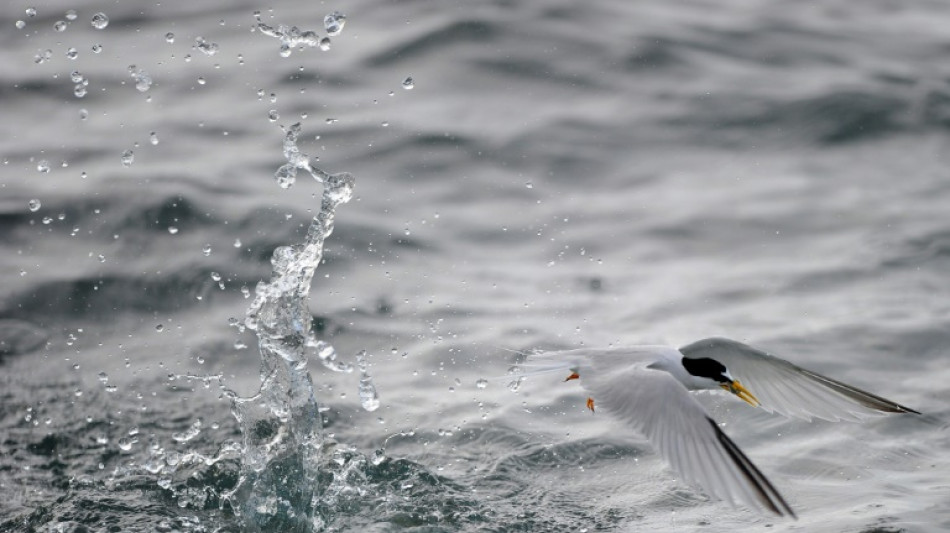
Microplastic pollution impairs seabird gut health / Photo: JEWEL SAMAD - AFP/File

 Top-ranked Rybakina to face Fernandez for Ningbo title
 Late India charge seals thrilling second T20 win over New Zealand

 Seen and heard at France protests

 White says Fiji can have 'massive' World Cup after beating Japan

 England thrash France 82-0 to keep Rugby League World Cup hopes alive

 Security high as France braces for new protests

 White makes winning start as Fiji edge Eddie Jones's Japan

 Lula, Bolsonaro strike calmer tone in final Brazil election debate

 'How is it possible?': Students protest Indonesian haze

 Israel launches major West Bank operation after soldiers killed

 Typhoon Champi knocks out power to thousands in Taiwan

 As Israeli election nears, campaign turns ugly

 Oscar hopeful 'La Bola Negra' offers lessons about communicating, directors say

 Trapped: Soaring fuel costs hurt Maine lobster industry before midterms

 Marc Marquez beats brother Alex to Australian MotoGP pole

 Ebola vaccine trial begins in DR Congo

 Travelling man Wade equals Prem try record

 Rescuers search for seven people in Nairobi building collapse

 Sacha Baron Cohen revives the 'problematic dinosaur' Ali G in new film

 New race in Barcelona tops 17-event '27 IndyCar season

 Neymar backs Flavio Bolsonaro in Brazil election

 Melania Trump says she brokered truce in war-torn Ukrainian city

 Leclerc tops times for Ferrari in opening practice for US Grand Prix

 Bayern Munich coach Kompany in hospital after collapsing

 Signs point to renewed major US military ops against Iran

Scientists have long known that wild seabirds ingest bits of plastic pollution as they feed, but a study Monday shows the tiny particles don't just clog or transit the stomach but can subvert its complex mix of good and bad bacteria too.
Plastic-infested digestive tracks from two species of Atlantic seabirds, northern fulmars and Cory's shearwaters, showed a decrease of mostly beneficial "indigenous" bacteria and more potentially harmful pathogens.
There was also an increase in antibiotic-resistant and plastic-degrading microbes, researchers reported in the journal Nature Ecology & Evolution.
Certain types of microplastic, the findings suggested, may be leeching chemicals that disrupt the birds' so-called gut microbiome.
Microplastics -- produced when plastic products break down in the environment -- are directly and indirectly ingested across most animal food chains.
They can be found in every corner of the world, from the deepest oceans trenches to top of Mount Everest.
In humans, they have been detected in the blood, breast milk and placentas.
The new study supports previous findings that prolonged ingestion of microplastics causes an imbalance of healthy and unhealthy bacteria in the stomach, a condition known as gut dysbiosis.
The implications are far-reaching.
Like humans, birds have evolved with a vast network of microbes, including bacteria, that live in our bodies in communities called microbiomes.
Some microbes cause diseases, but most exist as "friendly" bacteria with a critical role in digestion, immune response and other critical functions.
"There's a symbiosis that goes on -- and that's the case in the seabirds as well as in humans," lead author Gloria Fackelmann of Ulm University in Germany told AFP.
Little is known about the effects of individual microbes on the body.
But overall, a growing body of research points to the harmful impacts of microplastics on animal health.
The tiny particles -- less than five millimetres in diameter -- can cause cell death and allergic reactions in humans.
Chemicals in microplastics have also been linked to increased risks of cancer, reproductive problems, and DNA mutations.
The authors hope the findings in seabirds will spur related studies for humans.
"If this manmade substance could alter our microbiome, I think that should make people think," said Fackelmann.
W.Mansour--SF-PST