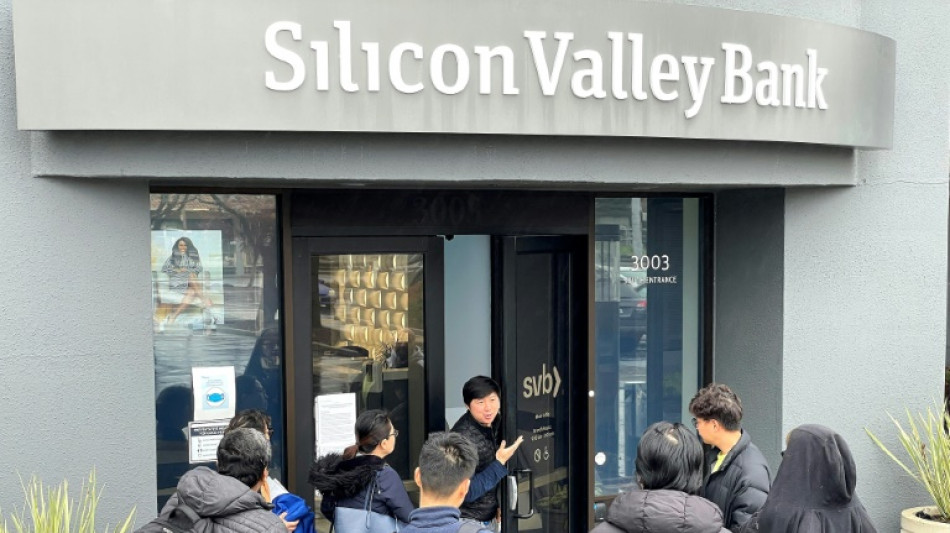
Interest rate risk: SVB's nemesis a well-known foe in banking / Photo: JUSTIN SULLIVAN - GETTY IMAGES NORTH AMERICA/AFP/File

 Thousands rally for Lula and Bolsonaro on eve of tight Brazil vote

 Red-hot Fuellkrug bags Bremen brace, Leipzig win

 Thousands gather at new Albanian anti-government rally

 French police fire tear gas during fresh protests

 Suspect detained after fire wrecks Hitler's mountain retreat

 Alexander Skarsgard and his viral 'Wicker' transformation

 Thousands protest in Turkey over journalists' arrests, media shutdowns

 Man City beaten by Aston Villa to end perfect Premier League start

 Luis Enrique says PSG unbothered by Lyon match switch

 US gymnast Richard wins floor exercise gold at worlds

 Moltzan upstages Shiffrin to win season-opening World Cup giant slalom

 Infantino says backed by 'vast majority' in bid for re-election

 Police fire tear gas as new French protests kick off

 Police fire tear gas as new French demonstrations kick off

 Tropical Storm Champi nears China after battering Taiwan, Japan

 'Weeks, not days' in Kompany recovery, say Bayern

 Unfair to compare us to Barca: Real Madrid's Mourinho

 North Korea's Kim makes unannounced visit to Chinese border city

 Fire breaks out at Hitler's mountain retreat, suspect arrested

 Marc Marquez wins Australian sprint as Martin crashes out

 North Korea's Kim calls for training world's 'strongest' military

 Brewers edge Rays to capture World Series opener

 France to deploy 70,000 police for fresh weekend protests

 Tatum delivers as Celtics down winless Knicks

 Romantasy fans ready for sleepless night as 'Court of Thorns and Roses' returns

Among the mysteries surrounding the collapse of Silicon Valley Bank, finance experts have fixated on the California lender's failure to practice basic risk management.
A catalyst for SVB's demise was the Federal Reserve's shift from near-zero interest rates to large interest rate increases to counter inflation, a reversal that immediately lowered the value of SVB's holdings linked to long-term US Treasury bonds.
Within the world of risk management, this issue -- referred to as "interest rate risk" -- is well known and relatively straightforward to address.
Banks manage this risk by hedging, purchasing futures contracts or other financial vehicles that rise in value in case a bank's holdings are devalued due to policy changes.
SVB's meager hedging operation "astounds me," said Clifford Rossi, a former risk management executive at Citigroup and a professor at the University of Maryland.
Rossi estimates SVB's hedging program should have been twice its size.
At the end of 2022, SVB reported $120 billion of these investment securities, or 55 percent of total assets, more than double the average of US banks.
A precipitating event in SVB's collapse was the March 8 disclosure that it sold $21 billion in securities at a loss of $1.8 billion to raise cash to fund operations.
If SVB had had in place an adequate hedging program, it would have generated enough profit to offset the effect of selling the Treasury-linked assets at a loss, said Kris James Mitchener, an economics professor at Santa Clara University in California.
"Why management chose not to (hedge) is a mystery thus far," Mitchener told AFP. "This is something we teach to undergraduates."
Mitchener noted that the Fed itself, in its role as a regulator, had not publicly spotlighted interest rate risk.
The Fed's 2022 stress tests on the largest banks did not include a scenario of sharply higher interest rates comparable to the one it has effected.
- 'Generally manageable' -
SVB officially failed on March 10, when California regulators directed the Federal Deposit Insurance Corporation to seize control of the bank and manage the return of funds to depositors.
Only days earlier, FDIC Chair Martin Gruenberg had highlighted interest rate risk at an event with the Institute of International Bankers.
Gruenberg noted that banks held about $620 billion in "unrealized losses" at the end of 2022, characterizing the matter as an "ongoing supervisory focus."
"The good news about this issue is that banks are generally in a strong financial condition, and have not been forced to realize losses by selling depreciated securities," Gruenberg said. "On the other hand, unrealized losses weaken a bank’s future ability to meet unexpected liquidity needs."
A December 2022 S&P Global Ratings report described unrealized losses as "generally manageable" for US banks, calling higher interest rates broadly "beneficial" to banks because they can charge more for loans, lifting net interest income (NII).
"However, we also recognize that if a bank were unexpectedly forced to realize losses on its securities, perhaps because of liquidity pressures, the benefit to NII and earnings from higher rates would very likely be insufficient to make up for the realized losses," S&P said.
- Contagion risk? -
In recent days, other midsized US banks that share traits with SVB have tanked on Wall Street.
First Republic, which has seen waves of investor selling, had much lower unrealized losses than SVB, but shared the tech-centered bank's heavy exposure to uninsured depositors.
A recent article in MarketWatch ranked 20 banks with the highest share of unrealized losses relative to size, with the top five including Comerica, Zion Bancorporation and KeyCorp, all of which have come under pressure on Wall Street.
Still, many banking experts consider SVB an outlier because of its confluence of risks, which also include its heavy exposure to a single industry in tech startups.
The largest US banks such as JPMorgan Chase and Bank of America have sophisticated hedging programs and a diversified deposit base. Many midsized banks do at least some hedging and had a smaller share of Treasuries compared to overall assets.
The hit from interest rates is "only a loss if you're forced to sell the asset," said Rohan Williamson, a finance professor at Georgetown University.
SVB was a case of "management failure or malpractice," he said.
Even if midsized banks do find themselves forced to sell assets to raise cash, new emergency Fed programs are designed to prevent an SVB-type scenario.
"At a minimum," the program "is buying the bank enough time to not face a run," said Mitchener. "It's a confidence game."
A.AbuSaada--SF-PST