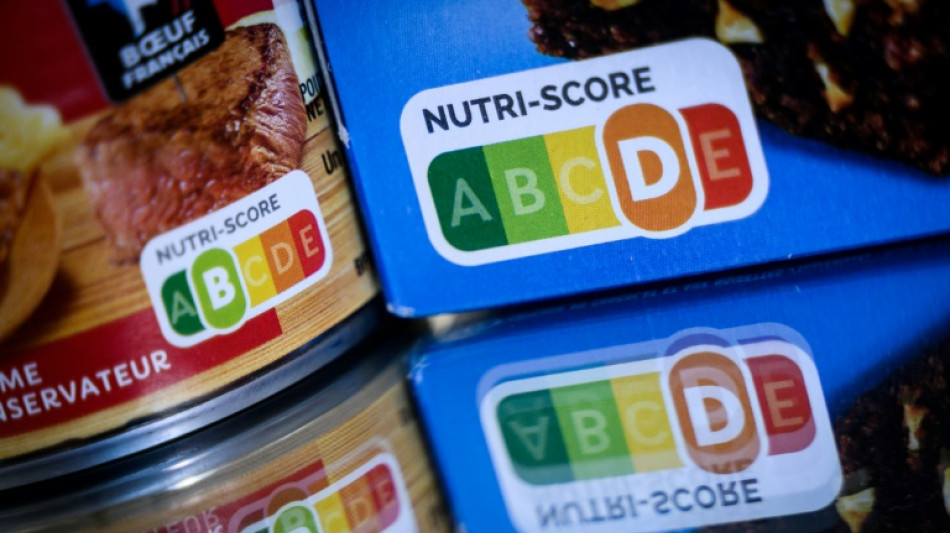
In EU, a food fight over nutrition labels / Photo: LOIC VENANCE - AFP/File

 Japan's Nakai wins Grand Prix de France for second straight year
 Ronaldinho to make comeback in Italian third tier

 Israeli forces displace Hebron families after deadly attack

 Hamilton on top with Antonelli fourth in final practice at US Grand Prix

 Beier late show sends Dortmund top of Bundesliga

 Police and protesters clash again at Albanian anti-government rally
 Arteta hails mentality as Arsenal go level with Man City

 Clashes break out in Paris, other cities amid fresh protests

 Bouthier kicks Vannes to first Top 14 win of season

 Thousands rally for Lula and Bolsonaro on eve of tight Brazil vote

 Red-hot Fuellkrug bags Bremen brace, Leipzig win

 Thousands gather at new Albanian anti-government rally

 French police fire tear gas during fresh protests

 Suspect detained after fire wrecks Hitler's mountain retreat
 Alexander Skarsgard and his viral 'Wicker' transformation

 Thousands protest in Turkey over journalists' arrests, media shutdowns

 Man City beaten by Aston Villa to end perfect Premier League start
 Luis Enrique says PSG unbothered by Lyon match switch
 US gymnast Richard wins floor exercise gold at worlds
 Moltzan upstages Shiffrin to win season-opening World Cup giant slalom

 Infantino says backed by 'vast majority' in bid for re-election
 Police fire tear gas as new French protests kick off

 Police fire tear gas as new French demonstrations kick off

 Tropical Storm Champi nears China after battering Taiwan, Japan

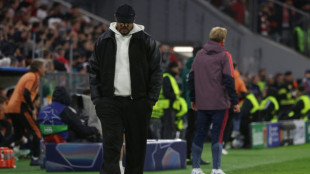 'Weeks, not days' in Kompany recovery, say Bayern

Europe is taking longer than planned to concoct an EU-wide food-labelling system after a colour-coded scheme created in France did not go down well in culinary rival Italy.
Fearing that cultural icons such as olive oil or Parmesan cheese would get bad grades, Italy successfully rallied other European Union nations to reject the French system.
The European Commission was supposed to come up by late 2022 with a label aimed at helping consumer make healthier food choices.
France's Nutri-Score system was initially seen as the front-runner to be used across the 27-nation EU. The front-of-pack nutrition label has already been adopted by Belgium, Germany, Luxembourg, the Netherlands and Spain.
Nutri-Score ranks food products on a green-to-red and A-to-E scale based on their nutritional value, from containing a good amount of protein or fibre to too much salt or saturated fat, but companies are not obligated to use the label.
Some 270 scientists signed a call in March 2021 urging the European Commission "not to yield to pressure groups" and back Nutri-Score, saying it was the only label that had undergone peer-reviews showing its "effectiveness and relevance to consumers and public health".
But the European Commission decided against Nutri-Score, with its deputy director-general of food sustainability, Claire Bury, saying in September that it would not put on the table something that "polarizes the debates".
- 'E' for cheese -
Italy, Cyprus, Greece, the Czech Republic, Romania and Hungary opposed the French system.
Italian Prime Minister Giorgia Meloni, who took office in October, had lambasted such food labels as "discriminatory and penalising" for the country's food industry.
"An intensive lobbying campaign against this tool by commercial interests has regrettably muddied the waters and turned a public health debate into a political one," said Emma Calvert, senior food policy officer at European consumers group BEUC.
While the European Commission may still use Nutri-Score for inspiration in devising a system, it is also looking at other labels.
Those include the green or black "Keyhole" system in Nordic countries and one backed by Italy, NutrInform Battery, which takes into account the potential portions of food consumed.
Italy has argued that Nutri-Score is not a good reference because it is based on 100 grams or 100 millilitres of food while certain products such as oil and cheese are consumed in smaller quantities.
Rome worries that labels would be harmful to products that are staples of its Mediterranean diet, including olive oil, cheese, prosciutto and pizza.
Italy's main agriculture association, Coldiretti, has said that Nutri-Score ends up "excluding healthy and natural foods that have been at the table for centuries in favour of artificial products".
In France, the makers of the blue cheese Bleu d'Auvergne refuse to put the label their product, which would get the worst possible grade, a red E, for its salt and fat content.
"How do you explain that Bleu d'Auvergne is classified as E when chips made in oil get an A," said Sebastien Ramade, president of the Auvergne cheese association.
But 875 brands representing 60 percent of the food market in France are using Nutri-Score, the system's founder, nutritionist Serge Hercberg told AFP.
"Some major brands still reject it, but more and more manufacturers are adopting it, some of whom had strongly resisted it in the past," Hercberg said.
"When we look at sales figures, we see that it works and it has had an effect on the reformulation and the improvement of the recipes for thousands of products," he added.
- Chile's strict label -
Time is running short for the commission to propose a label to EU states before the term of the current European Parliament expires next year.
"If the Commission fails to uphold its commitment to propose a mandatory EU-wide front-of-pack nutrition label it will be a major missed opportunity to help European consumers, especially vulnerable ones, to make the healthier choice in the supermarket," Calvert said.
Some members of the European Parliament say artificial foods should be targeted instead.
"The overweight issue among teenagers is not due to eating too much Camembert," said MEP Irene Tolleret.
Elsewhere in the world, Chile has had an even stricter system since 2016, with a black label that warns consumers about high saturated fats, sugar or salt.
Products in Chile that bear the label are barred from advertising on television.
"One of the consequences is that more than 20 percent of products have new formulas," with less salt or sugar, said Guido Girardi, a former senator behind the system who added that similar legislation is in the works in 32 countries.
P.AbuBaker--SF-PST