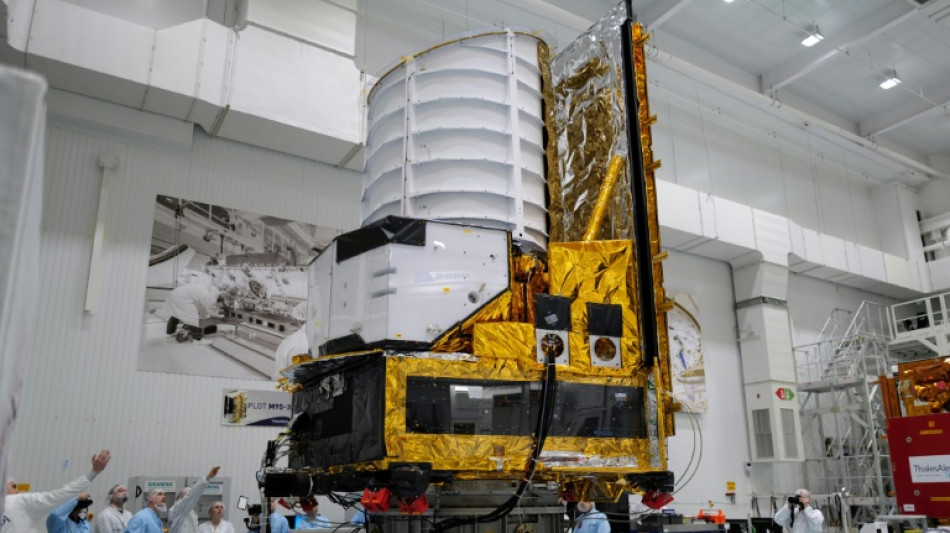
Euclid spacecraft prepares to probe universe's dark mysteries / Photo: Valery HACHE - AFP

 Obama blasts Trump's 'chaos and cruelty' while campaigning for Democrats

 Bolsonaro leads Lula in final Brazil election polls

 Antonelli storms to pole for US Grand Prix

 Alvarez fires Atletico to win against Deportivo

 Japan's Nakai wins Grand Prix de France for second straight year

 Ronaldinho to make comeback in Italian third tier

 Israeli forces displace Hebron families after deadly attack

 Hamilton on top with Antonelli fourth in final practice at US Grand Prix

 Beier late show sends Dortmund top of Bundesliga

 Police and protesters clash again at Albanian anti-government rally

 Arteta hails mentality as Arsenal go level with Man City

 Clashes break out in Paris, other cities amid fresh protests

 Bouthier kicks Vannes to first Top 14 win of season

 Thousands rally for Lula and Bolsonaro on eve of tight Brazil vote

 Red-hot Fuellkrug bags Bremen brace, Leipzig win

 Thousands gather at new Albanian anti-government rally

 French police fire tear gas during fresh protests

 Suspect detained after fire wrecks Hitler's mountain retreat

 Alexander Skarsgard and his viral 'Wicker' transformation

 Thousands protest in Turkey over journalists' arrests, media shutdowns
 Man City beaten by Aston Villa to end perfect Premier League start
 Luis Enrique says PSG unbothered by Lyon match switch

 US gymnast Richard wins floor exercise gold at worlds

 Moltzan upstages Shiffrin to win season-opening World Cup giant slalom

 Infantino says backed by 'vast majority' in bid for re-election

For now, Europe's Euclid spacecraft sits quietly in a sterilised room in the south of France, its golden trim gleaming under the fluorescent light.
But in a few months the space telescope will blast off on history's first mission to search for two of the universe's greatest mysteries: dark matter and dark energy.
Though together they make up 95 percent of the universe, almost nothing is known about either -- a glaring hole in scientific understanding that Euclid project manager Giuseppe Racca dubbed a "cosmic embarrassment".
Aiming to shed light on these dark secrets, the European Space Agency's mission will chart a 3D map of the universe encompassing two billion galaxies across more than a third of the sky.
The third dimension of this map will be time -- because Euclid's gaze will stretch out to 10 billion light years away, it will offer new insight into how the 13.8-billion-year-old universe evolved.
The two-tonne spacecraft, which is 4.7 metres (15 feet) tall and 3.5 metres (11 feet) wide, was unveiled to the media for the first time this week in a clean room of the Thales Alenia Space company in the southeastern French city of Cannes.
Only a few final tests remain before it heads to Cape Canaveral in the United States for a launch scheduled between July 1 and 30 on a SpaceX Falcon 9 rocket.
Euclid was originally planned to get a ride into space on a Russian Soyuz rocket, but last year Moscow withdrew its launchers in response to European sanctions over its invasion of Ukraine, delaying the launch.
- Taking a wider view -
Euclid will join fellow space telescope James Webb at a stable hovering spot around 1.5 million kilometres from Earth called the second Lagrangian Point, where it can keep its solar panel-covered back permanently to the Sun.
The first images are expected to roll in quickly once scientific operations start in October, but for larger discoveries it will likely take scientists months or years to sift through the "unprecedented amount of data", Racca said.
The 1.4-billion-euro ($1.5 billion) European mission is planned to last until 2029, though "if nothing strange happens" it could be extended a couple more years, Racca told a press conference.
How will Euclid, which is named after the ancient Greek founder of the field of geometry, observe something that cannot be seen? By searching for its absence.
The light coming from billions of years in the past is slightly distorted by the mass of visible and dark matter along the way, a phenomenon known as weak gravitational lensing.
"By subtracting the visible matter, we can calculate the presence of the dark matter which is in between," Racca said.
To do this, Euclid has two main instruments, a 1.2-metre (four-foot) diameter telescope and the Near Infrared Spectrometer and Photometer (NISP), which can split infrared wavelengths not visible to the eye.
- 'Unique tool' -
Partly what sets Euclid apart from other space telescopes is its field of view, which takes in an area equivalent to "two full moons", said David Elbaz, an astrophysicist at the French Atomic Energy Commission.
This wide view will enable Euclid to locate massive structures like black holes that the Webb telescope cannot hope to find because its "field of view is too small", Euclid's project scientist Rene Laureijs told AFP.
But Euclid's universe-spanning survey will be able to point Webb in the right direction for closer inspection, said Laureijs, who has been working on the project since the proposal stage in 2007.
The mission comes amid increasing signs that there are some serious inconsistencies in our understanding of how the universe works.
Two very precise measurements give two significantly different answers for the rate at which the universe is expanding -- a problem called the Hubble tension in which dark energy is thought to play a major role.
And just this week, the Webb telescope spotted six galaxies in the early universe that seemingly defy cosmological theory because they are far too massive to have formed so quickly after the Big Bang.
Euclid will be a "unique tool" in the quest to find answers to such questions, Elbaz said.
U.AlSharif--SF-PST