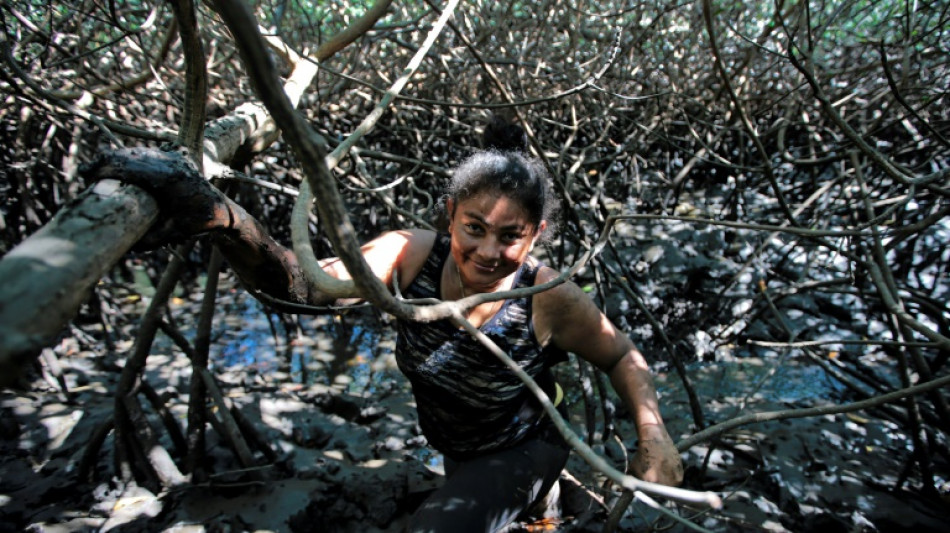
When men won't 'get dirty', Nicaraguan women dig for cockles / Photo: OSWALDO RIVAS - AFP

 Obama blasts Trump's 'chaos and cruelty' while campaigning for Democrats

 Bolsonaro leads Lula in final Brazil election polls

 Antonelli storms to pole for US Grand Prix

 Alvarez fires Atletico to win against Deportivo

 Japan's Nakai wins Grand Prix de France for second straight year

 Ronaldinho to make comeback in Italian third tier

 Israeli forces displace Hebron families after deadly attack

 Hamilton on top with Antonelli fourth in final practice at US Grand Prix

 Beier late show sends Dortmund top of Bundesliga

 Police and protesters clash again at Albanian anti-government rally

 Arteta hails mentality as Arsenal go level with Man City

 Clashes break out in Paris, other cities amid fresh protests

 Bouthier kicks Vannes to first Top 14 win of season

 Thousands rally for Lula and Bolsonaro on eve of tight Brazil vote

 Red-hot Fuellkrug bags Bremen brace, Leipzig win

 Thousands gather at new Albanian anti-government rally
 French police fire tear gas during fresh protests

 Suspect detained after fire wrecks Hitler's mountain retreat

 Alexander Skarsgard and his viral 'Wicker' transformation

 Thousands protest in Turkey over journalists' arrests, media shutdowns

 Man City beaten by Aston Villa to end perfect Premier League start

 Luis Enrique says PSG unbothered by Lyon match switch

 US gymnast Richard wins floor exercise gold at worlds

 Moltzan upstages Shiffrin to win season-opening World Cup giant slalom

 Infantino says backed by 'vast majority' in bid for re-election

From a young age, Elena Martinez and other female residents of Aserradores, a small fishing community in eastern Nicaragua, learn to navigate the dense mangrove forest to extract a black mollusc from deep under the mud.
Every few days, they leave home at dawn to row about two kilometers (1.2 miles) in a fishing boat to the mangroves, where they crawl through gnarly branches knee-deep in mud, digging for the delicacy by hand.
While keeping food on the table, the women also help conserve the mangrove forest -- a natural barrier that harbors countless animal species and protects coastal settlements from floods, tidal waves and hurricane winds.
It is hard, back-breaking work that leaves the women covered in mud from head to toe. But 40-year-old Martinez and her companions laugh and joke as they go about the task of finding mangrove cockles.
In several hours they each gather a small pile of the mollusc known to science as Anadara tuberculosa -- some for home consumption, but most to sell in town.
The cockle is a popular menu item in Nicaragua and famed for purported aphrodisiac qualities.
Restaurants can resell a dozen cockles for as much as 120 cordobas (about $3.30), but the women only get about a quarter to a sixth of that price.
"Only women" do this job "because men don't like to get dirty, they don't like to get scratched" by the mangrove branches, said Martinez.
"We have to do it because of our children, for our children's studies. We have to find a way to feed them," she explained.
The men of Aserradores make a living mainly from fishing for the table and to sell. But the fish are getting fewer.
- 'We plant, we reforest' -
The work of Martinez and her colleagues is also important for conservation.
While digging for cockles in the Aserradores estuary more than 150 kilometers (93 miles) northwest of Managua, they deposit seedlings provided by environmental authorities and NGOs to repopulate the mangrove forest.
"What we do is protect the mangrove... we plant, we reforest," said Martinez as she deftly dug into the mud, removed a cockle, and placed it in a bag hanging from her waist.
"It is for our own sake, that of our children and the rest" of the community, she said.
Martinez was 10 when she first started to gather cockles, at a time the finite nature of the resource was not appreciated, she said.
"Growing up, I did not consider how valuable it was... we took large amounts of shells without thinking that maybe one day they will run out and we won't have anything with which to sustain our children."
Martinez is a mother of three youngsters in their twenties engaged in fishing.
Juana Izquierdo, 50, recalls that as a child, the cockles were so plentiful she scooped them up from the surface of the mud but over the years, "they started decreasing because there were more collectors."
Nowadays, she returns smaller cockles to the mud to grow, "to protect and save our mangrove."
About 100 women in the municipality of El Viejo, which includes Aserradores, are involved in cockle harvesting and mangrove reforestation.
"We work three days and rest three or four days, then we return," said Izquierdo.
"We support our family. In the sea, sometimes they catch fish, sometimes not, sometimes the poor things (men) only earn enough for fuel. And since we row, we don't spend anything on fuel, we just spend our energy," she said.
K.Hassan--SF-PST