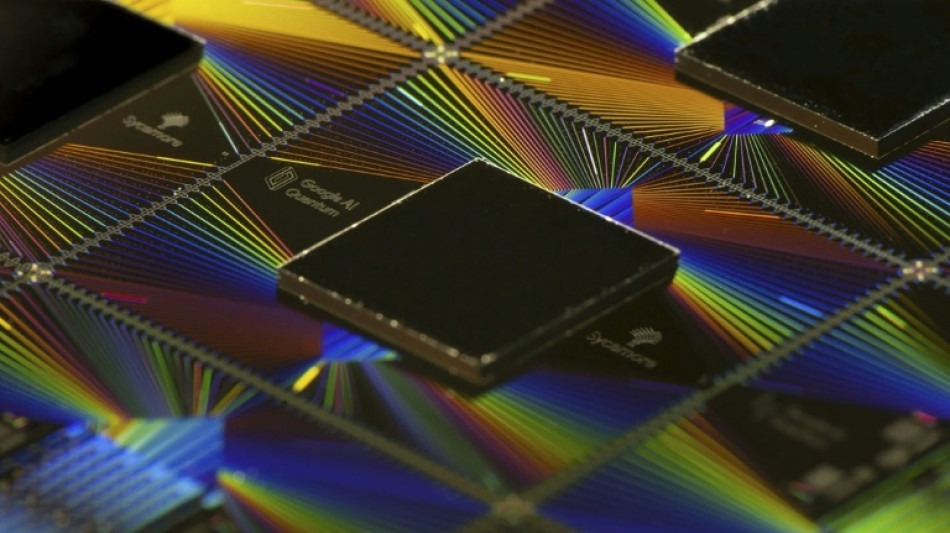
Google hails 'key milestone' in quantum computing / Photo: HO - GOOGLE/AFP/File

 Obama blasts Trump's 'chaos and cruelty' while campaigning for Democrats

 Bolsonaro leads Lula in final Brazil election polls

 Antonelli storms to pole for US Grand Prix

 Alvarez fires Atletico to win against Deportivo

 Japan's Nakai wins Grand Prix de France for second straight year

 Ronaldinho to make comeback in Italian third tier

 Israeli forces displace Hebron families after deadly attack

 Hamilton on top with Antonelli fourth in final practice at US Grand Prix

 Beier late show sends Dortmund top of Bundesliga

 Police and protesters clash again at Albanian anti-government rally

 Arteta hails mentality as Arsenal go level with Man City

 Clashes break out in Paris, other cities amid fresh protests

 Bouthier kicks Vannes to first Top 14 win of season

 Thousands rally for Lula and Bolsonaro on eve of tight Brazil vote

 Red-hot Fuellkrug bags Bremen brace, Leipzig win

 Thousands gather at new Albanian anti-government rally

 French police fire tear gas during fresh protests

 Suspect detained after fire wrecks Hitler's mountain retreat

 Alexander Skarsgard and his viral 'Wicker' transformation

 Thousands protest in Turkey over journalists' arrests, media shutdowns

 Man City beaten by Aston Villa to end perfect Premier League start

 Luis Enrique says PSG unbothered by Lyon match switch

 US gymnast Richard wins floor exercise gold at worlds

 Moltzan upstages Shiffrin to win season-opening World Cup giant slalom

 Infantino says backed by 'vast majority' in bid for re-election

Google scientists said Wednesday they have passed a major milestone in their quest to develop effective quantum computing, with a new study showing they reduced the rate of errors -- long an obstacle for the much-hyped technology.
Quantum computing has been touted as a revolutionary advance that uses our growing scientific understanding of the subatomic world to create a machine with powers far beyond those of today's conventional computers.
However the technology remains largely theoretical, with many thorny problems still standing in the way -- including stubbornly high error rates.
In new research published in the journal Nature, the Google Quantum AI lab described a system that can significantly decrease the error rate.
That could give the US tech giant a step up on its rivals such as IBM, which is also working on superconducting quantum processors.
While traditional computers process information in bits that can be represented by 0 or 1, quantum computers use qubits, which can be a combination of both at the same time.
This property, known as superposition, means that a quantum computer can crunch an enormous number of potential outcomes simultaneously.
The computers harness some of the most mind-boggling aspects of quantum mechanics, including a phenomenon known as "entanglement" -- in which two members of a pair of bits can exist in a single state, even if far apart.
- 'Magic' -
But a problem called decoherence can cause the qubits to lose their information when they leave their quantum state and come into contact with the outside world.
This fragility causes high error rates, which also increase with the number of qubits, frustrating scientists wanting to ramp up their experiments.
However Google's team said it had demonstrated for the first time in practice that a system using error-correcting code can detect and fix errors without affecting the information.
The system was first theorised in the 1990s, however previous attempts had just thrown up more errors, not less, said Google's Hartmut Neven, a co-author of the study.
"But if all components of your system have sufficiently low error rates, then the magic of quantum error correction kicks in," Neven told a press conference.
Julian Kelly, another study co-author, hailed the development as "a key scientific milestone", saying that "quantum error correction is the single most important technology for the future of quantum computing".
Neven said the result was still "not good enough, we need to get to an absolute low error rate".
He added that "there are more steps to come" to achieve the dream of a useable quantum computer.
Google claimed in 2019 it had passed a milestone known as "quantum supremacy", when the tech giant said its Sycamore machine executed a calculation in 200 seconds that would have taken a conventional supercomputer 10,000 years to complete.
However the achievement has since been disputed, with Chinese researchers saying last year that a supercomputer could have beaten Sycamore's time.
A.AbuSaada--SF-PST