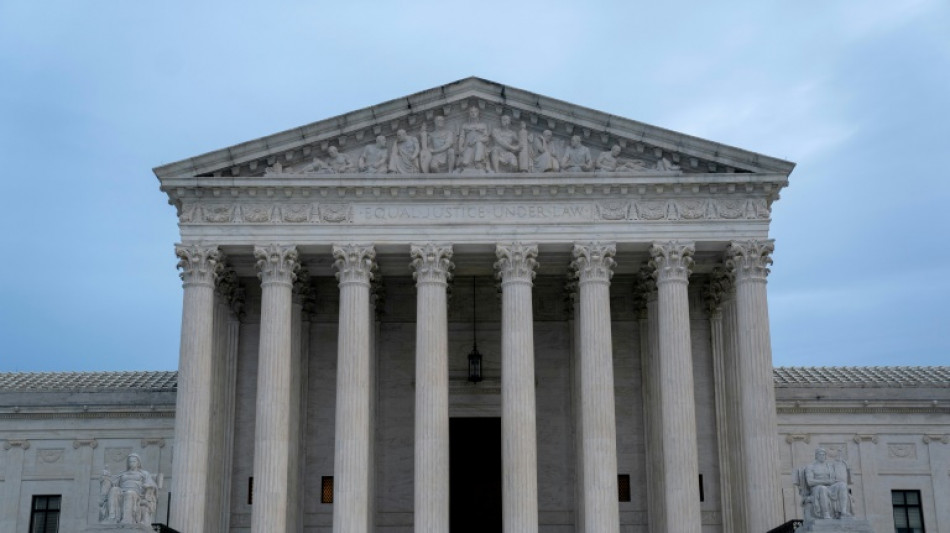
US Supreme Court takes on immunity for tech giants / Photo: Stefani Reynolds - AFP/File

 Musk accuses Ukraine of violating Starlink's terms of service

 Fed expected to hold rates steady days ahead of US midterms

 More Lula, or back to the Bolsonaros? Brazil votes in cliffhanger

 Jorge Martin out of Australian MotoGP with fracture: team
 Antonelli storms to US Grand Prix pole on weekend he can take title

 Apologetic Alvarez fires Atletico to win against Deportivo

 Lens beat PFC in Ligue 1 matchday impacted by social unrest

 Valkyries hit back against Dream to level WNBA Finals

 'Fighting for our rights': Paris protesters determined to march on

 Clashes break out in Paris, other French cities amid fresh protests

 Spurs seal rare win at Chelsea as Palmer sees red

 Nearly 1,000 arrested in French protests marred by 'elevated' violence: minister

 France extends detention of suspected racist shooter

 Andrade and Nemour star as Biles cheers at world gymnastics champs

 Nigeria's Tinubu defends record as economy bites ahead of election

 'Guiding star' Fuellkrug bags Bremen brace, Leipzig win

 Man City's perfect start ended by Aston Villa, Arsenal go joint-top

 Arsenal sink Everton to join Man City at Premier League summit

 France protests: Latest developments

 French ice dancers Cizeron and Fournier make golden start to season

 Thousands protest crackdown on media in Turkey

 Brazil's Andrade returns to take vault gold at worlds

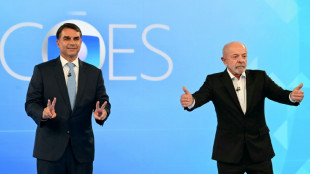 Lula, Bolsonaro hold final rallies ahead of Brazil election

 Ukraine has 'stable connection' to Starlink: govt

 French protests kick off amid heavy security blanket

The US Supreme Court this week examines a quarter-century old law that has protected tech companies from lawsuits and prosecution for content posted by their users, with a chance that the rules governing the internet will no longer stand.
Enacted when Facebook founder Mark Zuckerberg was just 11 years old and Google’s creation still two years off, Section 230 is seen as a fundamental law of the internet and considered inviolable by its staunch defenders.
Section 230 was part of the Communication Decency Act, an anti-pornography law signed in 1996, that helped set the rules of the road for the internet, which was still in its infancy as an online playground for all.
The idea was to protect the then embryonic internet sector from cascading lawsuits and to allow it to flourish, while encouraging tech companies to moderate their content.
At the time most of the attention went on limits put on sexual content, a part of the bill that was backed by then president Bill Clinton and that was later struck down by the Supreme Court in a landmark case.
But inserted into the legislation was Section 230 which stated that "no provider or user of an interactive computer service shall be treated as the publisher" or hold responsibility for content that came from an outside party.
This immunity is largely seen as the regulatory tweak that would eventually free the way for Google search and sow the seeds for the social media revolution.
Under the protection of Section 230, Facebook, Instagram, Twitter or YouTube became the conduits of a world conversation without ever being at risk of lawsuit by someone taking offense at a tweet or a controversial video.
The law also protects Wikipedia or classified ads sites such as Craigslist whose success would also upend traditional media.
But opponents to the law would like to see platforms get sued for drug deals, cyber stalking and violent threats that take place on their sites.
To be sure, Section 230 is not free speech absolutism as endorsed by Elon Musk, the multibillionaire owner of Twitter.
Stung by scandals, big tech companies hire thousands of workers to moderate their platforms in order to preserve their huge audiences and big advertisers as well as avert closer government scrutiny.
But the work is never perfect, and companies still face challenges in policing posts from billions of users.
Courts in the US have regularly upheld Section 230 in its almost 30 years of existence, but its powerful backers are worried about the emotionally charged cases that will be put before the Supreme Court, both involving terrorism.
- 'Material support' for terrorism -
In two hearings on Tuesday and Wednesday, the judges will listen to arguments brought by families of the victims of jihadist attacks who accuse Google and Twitter of having "helped" the perpetrators, the Islamic State group, by publishing its propaganda.
By recommending "ISIS videos to users, Google assists ISIS in spreading its message and thus provides material support to ISIS...", lawyers for the family of Nohemi Gonzalez said in their legal brief to the court.
Gonzalez, a 23-year-old US citizen, was killed when ISIS terrorists fired into an outdoor crowd at La Belle Equipe bistro in Paris.
Twenty-eight state governments are also calling for a rethink of Section 230.
"What was enacted as a narrow protection from defamation liability has become an all-purpose license to exploit and profit from harmful third-party conduct," said a brief from several of those states, including Alabama and California.
The novelty of the case is that complainants this time are isolating algorithms as the cause of the harm, arguing that the highly complex recommendation systems perfected by big platforms fall out of the scope of Section 230.
The big tech industry, but all sorts of other actors as well, are firmly opposed to revisiting Section 230 and to the latest arguments being put forward.
"If this case alters federal law, companies are likely to respond in one of two ways to protect themselves legally," warned Matt Schruers, head of the Computer and Communications Industry Association.
"Companies who could muster the resources would over-moderate everything, while others would throw up their hands and not moderate anything," he said.
In the other case to be heard on Wednesday, family members of Nawras Alassaf, a Jordanian killed in an IS group attack in Turkey, argue that Twitter did too little to weed out extremist content.
The court is expected to issue its rulings by June 30.
S.Abdullah--SF-PST