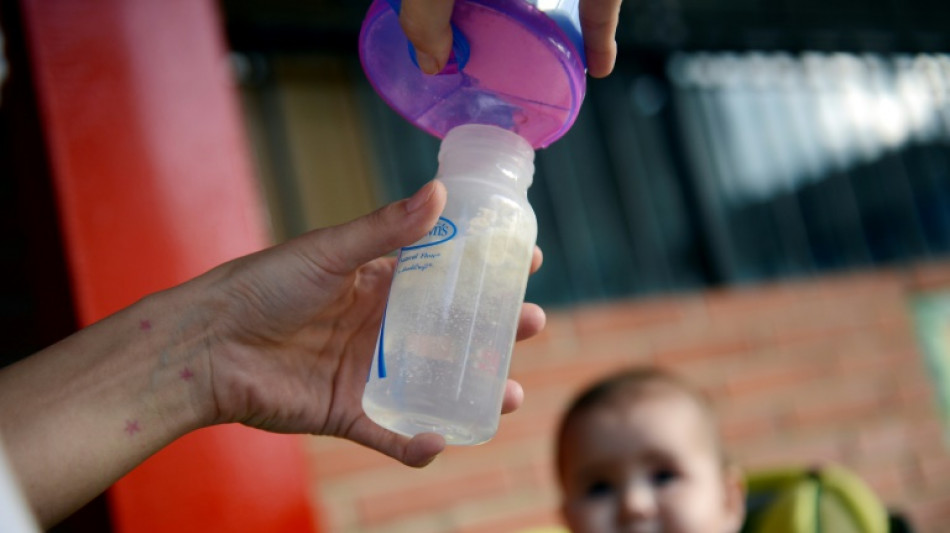
Most baby formula health claims not backed by science: study / Photo: LEO RAMIREZ - AFP/File

 Musk accuses Ukraine of violating Starlink's terms of service

 Fed expected to hold rates steady days ahead of US midterms

 More Lula, or back to the Bolsonaros? Brazil votes in cliffhanger

 Jorge Martin out of Australian MotoGP with fracture: team

 Antonelli storms to US Grand Prix pole on weekend he can take title

 Apologetic Alvarez fires Atletico to win against Deportivo

 Lens beat PFC in Ligue 1 matchday impacted by social unrest

 Valkyries hit back against Dream to level WNBA Finals

 'Fighting for our rights': Paris protesters determined to march on

 Clashes break out in Paris, other French cities amid fresh protests

 Spurs seal rare win at Chelsea as Palmer sees red

 Nearly 1,000 arrested in French protests marred by 'elevated' violence: minister

 France extends detention of suspected racist shooter

 Andrade and Nemour star as Biles cheers at world gymnastics champs

 Nigeria's Tinubu defends record as economy bites ahead of election

 'Guiding star' Fuellkrug bags Bremen brace, Leipzig win

 Man City's perfect start ended by Aston Villa, Arsenal go joint-top

 Arsenal sink Everton to join Man City at Premier League summit

 France protests: Latest developments

 French ice dancers Cizeron and Fournier make golden start to season

 Thousands protest crackdown on media in Turkey

 Brazil's Andrade returns to take vault gold at worlds

 Lula, Bolsonaro hold final rallies ahead of Brazil election

 Ukraine has 'stable connection' to Starlink: govt

 French protests kick off amid heavy security blanket

The vast majority of health claims used to advertise baby formula worldwide are not supported by rigorous scientific evidence, a study said Thursday, leading researchers to urge the breast milk substitutes be sold in plain packaging.
The study comes a week after a group of doctors and scientists called for a regulatory crackdown on the $55-billion formula industry for "predatory" marketing which they said exploits the fears of new parents to convince them not to breastfeed.
Breastfeeding is widely recognised to have huge health benefits for babies. The World Health Organization and the US CDC recommend breastfeeding exclusively during the first six months of a newborn's life.
However that recommendation is followed for less than half of infants globally, according to the WHO.
Daniel Munblit, an honorary senior lecturer at Imperial College London and an author of the new study, said researchers were not on a "crusade" against infant formula, which should remain an option for mothers who cannot or choose not to breastfeed.
"But we are very much against inappropriate infant formula marketing, which provides misleading claims not backed up by solid evidence," Munblit told AFP.
Munblit and an international team of researchers looked at the health claims made for 608 products on the websites of infant formula companies in 15 countries, including the United States, India, Britain and Nigeria.
The most common claims were that formula supports brain development, strengthens immune systems and more broadly helps growth.
Half of the products did not link the claimed health benefit to a specific ingredient, according to the study published in the BMJ journal.
Three quarters did not refer to scientific evidence supporting their claims.
Of those that provided a scientific reference, more than half pointed to reviews, opinion pieces or research on animals.
Just 14 percent of the products referred to registered clinical trials on humans. However 90 percent of those trials carried a high risk of bias, including missing data or the finding not supporting the claim, the study said.
And nearly 90 percent of the clinical trials had authors who received funding from or had ties to the formula industry, it added.
- 'Distressing' -
The most commonly cited ingredient was polyunsaturated fatty acids, which is in breast milk and is considered important for brain development.
However there is no evidence of any added benefit when the ingredient is added to baby formula, according to a Cochrane systematic review.
Munblit said the health claims were mostly used to advertise premium formula products, which could be "distressing" for parents who are misled into believing the ingredients are essential but cannot afford them.
When asked what he thinks needs to be done to address the problem, Munblit was concise.
"Plain packaging," he said.
The study comes after a series of papers were published in the Lancet journal last week calling for global policy makers to end exploitative formula marketing.
WHO infant health specialist Nigel Rollins, an author of one of the Lancet papers, said busy parents "lack the time to properly scrutinise claims" about infant formula.
The new study showed that "governments and regulatory authorities must commit the necessary time and attention to review the claims of formula milk products," Rollins said in a linked BMJ editorial.
E.AbuRizq--SF-PST