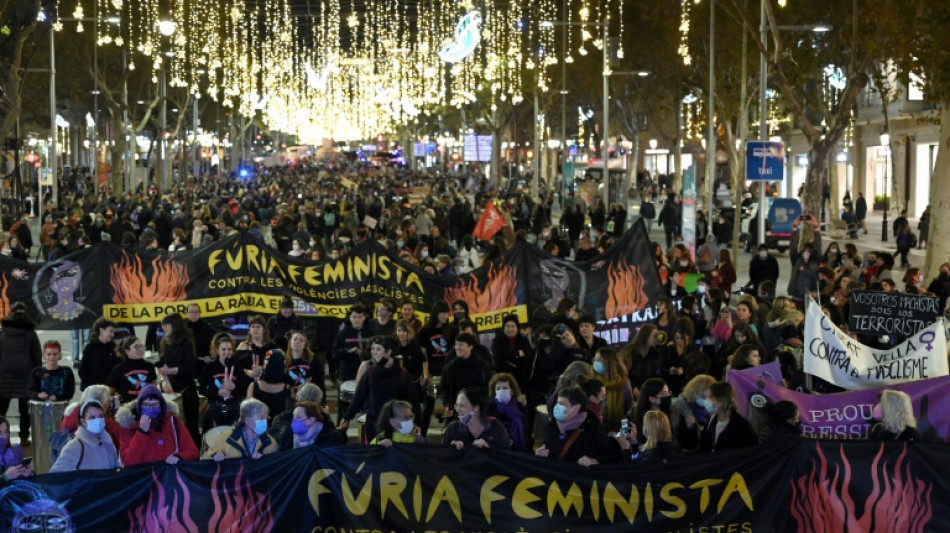
Spain struggles to curb the scourge of femicide / Photo: LLUIS GENE - AFP/File

 Comeback kings Brewers down Rays to take 2-0 World Series lead

 Sri Lankan turbine project fuels anger as fish hauls plunge

 No LeBron, no problem as Sixers roll on

 Israel to close all land crossings with West Bank on election day

 'Tech debt coming due': AI-found flaw signals chaos ahead

 Stop-motion 'Wildwood' showcases 'human creativity' in AI age

 Obama blasts Trump's 'chaos and cruelty' while campaigning for Democrats

 Bolsonaro leads Lula in final Brazil election polls

 Antonelli storms to pole for US Grand Prix

 Alvarez fires Atletico to win against Deportivo

 Japan's Nakai wins Grand Prix de France for second straight year

 Ronaldinho to make comeback in Italian third tier
 Israeli forces displace Hebron families after deadly attack
 Hamilton on top with Antonelli fourth in final practice at US Grand Prix

 Beier late show sends Dortmund top of Bundesliga

 Police and protesters clash again at Albanian anti-government rally
 Arteta hails mentality as Arsenal go level with Man City

 Clashes break out in Paris, other cities amid fresh protests

 Bouthier kicks Vannes to first Top 14 win of season

 Thousands rally for Lula and Bolsonaro on eve of tight Brazil vote

 Red-hot Fuellkrug bags Bremen brace, Leipzig win

 Thousands gather at new Albanian anti-government rally
 French police fire tear gas during fresh protests

 Suspect detained after fire wrecks Hitler's mountain retreat
 Alexander Skarsgard and his viral 'Wicker' transformation

Eleven years ago, Ester narrowly escaped death when her partner tried to throw her off a balcony at their home in northwestern Spain.
Saved by a neighbour, she went to the police. Until that point, she'd suffered years of emotional and psychological abuse but hadn't recognised the warning signs and never reported him.
Although Ester escaped with her life, hundreds more have died since then at the hands of partners or ex-partners with a recent spike in murders prompting widespread soul-searching across the country.
Spain has long been seen as a frontrunner in the battle to stamp out gender violence, but in December, 11 women were killed making it the deadliest month since 2008.
Another seven died in January.
In many cases, the authorities have failed to detect the undercurrent of simmering violence. And women themselves often don't see the warning signs until it's too late.
"There were a load of things that happened beforehand which I just didn't recognise for what they were," admits Ester, now 30, who did not want to give her family name.
Looking back, all the signs were there: how he increasingly isolated her from friends, remarks about her way of dressing, nights when he would force her to sleep on the floor...
Even so, she doesn't see herself as a victim.
"Victims are those who are no longer around to talk, who were murdered," she told AFP.
December's bloodshed shook Spain, with Interior Minister Fernando Grande-Marlaska calling it a "social tragedy" and "not a private matter as we thought in the past".
- Eight years to file a complaint -
Inside a call centre at a secret location, about a dozen operators are manning the 016 gender violence hotline.
"016 hello: how can I help? says one operator in the purple-painted room, gently trying to calm the woman on the other end of the line.
"Is he sitting next to you right now?"
Set up in 2007, the hotline received its highest-ever number of calls last year, with 102,000 appeals for help.
Hotline coordinator Susana Galvez told AFP the aim is to make women aware of their options.
"016 is the first step to get out of a violent situation," she said.
Despite efforts by the authorities, who have prioritised the fight against gender-based violence since 2004 when Spain approved its groundbreaking law against it, women take "an average of eight years and eight months" to file a complaint, says state prosecutor Teresa Peramato.
And for women in rural areas, the figure is between 12 and 20 years, says this specialist in domestic violence cases.
"Very often they are the last ones to realise that they are suffering violence," says Peramato.
"They have trivialised it and are afraid of the repercussions. They don't trust the justice system and are economically and emotionally dependent (on their abuser)."
- 'Insults, threats, spitting' -
Like Esther, Noelia Miguez says she too was "in denial".
In 2015, her former boyfriend tried to strangle her before stabbing her eight times.
She only survived because she pretended to be dead.
Now 29, she can clearly see the early signs of trouble -- "the first humiliations, the insults, the threats, the spitting".
Beyond the victim's awareness of what's going on, it's also important to ask if the justice system itself has "failed" to protect these women, Peramato says.
In almost half -- 43 percent -- of the murders that occurred last year, the women had already started legal proceedings against their abuser, or he already had a police record.
When Miguez went to the police, she learned her abuser had already been convicted for attacking another former girlfriend.
Last week, Spain's leftist government said police could warn women filing a complaint if their partner had a history of violence, although such a decision would be made on a case-by-case basis.
Ester said such a step "could save many women".
"How many men have already been convicted or jailed for abuse and then have started a new relationship? " she wondered.
"Until you actually realise this person is dangerous for you, a lot of things can happen."
- Long way to go -
Since 2007, Spain has used a risk assessment programme called VioGen that has logged details of more than 700,000 cases to assess the threat level in any given situation.
But campaigners say the algorithm needs improvement, with the recent murder of a 46-year-old woman in the Canary Islands highlighting some of its shortcomings.
In late December, the woman filed a complaint against her ex-partner but later withdrew it, prompting VioGen to downgrade her risk level, local media reported.
The next day, she was killed.
Joshua Alonso -- whose mother died in 2017 when her ex-partner burned down the house, killing them both -- runs workshops to teach children and young people about gender violence.
Although Spain is a reference point in the fight against gender violence, more than 1,000 women have been killed since records began in 2003, meaning it still has a long way to go, he says.
"If that's the case here and we're a frontrunner, I don't even want to think about what it's like elsewhere."
M.Qasim--SF-PST