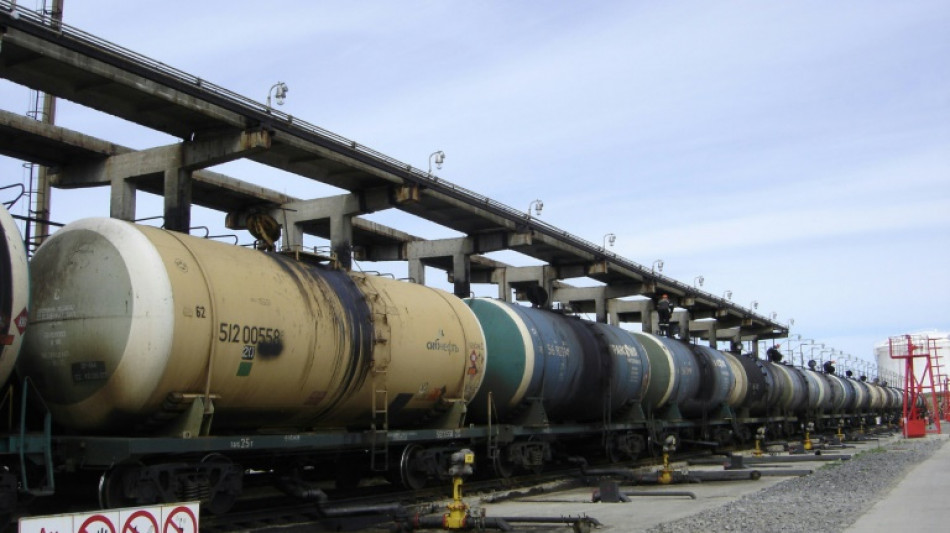
West's new oil sanctions aim to tighten screws on Russia / Photo: © AFP/File

 Last MotoGP race at Phillip Island cancelled due to weather in Marquez setback

 Sri Lanka seeks faster green energy shift after oil shocks
 Riyadh airport resumes flights following Houthi attacks

 'Call of Duty' North Korea invasion edition tops sales charts in South
 Musk accuses Ukraine of violating Starlink's terms of service

 Fed expected to hold rates steady days ahead of US midterms

 More Lula, or back to the Bolsonaros? Brazil votes in cliffhanger

 Jorge Martin out of Australian MotoGP with fracture: team

 Antonelli storms to US Grand Prix pole on weekend he can take title

 Apologetic Alvarez fires Atletico to win against Deportivo

 Lens beat PFC in Ligue 1 matchday impacted by social unrest

 Valkyries hit back against Dream to level WNBA Finals

 'Fighting for our rights': Paris protesters determined to march on

 Clashes break out in Paris, other French cities amid fresh protests
 Spurs seal rare win at Chelsea as Palmer sees red

 Nearly 1,000 arrested in French protests marred by 'elevated' violence: minister
 France extends detention of suspected racist shooter

 Andrade and Nemour star as Biles cheers at world gymnastics champs

 Nigeria's Tinubu defends record as economy bites ahead of election

 'Guiding star' Fuellkrug bags Bremen brace, Leipzig win
 Man City's perfect start ended by Aston Villa, Arsenal go joint-top

 Arsenal sink Everton to join Man City at Premier League summit
 France protests: Latest developments
 French ice dancers Cizeron and Fournier make golden start to season

 Thousands protest crackdown on media in Turkey

The West's latest wave of sanctions on Russian energy exports seeks to hit Moscow harder than its previous moves over the Ukraine war.
An EU-wide ban on Russia oil products -- like diesel, gasoline and jet fuel -- came into effect Sunday alongside a Group of Seven (G7) price cap on the same items.
That expanded on an EU embargo on seaborne oil deliveries introduced two months ago -- when it also established with G7 partners a $60-dollar-per-barrel cap for exports around the world.
There are two price cap levels, $100 per barrel for more expensive fuel like diesel and $45 on lower-quality products such as fuel oil.
Key energy producer Russia launched its invasion of Ukraine almost one year ago, on February 24, 2022, sparking international condemnation and economic retaliation.
- More profound impact -
"The caps and ban on Russian petroleum products are likely to have a more profound impact than the similar measures that targeted crude oil in December," said PVM Energy analyst Stephen Brennock.
"Unlike with its crude exports, there are no readily available markets to accommodate its surplus fuel supplies."
Prior to the conflict, the 27-nation European Union was the main buyer of Russian diesel, consuming almost 700,000 barrels per day (bpd) or half of its imports of that product.
Despite a sharp drop over the last year, more than one quarter of EU diesel imports still originated in Russia in first few weeks the year, according to S&P Global data.
That amounted to an average of 450,000 bpd.
Moscow will be forced to find new markets for its oil products to preserve revenues that help finance its ongoing war in Ukraine.
The most obvious candidates are Asian superpowers China and India.
"China and India ... have become the biggest buyers of Russian crude in recent months. Yet the same ravenous appetite for crude will not apply to its refined oil products," Brennock said.
"Both countries are net exporters of products and have plenty of excess refining capacity -- so there is scant need for them to be importing more."
Moscow's only other option might be to refine less fuel -- but this would likely lead to a drop in oil production.
- G7 pressure -
The G7 industrialised countries and Australia reached agreement Friday on price caps for Russian petroleum products.
The policy aimed "to prevent Russia from profiting from its war of aggression against Ukraine" and support stability in energy markets, the G7 said a statement.
Commerzbank analyst Carsten Fritsch added that Russian diesel was already selling below the price cap, with Baltic Sea shipments costing only $90 per barrel last week.
Moscow last week banned the sale of Russian crude to nations using the G7 cap and warned that the measures would destabilise world markets.
But oil prices were broadly unmoved on Monday.
European Commission president Ursula von der Leyen estimates that the oil price cap costs Moscow 160 million euros ($170 million) per day.
However, since the start of the war, Russia has earned 194 billion euros from exports of oil and petroleum products, according to the Centre for Research on Energy and Clean Air (CREA) think-tank.
That includes almost 85 billion euros from EU nations, according to the CREA.
X.AbuJaber--SF-PST