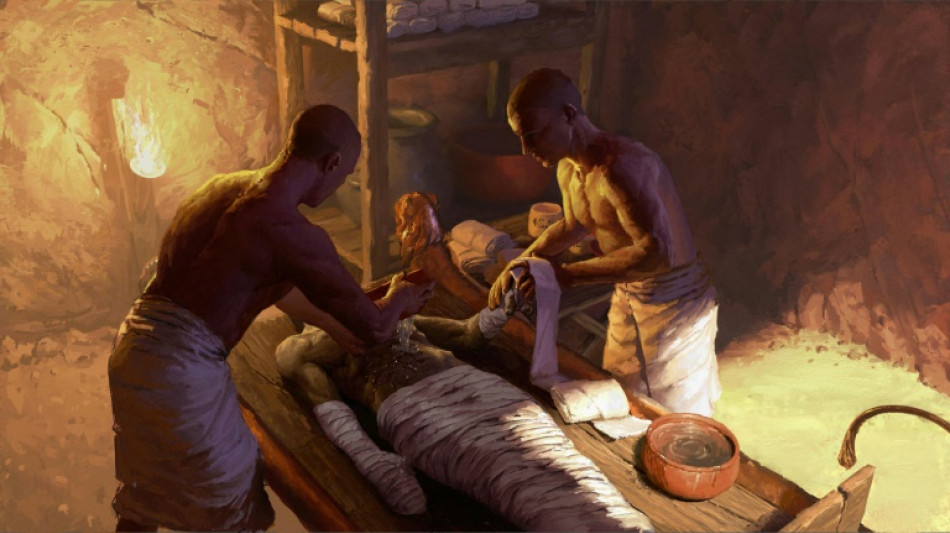
'Surprising' ancient Egyptian mummy ingredients discovered / Photo: NIKOLA NEVENOV - Ludwig Maximilian University of Munich/AFP

 Last MotoGP race at Phillip Island cancelled due to weather in Marquez setback

 Sri Lanka seeks faster green energy shift after oil shocks

 Riyadh airport resumes flights following Houthi attacks

 'Call of Duty' North Korea invasion edition tops sales charts in South

 Musk accuses Ukraine of violating Starlink's terms of service

 Fed expected to hold rates steady days ahead of US midterms

 More Lula, or back to the Bolsonaros? Brazil votes in cliffhanger

 Jorge Martin out of Australian MotoGP with fracture: team

 Antonelli storms to US Grand Prix pole on weekend he can take title

 Apologetic Alvarez fires Atletico to win against Deportivo

 Lens beat PFC in Ligue 1 matchday impacted by social unrest

 Valkyries hit back against Dream to level WNBA Finals

 'Fighting for our rights': Paris protesters determined to march on
 Clashes break out in Paris, other French cities amid fresh protests

 Spurs seal rare win at Chelsea as Palmer sees red

 Nearly 1,000 arrested in French protests marred by 'elevated' violence: minister

 France extends detention of suspected racist shooter

 Andrade and Nemour star as Biles cheers at world gymnastics champs

 Nigeria's Tinubu defends record as economy bites ahead of election

 'Guiding star' Fuellkrug bags Bremen brace, Leipzig win

 Man City's perfect start ended by Aston Villa, Arsenal go joint-top

 Arsenal sink Everton to join Man City at Premier League summit

 France protests: Latest developments

 French ice dancers Cizeron and Fournier make golden start to season

 Thousands protest crackdown on media in Turkey

The discovery of dozens of beakers and bowls in a mummification workshop has helped reveal how ancient Egyptians embalmed their dead, with some "surprising" ingredients imported from as far as Southeast Asia, a study said Wednesday.
The exceptional collection of pottery, dating from around 664-525 BC, was found at the bottom of a 13-metre (42 feet) well at the Saqqara Necropolis south of Cairo in 2016.
Inside the vessels, researchers detected tree resin from Asia, cedar oil from Lebanon and bitumen from the Dead Sea, showing that global trade helped embalmers source the very best ingredients from across the world.
Ancient Egyptians developed a remarkably advanced process to embalm corpses, believing that if bodies were kept intact they would reach the afterlife.
The process took up to 70 days. It involved desiccating the body with natron salt, and evisceration -- removing the lungs, stomach, intestines and liver. The brain also came out.
Then the embalmers, accompanied by priests, washed the body and used a variety of substances to prevent it from decomposing.
But exactly how this was done has largely remained lost to time.
Now a team of researchers from Germany's Tuebingen and Munich universities in collaboration with the National Research Centre in Cairo has found some answers by analysing the residue in 31 ceramic vessels found at the Saqqara mummification workshop.
By comparing the residue to containers found in adjacent tombs, they were able to identify which chemicals were used.
- 'To make his odour pleasant' -
The substances had "antifungal, anti-bacterial properties" which helped "preserve human tissues and reduce unpleasant smells," the study's lead author, Maxime Rageot, told a press conference.
Helpfully, the vessels have labels on them. "To wash," reads the label of one bowl, while another says: "to make his odour pleasant".
The head received the most care with three different concoctions -- one of which was labelled "to put on his head".
"We have known the names of many of these embalming ingredients since ancient Egyptian writings were deciphered," Egyptologist Susanne Beck said in a statement from Tuebingen University.
"But until now, we could only guess at what substances were behind each name."
The labels also helped Egyptologists clear up some confusion about the names of some of the substances.
The scant details we have about the mummification process mostly comes from ancient papyrus, with Greek authors such as Herodotus often filling in gaps.
By identifying the residue in their new bowls, the researchers found that the word "antiu", which has long been translated as myrrh or frankincense, can actually be a mixture of numerous different ingredients.
In Saqqara, the bowl labelled antiu was a blend of cedar oil, juniper or cypress oil and animal fats.
- Embalming drove 'globalisation' -
The discovery showed the ancient Egyptians had built up "enormous knowledge accumulated through centuries of embalming," said Philipp Stockhammer of Germany's Max Planck Institute of Geoanthropology.
For example, they knew that if the body was taken out of the natron salt, then it was in danger of being immediately "colonised by microbes that would eat up the skin," he said.
Stockhammer said "one of the most surprising findings" was the presence of resins, such as dammar and elemi, which likely came from tropical forests in Southeast Asia, as well as signs of Pistacia, juniper, cypress and olive trees from the Mediterranean.
The diversity of substances "shows us that the industry of embalming" drove momentum for "globalisation," Stockhammer said.
It also shows that "Egyptian embalmers were very interested to experiment and get access to other resins and tars with interesting properties," he added.
The embalmers are believed to have taken advantage of a trade route that came to Egypt through present-day Indonesia, India, the Persian Gulf and the Red Sea from around 2000 BC.
The Saqqara excavation was led by Ramadan Hussein, a Tuebingen University archaeologist, who died last year before the research was published in the journal Nature on Wednesday.
N.Shalabi--SF-PST