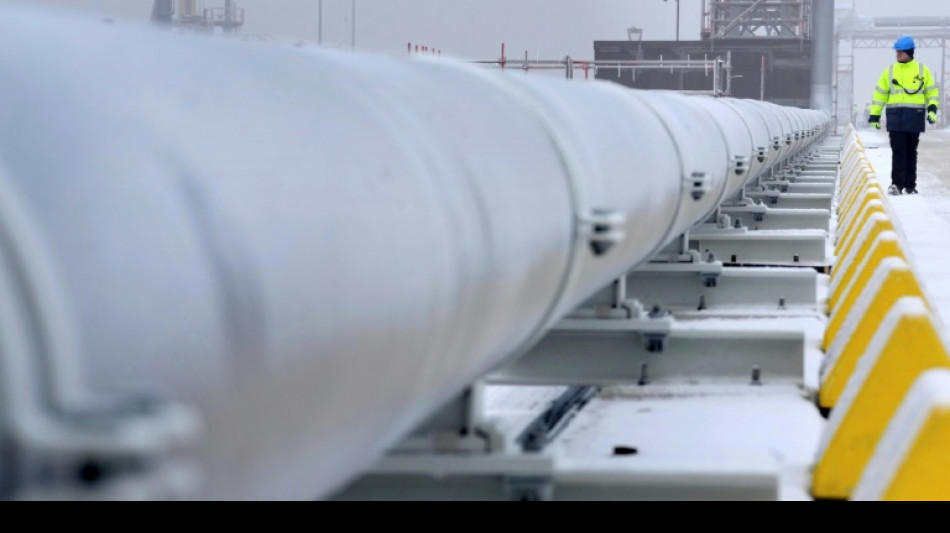
Winter not over, but Europe braces for the next one / Photo: Michael Sohn - POOL/AFP/File

 Last MotoGP race at Phillip Island cancelled due to weather in Marquez setback

 Sri Lanka seeks faster green energy shift after oil shocks
 Riyadh airport resumes flights following Houthi attacks

 'Call of Duty' North Korea invasion edition tops sales charts in South
 Musk accuses Ukraine of violating Starlink's terms of service
 Fed expected to hold rates steady days ahead of US midterms

 More Lula, or back to the Bolsonaros? Brazil votes in cliffhanger

 Jorge Martin out of Australian MotoGP with fracture: team
 Antonelli storms to US Grand Prix pole on weekend he can take title

 Apologetic Alvarez fires Atletico to win against Deportivo

 Lens beat PFC in Ligue 1 matchday impacted by social unrest

 Valkyries hit back against Dream to level WNBA Finals

 'Fighting for our rights': Paris protesters determined to march on

 Clashes break out in Paris, other French cities amid fresh protests
 Spurs seal rare win at Chelsea as Palmer sees red

 Nearly 1,000 arrested in French protests marred by 'elevated' violence: minister
 France extends detention of suspected racist shooter

 Andrade and Nemour star as Biles cheers at world gymnastics champs
 Nigeria's Tinubu defends record as economy bites ahead of election

 'Guiding star' Fuellkrug bags Bremen brace, Leipzig win
 Man City's perfect start ended by Aston Villa, Arsenal go joint-top

 Arsenal sink Everton to join Man City at Premier League summit
 France protests: Latest developments
 French ice dancers Cizeron and Fournier make golden start to season
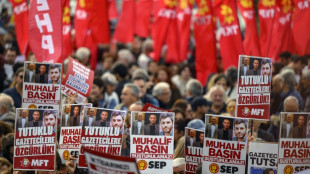 Thousands protest crackdown on media in Turkey

Europe has weathered the energy crisis that followed Russia's invasion of Ukraine so far, but businesses and households are already thinking about how to get through the next winter.
Mild weather, government aid, gas storage facilities at full capacity and energy imports from other regions have helped Europe limit the economic damage caused by the war.
Outside the western industrial city of Dortmund in Germany, brewery Veltins adapted by using reuseable bottles, partially converting its gas oven to use fuel oil and spending 30 million euros ($32.5 million) to stock up on raw materials.
"We did not have to lower our production," Veltins spokesman Ulrich Biene told AFP.
Germany, which relied heavily on Russian gas imports before the war, provided massive aid to consumers, scrambled to fill up its storage facilities and found new sources of energy as Moscow turned off the taps.
The government said last week it expects Europe's biggest economy to avoid recession this year, though data on Monday showed a contraction in the last three months of 2022.
To beef up winter supplies, Germany and its EU neighbours bought LNG from Qatar and the United States, which is more expensive than Russian gas that was brought in via pipelines.
LNG imports in Europe jumped by 60 percent in 2022 compared to the previous year, according to the Institute for Energy Economics and Financial Analysis (IEEFA).
As a result "the worst case scenarios for 2022/2023 winter did not happen," said Fabian Skarboe Ronningen, senior analyst for power markets research at Rystad Energy.
- 'Absolutely extraordinary' -
European gas stocks are currently at 72 percent of capacity -- double this time last year.
With temperatures so far this winter more clement than usual, European consumers turned the heating on later -- keeping bill rises in check, ensuring reserves stay high.
Demand for natural gas receded 12 percent in 2022 after the Russian invasion in late February compared with the 2019-2021 average, according to the Bruegel think tank in Brussels.
"That was absolutely, I think, extraordinary," said Bruegel researcher Simone Tagliapietra.
Supply received another boost from the progressive return on stream of several French nuclear reactors that had been taken offline.
After Russia's invasion, European energy prices hit record levels -- surpassing 300 euros per megawatt hour in August before a falloff after governments rushed to boost storage.
Europe's main futures contract has now settled at around 55 euros -- still around double what it was prior to the Covid-19 pandemic.
But the drop has yet to be seen on household bills as wholesalers buy months in advance, leaving consumers struggling to pay as inflation soars.
"Even next month will be a struggle," said Dora Jesus, a 42-year-old Londoner on state benefits whose bill has risen past 100 pounds ($123) from 82 pounds previously.
- 'Race for gas' -
Some analysts say a return to typical prices could take years.
"All eyes are already on 2023/2024 winter already," said Ronningen, noting that Russian supplies will remain out of the equation.
"Europe will rely even more on LNG in 2023, as this is the first full year with very low volumes coming from Russia," he said.
And if Asian demand rebounds, "the competition between Europe and Asia for LNG will get even harder, which could result in higher prices than we see now."
For Tagliapietra, "Europe is in a better position vis a vis the last year, because last year, Europe managed to find a new energy equilibrium after the shock of cutting the Russian gas supplies."
He said demand must be kept in check as far as possible while more renewables are added into the system.
"I think it will be very important for European countries to coordinate" on filling storage tanks as "we need to avoid this race for gas that we've seen in the summer", Tagliapietra said.
"The more we coordinate, the more we can save money."
S.AbuJamous--SF-PST