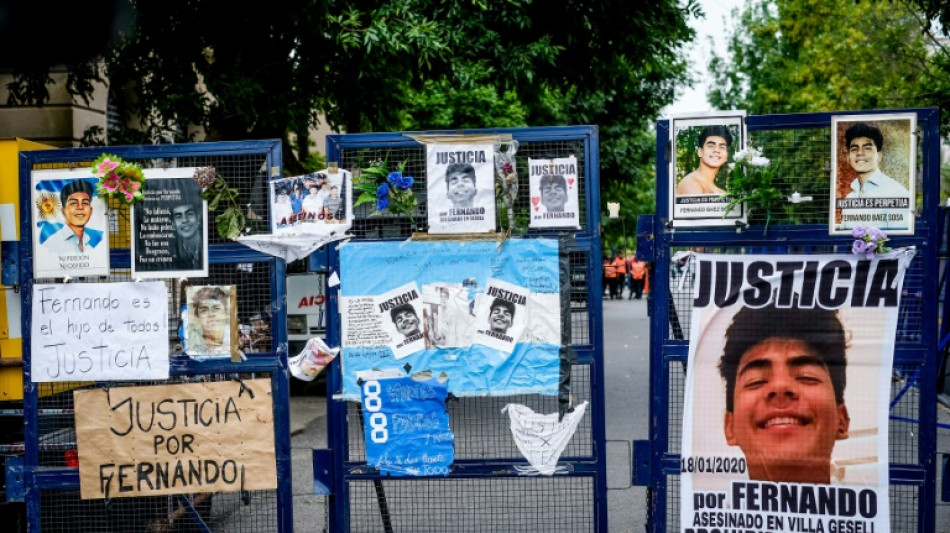
High-profile murder trial shines light on Argentine discrimination / Photo: Diego Izquierdo - TELAM/AFP

 UK PM calls for 'honest discussion' about EU free movement

 Far-right leader Le Pen kicks off tilt at French presidency amid nationwide protests

 Naomi Osaka could quit tennis if daughter asks her to

 Last MotoGP race at Phillip Island cancelled due to weather in Marquez setback

 Sri Lanka seeks faster green energy shift after oil shocks

 Riyadh airport resumes flights following Houthi attacks

 'Call of Duty' North Korea invasion edition tops sales charts in South

 Musk accuses Ukraine of violating Starlink's terms of service

 Fed expected to hold rates steady days ahead of US midterms

 More Lula, or back to the Bolsonaros? Brazil votes in cliffhanger

 Jorge Martin out of Australian MotoGP with fracture: team

 Antonelli storms to US Grand Prix pole on weekend he can take title

 Apologetic Alvarez fires Atletico to win against Deportivo

 Lens beat PFC in Ligue 1 matchday impacted by social unrest

 Valkyries hit back against Dream to level WNBA Finals

 'Fighting for our rights': Paris protesters determined to march on
 Clashes break out in Paris, other French cities amid fresh protests

 Spurs seal rare win at Chelsea as Palmer sees red

 Nearly 1,000 arrested in French protests marred by 'elevated' violence: minister

 France extends detention of suspected racist shooter

 Andrade and Nemour star as Biles cheers at world gymnastics champs

 Nigeria's Tinubu defends record as economy bites ahead of election

 'Guiding star' Fuellkrug bags Bremen brace, Leipzig win

 Man City's perfect start ended by Aston Villa, Arsenal go joint-top

 Arsenal sink Everton to join Man City at Premier League summit
The shocking story of a teenager beaten to death by eight young rugby players has opened old wounds and shed light on class, race and gender discrimination in Argentine society.
Eight friends, now age 21 to 23, are facing life in prison if convicted of the premeditated murder of Fernando Baez three years ago in a popular seaside resort.
The trial is under way in Dolores, 200 kilometers (125 miles) south of Buenos Aires, and has gripped the nation, as did the original murder that sparked protests in several cities.
In the early hours of January 18, 2020, a fight broke out in a nightclub in Villa Gesell, a resort city popular with young people.
After those involved were evicted from the club, their quarrel continued in the street, but Baez, then 18, became isolated from his friends and surrounded by the eight defendants, who beat him so severely that he died of his injuries.
The trial opened three weeks ago but precious little light has been shone on who did what that night.
Some defendants have even denied hitting Baez.
The matter of who, or what, exactly was responsible for Baez's death has inflamed social media debates.
"The question of class plays an important role in this case," said sociologist Guillermo Levy, a professor at the universities of Buenos Aires and Avellaneda.
"Most of the rugby players are from rich, rural families."
Some have pointed the finger at rugby itself, and the culture that surrounds it.
"It's true that it is a cocktail of violence, racism, machismo, alcohol, etc. But I'm going to add the component of rugby training," Facundo Sassone, a sociologist at the University of San Martin who is also a junior rugby coach, told AFP.
He said the "herd" mentality nurtured within a team environment had a role to play.
- 'Why did rugby values fail?' -
For all its positive publicity as a sport where respect and camaraderie are integral, rugby has a dark side in which gratuitous violence, and sometimes deeply inappropriate pranks, are commonplace and unquestioned.
"If we... say that it is a sport of values and friendship, why did it fail?" asked Sassone.
"Some issues can be misunderstood by rugby players and can generate situations of violence away from the pitch."
Some former professional players have spoken out on the matter.
Former Argentina captain Agustin Pichot was one of the people to hit out at his sport after meeting Baez's family in 2021.
He said rugby had "normalized bad things" by failing "to differentiate good from bad" in some of the practices that have developed within and around the sport.
Rugby by no means has a monopoly on violence -- barely a year goes by without a death related to clashes between rival football fans, while drink-fueled fights outside nightclubs are commonplace.
It is a minority sport in Argentina, whose popularity pales compared with football.
But it stands out because it is traditionally played and watched by a wealthy elite.
And that is why this case has captured the public's imagination in a way that violence between poor people would not, said sociologist and writer Alejandro Seselovsky.
The wealthy white "who kills, that's like 'a man bit a dog', it's newsworthy," said Seselovsky.
- 'Society needs to reflect' -
The racial aspect of this murder is also forcing Argentine society to confront an awkward truth it would rather brush under the carpet.
According to witnesses, the defendants called Baez -- whose parents, a bricklayer and a caregiver, are both Paraguayan immigrants -- a "shitty black" while beating him.
"You cannot escape the reference to Fernando's blackness in the assault," sociologist Sebastian Bruno, an immigration specialist, told AFP.
The "racism and classism" is obvious, said Bruno, although Levy points out that it "doesn't mean they wouldn't have attacked him if he weren't" Paraguayan.
In a country where the majority of the population is descended from white Europeans, mostly from Spain, Italy or Germany, the term "black" has been widely used to describe indigenous people or migrants from neighboring countries viewed as inferior, said Bruno.
"We need to reflect on the society that produced this," said Levy.
T.Khatib--SF-PST