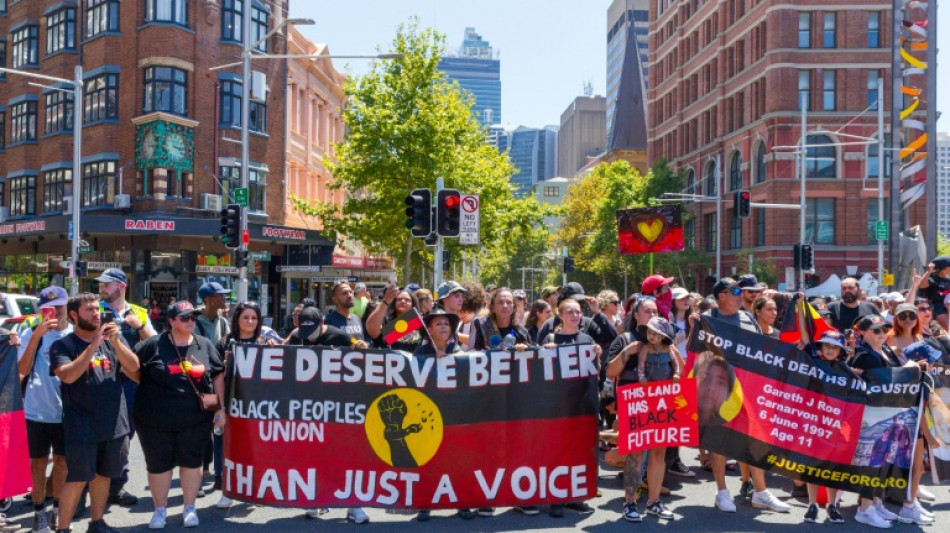
'Invasion Day' rallies mark divisive national holiday in Australia / Photo: Robert Wallace - AFP

 UK PM calls for 'honest discussion' about EU free movement

 Far-right leader Le Pen kicks off tilt at French presidency amid nationwide protests

 Naomi Osaka could quit tennis if daughter asks her to

 Last MotoGP race at Phillip Island cancelled due to weather in Marquez setback

 Sri Lanka seeks faster green energy shift after oil shocks
 Riyadh airport resumes flights following Houthi attacks

 'Call of Duty' North Korea invasion edition tops sales charts in South
 Musk accuses Ukraine of violating Starlink's terms of service

 Fed expected to hold rates steady days ahead of US midterms
 More Lula, or back to the Bolsonaros? Brazil votes in cliffhanger
 Jorge Martin out of Australian MotoGP with fracture: team

 Antonelli storms to US Grand Prix pole on weekend he can take title

 Apologetic Alvarez fires Atletico to win against Deportivo

 Lens beat PFC in Ligue 1 matchday impacted by social unrest

 Valkyries hit back against Dream to level WNBA Finals

 'Fighting for our rights': Paris protesters determined to march on
 Clashes break out in Paris, other French cities amid fresh protests
 Spurs seal rare win at Chelsea as Palmer sees red

 Nearly 1,000 arrested in French protests marred by 'elevated' violence: minister
 France extends detention of suspected racist shooter

 Andrade and Nemour star as Biles cheers at world gymnastics champs
 Nigeria's Tinubu defends record as economy bites ahead of election
 'Guiding star' Fuellkrug bags Bremen brace, Leipzig win
 Man City's perfect start ended by Aston Villa, Arsenal go joint-top

 Arsenal sink Everton to join Man City at Premier League summit
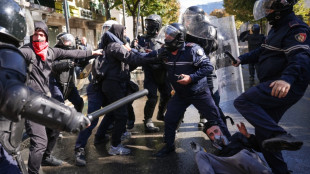
Thousands protested Australia's increasingly divisive national day Thursday as the public debates whether the country's Indigenous population should be recognised in the constitution.
Australia Day on January 26 has traditionally celebrated the arrival of European settlers at Sydney Harbour in 1788, and has typically been observed with beach parties and backyard barbecues.
But in recent years, it has also become a day of national protest, with some Australians calling it "Invasion Day" and saying it was the start of a cultural genocide by European colonisers.
Indigenous activist Paul Silva, speaking to a crowd of thousands at an Invasion Day rally in central Sydney, said the national holiday should be abolished.
"They invaded our lands, killing our extended families, turning our warriors into slaves," he said, as the crowd shouted "shame" in response.
"How can this day be celebrated?"
Indigenous poet Lizzie Jarrett said Sydney was "ground zero for a genocide of First Nations people".
"You think we're angry? Wouldn't you be angry?" she asked the crowd.
Ethan Lyons, 17, said he wanted to acknowledge the "beautiful land" of Indigenous Australians.
"We also have to acknowledge the almost 250 years of ongoing theft and destruction," he told the crowd.
Similar rallies took place in major cities across Australia.
At a lively protest in Hobart, the capital of the island state of Tasmania, demonstrators carried flags declaring "Stolen Land" and "We are still here".
The demonstrations have an added significance this year as Australia's centre-left government pushes to change the country's constitution to better recognise Indigenous Australians.
- 'Most important question' -
There is currently no mention of Indigenous Australians in the constitution, adopted in 1901.
They were banned from voting in some states and territories until the 1960s.
The public will vote on the change -- called the Indigenous Voice to Parliament -- in a binding referendum later this year.
It aims to give Indigenous Australians a greater say in national policy-making as they battle poorer health, lower incomes and higher barriers to education.
The Voice proposal has been politically divisive, with several conservative figures deriding it as unneeded and a waste of time.
But Indigenous lawyer Noel Pearson said the Voice was "the most important question" currently facing Australia.
"The question that will be put is: do we recognise Indigenous people in the constitution?" he told national broadcaster ABC.
"And if we say no to that, then I can't see how the future will be anything other than protest."
Indigenous Australians settled in the country an estimated 65,000 years ago but have suffered widespread discrimination and oppression since the arrival of the British more than two centuries ago.
Australian historian Lyndall Ryan has estimated that more than 10,000 Indigenous people were killed in 400 separate massacres since the British arrived.
The inequalities facing the Indigenous population remain stark -- they have life expectancies years shorter than other Australians and are far more likely to die in police custody.
R.Halabi--SF-PST